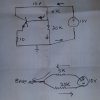
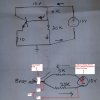
2 transistor circuit input output question.

dorke

Jun 20, 2015
2,342
Joined
Jun 20, 2015
Messages
2,342
John,
The current through the 5k splits into iB and the current through the 20K .
i5k=iB+i20K
The situation you are talking about would be like you have disconnected the 20K from the circuit which isn't the case at all.(see pic)
The use of the Thevnin equivalent simplifies the calculations.
Without it you need to solve these two equations:

1) i5k=iB+i20K
2) VB=VE+Vbe

thus

1) (10-VB)/5k =ib+VB/20k
2) VB=ib*(beta+1)*10k+0.7

untitled.JPG
 
Last edited:

Tha fios agaibh

Aug 11, 2014
2,253
Joined
Aug 11, 2014
Messages
2,253
If you do a Tevenin equivalent of the 5k and 20K bias resistors, you will get a voltage Vbb =8V and a series resistor of 4k.

i10K=VE/10k=(VB-0.7)/10K
ib=(8-VB)/4k
i10k=2*iE=2*(beta+1)*ib=2*(beta+1)*(8-VB)/4k

thus
2*(beta+1)*(8-VB)/4k=(VB-0.7)/10K
solve for VB and make an assumption on beta
 

Tha fios agaibh

Aug 11, 2014
2,253
Joined
Aug 11, 2014
Messages
2,253
Thanks for you patients in explaining this to me.
The above qote by Dorke is what I'm having trouble with. Why is the thevenin resistance of 4k used in determining ib.
What I'm trying to understand is why 4k is used in the formula. I understand how the thevenin resistance is calculated, but really why.
when I look at the circuit it appears to me that the resistance to calculate ib should be the 5k resistor, as opposed to 4k.
Another words, I don't think of current running thru the 20k through the base.
 

Tha fios agaibh

Aug 11, 2014
2,253
Joined
Aug 11, 2014
Messages
2,253
Thank you dorke, I think I get it.

Even though current through the 20k doesn't flow up into the base, the resistance of both resistors still needs to be considered, even if current is flowing in opposite directions. That's why when using thevenin equivalent, the voltage source treated as a short and the resistors are considered paralleled in this case.
 

dorke

Jun 20, 2015
2,342
Joined
Jun 20, 2015
Messages
2,342
Jhon,
we are not there yet ...

Let's forget all about iB ,the "load", (which btw, can be anything from the Thevenin's-theorem "point of view").
We are left with the circuit in the pic below.

While Calculating the Thevenin equivalent we don't care what is/would be connected as a load.
The load can be the same BJT circuit, a FET ,a vacuum-tube or a resistor, anything !
In all cases the Thevenin equivalent would be exactly the same regardless of the load and it's behavior!

Watch this video to get the idea (later on ,the guy uses a different method to calculate Rth,which you can use here as well,and get the same 4k value... )

And this video for "practical examples ".
Note that in this one the guy says:
"The circuit [that we replace with the Thevenin equivalent] could be anything".
That statement is not accurate!
He should have said:It could be any LTI circuit(Linear Time Invariant circuit).

Th.JPG
 
Last edited:

hevans1944

Hop - AC8NS
Jun 21, 2012
4,968
Joined
Jun 21, 2012
Messages
4,968
... Even though current through the 20k doesn't flow up into the base, the resistance of both resistors still needs to be considered, even if current is flowing in opposite directions. ...
Current is flowing in the same direction through both resistors and the base.
 

Tha fios agaibh

Aug 11, 2014
2,253
Joined
Aug 11, 2014
Messages
2,253
1454022469929.jpg Yes, I got it. I was hung up on the current direction.
Current is flowing in the same direction through both resistors and the base.
I know, but it flows into the 5k and out of the 20k. So yes your right, but I was thinking of the configuration like the bottom of my sketch. Another words I was focusing on current direction instead of just calculating Rth.
Even with current flowing out of the positive into the 5k and returning through the 20k, the two resistances are still theoretically paralleled even though current paths differ. Does that make sense?
Thank you Dork, along with your explanation, the 2nd video was clear and concise.
 

dorke

Jun 20, 2015
2,342
Joined
Jun 20, 2015
Messages
2,342
View attachment 24725 Yes, I got it. I was hung up on the current direction.

I know, but it flows into the 5k and out of the 20k. So yes your right, but I was thinking of the configuration like the bottom of my sketch. Another words I was focusing on current direction instead of just calculating Rth.
Even with current flowing out of the positive into the 5k and returning through the 20k, the two resistances are still theoretically paralleled even though current paths differ. Does that make sense?
Thank you Dork, along with your explanation, the 2nd video was clear and concise.

" theoretically paralleled even though current paths differ"

Well,
for calculating Rth between points A and B
1) why theoretically ? they are paralleled !
2) current paths don't matter at all!

1454022469929.jpg
 

Tha fios agaibh

Aug 11, 2014
2,253
Joined
Aug 11, 2014
Messages
2,253
why theoretically ? they are paralleled !
2) current paths don't matter at all.
I don't disagree, but I'm have trouble calling this a true parallel because there is a physical connection (the voltage source) between them. Wither it's a battery or a power supply, this has an effect on the resistance one way or the other. Right?

Totally agree on point 2. This was my sticking point which has blossomed into an epiphany of understanding.
 

dorke

Jun 20, 2015
2,342
Joined
Jun 20, 2015
Messages
2,342
Well,
We are gradually solving this by breaking down the "problem" to it's "atomic ingredients".

So,
We are left with the question :
" How does a voltage source influence the equivalent thevenin resistance Rth ?

It absolutely does influence both Rth and Vth!

Here, and in most cases, we take for granted that the power supply is an ideal one, both for Vth and Rth.
In fact ,we do that for every calculation we make on the circuit regardless of Thevnin ,don't we? ;).

Are we ready for the 64K question yet?
Who would have thought we shall get that far,and in depth, when answering this "beginner's question"...
How come thevnein's theorem is true?
hint :superposition.


I re-psot from #2 ===>

The voltage/current sources are replaced by their equivalent internal resistances.
Only for an ideal voltage source it is 0 ohms
-look at the blue in the below pic.


tev.jpg
 
Last edited:

Ratch

Mar 10, 2013
1,102
Joined
Mar 10, 2013
Messages
1,102
I don't disagree, but I'm have trouble calling this a true parallel because there is a physical connection (the voltage source) between them. Wither it's a battery or a power supply, this has an effect on the resistance one way or the other. Right?

Totally agree on point 2. This was my sticking point which has blossomed into an epiphany of understanding.

What don't you understand about parallelism? The current is present in the 5k resistor, splits into two paths via the 20k resistor and the transistor, and comes together again at ground. If that isn't parallelism, then I don't know what is. Can you articulate why you are having a problem with that topology?

Ratch
 

Arouse1973

Adam
Dec 18, 2013
5,178
Joined
Dec 18, 2013
Messages
5,178
I think John's issue is how can a voltage source connect two resistors together like that. As we dont normally think about it doing that. I personally gave up on this sort of thing in real life, only going back to it when this sort of thing comes up, I find it interesting but nothing else. I dont intentionatly use KVL and KCL as I find KVL doesnt work for everything. Faradays law is better if you want to get into that sort of thing.
Adam
 

Ratch

Mar 10, 2013
1,102
Joined
Mar 10, 2013
Messages
1,102
I think John's issue is how can a voltage source connect two resistors together like that. As we dont normally think about it doing that. I personally gave up on this sort of thing in real life, only going back to it when this sort of thing comes up, I find it interesting but nothing else. I dont intentionatly use KVL and KCL as I find KVL doesnt work for everything. Faradays law is better if you want to get into that sort of thing.
Adam

A voltage source set to zero output and connected between two points in a circuit effectively shorts out the two points. That is the basis for finding the Thevenin resistance, right? Why is there any angst about that?

Ratch
 
Last edited:

Arouse1973

Adam
Dec 18, 2013
5,178
Joined
Dec 18, 2013
Messages
5,178
I was trying to understand why John was having issues.
Adam
 

Ratch

Mar 10, 2013
1,102
Joined
Mar 10, 2013
Messages
1,102
I was trying to understand why John was having issues.
Adam
Another way to find the Thevenin resistance is to divide the short circuit current into the open circuit voltage. 8 volts divided by 2 amps is 4 ohms.

Ratch
 

Merlin3189

Aug 4, 2011
250
Joined
Aug 4, 2011
Messages
250
Or even 8V / 2mA is 4kΩ
But I do like this idea, as it seems to fit with the Thevenin model.

I wonder whether it might help to ask oneself, if I look just at the part of the circuit we are trying to find the Thevenin equivalent for (the 10V source, the 20k and the 5k, removing everything else) and I tried to measure the resistance between the two points A and B, what would I find? And if I tried to calculate that resistance, how would I do it? (For the moment forgetting about Thevenin's theorem.)
 

hevans1944

Hop - AC8NS
Jun 21, 2012
4,968
Joined
Jun 21, 2012
Messages
4,968
Well, folks, Thevenin Equivalent Circuit is supposed to simplify things... I recall the classic problem of two voltage sources of arbitrary value and polarity, each connected to a series resistor, with the other end of each of those two resistors connected to a third resistor and thence to common of the two power supplies. Calculate current and voltage drop across all three resistors. Ain't superposition wunnerful?
 

Tha fios agaibh

Aug 11, 2014
2,253
Joined
Aug 11, 2014
Messages
2,253
Well,
We are gradually solving this by breaking down the "problem" to it's "atomic ingredients".
" How does a voltage source influence the equivalent thevenin resistance Rth ?

It absolutely does influence both Rth and Vth!
Here, and in most cases, we take for granted that the power supply is an ideal one, both for Vth and Rth.
In fact ,we do that for every calculation we make;)
I don't know the atomic level, but a voltage source can influence the resistance by either adding an internal resistance (e.g.battery) or conductance.

That's why I said theoretically paralleled.
After all it's thevenins "theory", right?

"How come thevenin theory is true?"

I'd say, because Its based on a process of elimination. Simplifying a circuit to its simplest form, eliminating the load, and following ohms and kvl law you can prove that the numbers match throughout the entire circuit.

"Only for an ideal source is it 0 ohms"

Now you see why I have trouble accepting two resistors with a source between them as parallel.
But yes, I know what your saying.
 

Tha fios agaibh

Aug 11, 2014
2,253
Joined
Aug 11, 2014
Messages
2,253
What don't you understand about parallelism? The current is present in the 5k resistor, splits into two paths via the 20k resistor and the transistor, and comes together again at ground.
I think of a parallel as physically connected at both ends, not having a battery in series with it.
In this example the 5k hooks to +, and the 20k hooks to - (neg). To me that's not the same node.
I guess I'm thinking of the battery as a component.
 
Top