Denon AVR 1804 amp won't switch on

bushtech

Sep 13, 2016
1,025
Joined
Sep 13, 2016
Messages
1,025
Thanks. You reckon I can stretch to 1500μf?

Which would be your pick of the bunch? My knowledge is unfortunately not good enough to make a good pick with so many variables
 

eKretz

Apr 8, 2013
251
Joined
Apr 8, 2013
Messages
251
I would pick whatever is in that list that suits your fancy. They should all be close enough, and all are Nichicon, a good solid brand of cap. You might want to compare lifetime (that can range from 2,000 to 10,000 hours IIRC) or ripple current to your original caps' specs if you can find them.
 

davenn

Moderator
Sep 5, 2009
14,470
Joined
Sep 5, 2009
Messages
14,470
Thanks. You reckon I can stretch to 1500μf?

Which would be your pick of the bunch? My knowledge is unfortunately not good enough to make a good pick with so many variables

it lists a 1200uF which is the same as your original, no need to stretch to something else
pick a voltage that is the same as the one you have or the next highest if your original voltage value isn't listed
 

bushtech

Sep 13, 2016
1,025
Joined
Sep 13, 2016
Messages
1,025
Thanks davenn & ekretz. You are a great help. I now have a fair idea of what I'm looking for. I will now pull that board from the amp so that I can have a look at the other caps near heat sinks as davenn suggested.
I'm looking at this board with fear in my eyes. It looks like a very very tricky operation to remove that board including unbolting 11 big transistors from their heatsink.:eek:
 

eKretz

Apr 8, 2013
251
Joined
Apr 8, 2013
Messages
251
I know how you feel, just finished recapping the power supply board in my receiver a few days ago.

IMG_20161015_121245293.jpg
 
Last edited:

bushtech

Sep 13, 2016
1,025
Joined
Sep 13, 2016
Messages
1,025
Ouch! That looks horribly familiar. Now with all my new found knowledge on caps did you use any Nichicon Muse's in there? I'm thinking about replacing the caps. Just wish i knew more about it so that I could just replace the caps that are heavily involved in sound reproduction
 

eKretz

Apr 8, 2013
251
Joined
Apr 8, 2013
Messages
251
That receiver is chock full of Muse caps - lots of the FG "Fine Gold" series Muse caps in there, along with several others. The power supply caps I replaced were originally Nichicon series RS and I switched to series RZ caps. 12 in total - I replaced a parallel bank of 5 that were in terrible shape and a parallel bank of 7 that were not far from on their way out.
 

bushtech

Sep 13, 2016
1,025
Joined
Sep 13, 2016
Messages
1,025
Nice. I think my receiver too old for muse's but we'll see where we go with this one. Would like to end up with a better receiver than when I started.

Before I make a mess right at the start. How do you disconnect these light brown cable connectors?

Connectors1.jpg
 

eKretz

Apr 8, 2013
251
Joined
Apr 8, 2013
Messages
251
My receiver is actually from 2001, but it was very high end gear back then.

For those connectors it looks like you need to depress the small hooks/tabs near the sides in the narrow slots, then either pull the connector out or push it out from the mated joint with something like a small flat blade screwdriver
 

bushtech

Sep 13, 2016
1,025
Joined
Sep 13, 2016
Messages
1,025
Thanks. I did try one and got it disconnected. I stuck a small screwdriver in under the small flap that sits over the little notch that latches it.
 

davenn

Moderator
Sep 5, 2009
14,470
Joined
Sep 5, 2009
Messages
14,470
Thanks. I did try one and got it disconnected. I stuck a small screwdriver in under the small flap that sits over the little notch that latches it.

Yeah OK, but please, don't make a habit of that, they are easily damaged, just stick to the gentle wriggle :)


dave
 

bushtech

Sep 13, 2016
1,025
Joined
Sep 13, 2016
Messages
1,025
Thanks for the warning dave. But after being connected for 15 years or so it takes a fair amount of persuasion. :oops:
 

bushtech

Sep 13, 2016
1,025
Joined
Sep 13, 2016
Messages
1,025
Making progress, but how do you disconnect these white interboard connectors.? Are they soldered underneath each pcb?

Board connectors1.jpg

The one I'm talking about is to the right and slightly behind the white ribbon cable
 

bushtech

Sep 13, 2016
1,025
Joined
Sep 13, 2016
Messages
1,025
I think the plot is about to thicken rapidly.
For starters those 2 big caps are 12000μf not 1200μf:eek:
And "good" cap reading 13060μf, ESR=0.08ohm, Vloss= 1.3%
"Bad" cap reading 13150μf, ESR=0.08ohm, Vloss=1.9%
Now I don't know what Vloss is all about but the caps look OK to me.
Am I missing something?
 

bushtech

Sep 13, 2016
1,025
Joined
Sep 13, 2016
Messages
1,025
So the jury is still out on whether those 2 big caps are good or bad. Would appreciate it if somebody would care to comment on those cap readings.

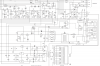
The service manual for this AVR is available here: http://manualmachine.com/denon/avr-1804-884-avr-1880/199246-service-manual/

Still trying to figure out how to copy some pages from a pdf.

I am wondering if the problem is not occurring pre those big caps.

As I recall the switch on sequence you press the on button on the remote, The AVR clicks and the display comes on (In default mode I think). A few seconds later there is another click and the sound comes on.
Now I am not even hearing the first click. With my meager knowledge of electronics I surmise that this startup relay is either stuffed or not getting power.
I see 6 relays on the board:
Surround back
Surround
Front A
Front B
Centre
These are all 24VDC
The sixth one is unlabeled and 12VDC. It has got a MOV right next to it. I suspect that this might be the relay involved in the first click so I will try and check it. Then I suppose the transformer is also in play here. Auntie Google tells me it's unusual for these transformers to fail and usually accompanied by a smell.

But this is really way above my pay grade and I would really appreciate some help pointing me in the right direction or telling me what to check.

Thanks in advance
 

eKretz

Apr 8, 2013
251
Joined
Apr 8, 2013
Messages
251
Those big caps are not from the power supply, those are output caps, they give reserve power when the receiver needs it for a big bass hit. I've never seen a set fail on any receiver I've had. As Dave pointed out, you should start looking in the power supply section - the caps in circuit after the rectifier(s). Some receivers have a protection circuit that won't let that relay engage if any DC voltage is detected where it shouldn't be also.
 
Top