
I am posting the mechanical side of my project here, as there was interest in this part of my project, and the electronic side of this project is posted here(http://www.electronics-lab.com/forum/index.php?topic=3343.0)
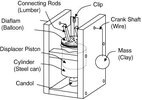
I'll have a go at trying to explain how this engine works for those who are interested, first of all it's important to have a perfect seal, when heat is applied to the bottom chamber (the loosely fitting balsa wood piston is at the top") the air inside expands forcing the diaphram upwards, as a result forcing the push-rods upwards creating a half turne of the crank, the piston which is connected via a piece of fishing line to the crank, at the point of which is to a 90 degree phase angle in relation to the push rods, descends downwards displacing the hot air from the bottom of the chamber to the top, and as a result cooling the displaced air which has the effect of drawing the diaphram inwards creating a complete revolution of the crank shaft.
This Stirling engine design is relatively simple to construct, and I think it is a very good place to start for experimenting, however I have found one major problem with this design, which is the whole in the diaphram connecting the piston to the crank, it wears out far too quickly. I do have some ideas to remedy the problem, but to do so I think it will be best to scale up this Stirling engine a bit, because it is just two small and fiddly to try to implement a reliable ceiling solution. Another problem is, the crank shaft needs to be of a much heavier gauge, I found that I need to bend the crank shaft back into shape, each time I needed to replace the diaphram, so basically the crank is getting more and more out of whack each time I have to straighten it, resulting in increased friction and reduced efficiency.
I have attached a short video clip of my Stirling engine ;D.

Sterling_Engine_video.zip
I'll have a go at trying to explain how this engine works for those who are interested, first of all it's important to have a perfect seal, when heat is applied to the bottom chamber (the loosely fitting balsa wood piston is at the top") the air inside expands forcing the diaphram upwards, as a result forcing the push-rods upwards creating a half turne of the crank, the piston which is connected via a piece of fishing line to the crank, at the point of which is to a 90 degree phase angle in relation to the push rods, descends downwards displacing the hot air from the bottom of the chamber to the top, and as a result cooling the displaced air which has the effect of drawing the diaphram inwards creating a complete revolution of the crank shaft.
This Stirling engine design is relatively simple to construct, and I think it is a very good place to start for experimenting, however I have found one major problem with this design, which is the whole in the diaphram connecting the piston to the crank, it wears out far too quickly. I do have some ideas to remedy the problem, but to do so I think it will be best to scale up this Stirling engine a bit, because it is just two small and fiddly to try to implement a reliable ceiling solution. Another problem is, the crank shaft needs to be of a much heavier gauge, I found that I need to bend the crank shaft back into shape, each time I needed to replace the diaphram, so basically the crank is getting more and more out of whack each time I have to straighten it, resulting in increased friction and reduced efficiency.
I have attached a short video clip of my Stirling engine ;D.
Sterling_Engine_video.zip

 ,
,


