Alternating L/R 4-way flashers

RW74_Valiant

Nov 15, 2024
17
Joined
Nov 15, 2024
Messages
17
I'm trying to get the 4-way flashers, on my car, to flash independently left/right/left/right, instead of off/on/off/on.

1978 Buick.

Non-LED

How can I do this with a single flasher circuit and diodes?
 
Last edited:

Bluejets

Oct 5, 2014
7,374
Joined
Oct 5, 2014
Messages
7,374
Your description suggests it is only 2 way not 4 way....unless you mean left front , right front etc.
If that is the case,rewire.
 

Delta Prime

Jul 29, 2020
2,987
Joined
Jul 29, 2020
Messages
2,987
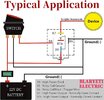
Five pin automotive relay 12 V current of your choice.
1731710860745.jpeg
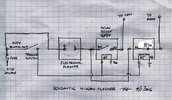
In the modified schematic below 87a
Is normally closed for the right side Front and rear flasher.
87 normally open pin goes to the left side front and rear, and they will alternate right left instead of on off.
This is only an example, but it’s simple. If you wish you may put your diodes across The relay coil.
The anode Of the diode would be connected to the ground side Pin 86 of the coil and the cathode to
Pin 85 relay coil feed trigger wire.
The relay pin designations are reversed on the coil in the modified schematic below, with respect to the pictorial diagram above. My apologies for any confusion.o_O

IMG_0094.jpeg
 
Last edited:

Bluejets

Oct 5, 2014
7,374
Joined
Oct 5, 2014
Messages
7,374
Be aware most automotive is earth return.
i.e. not as simple as one first thinks when weird things start to happen (feedback)
 

RW74_Valiant

Nov 15, 2024
17
Joined
Nov 15, 2024
Messages
17
Five pin automotive relay 12 V current of your choice.
View attachment 65202
In the modified schematic below 87a
Is normally closed for the right side Front and rear flasher.
87 normally open pin goes to the left side front and rear, and they will alternate right left instead of on off.
This is only an example, but it’s simple. If you wish you may put your diodes across The relay coil.
The anode Of the diode would be connected to the ground side Pin 86 of the coil and the cathode to
Pin 85 relay coil feed trigger wire.
The relay pin designations are reversed on the coil in the modified schematic below, with respect to the pictorial diagram above. My apologies for any confusion.o_O

View attachment 65203
This helps to some degree but, I don't know how to read diagrams. I will figure it out on my test vehicle until it works.

In the end, when finished, this is my goal:

When facing the rear of the vehicle with the hazard lights on, the flashers will alternate from the left turn signal (amber) and right brake light (red), to the right turn signal (amber) and left brake light (red).

This will have the effective result of higher visibility and, at no point will the lights on the rear of the car turn off until the hazard switch is deactivated.

Furthermore, when activated, a rear dash dual rotating amber light housing will, likewise, turn on and stay on as it will be connected to the positive feed directly from the switch, itself, to a relay.

I'm familiar with standard electrical wiring for automotive, commercial, locomotive and building wiring up to 1990. Much past that, and I'm lost.

The railroad crossbuck flashers were the inspiration for this and I greatly appreciate your help.

As it stands, the interior lights and hazard lights are the only electrical circuits wired to key off power since I rewired the vehicle.

Furthermore, a single bronze strip runs the entire length of the chassis' left side and is the sole contact point for all exterior ground connections.

The bronze strip on the chassis' right side is the positive connection and both strips are backed with CPVC. The screws that hold it to the frame are run through the plastic, only.

The bronze strips are held to the CPVC by radiator accessory fasteners.

For interior connections, there are two bronze buss bars that are on insulated mounts on the firewall.

The headlights, parking lights, cigarette lighter, dash lights, AM/FM/CB cannot be used without the ignition on and all are on relay circuits. The battery is a single commercial AGM gel battery and all electrical circuits, alternator, etc, have been upgraded to handle the extra power.

Typically, there are between 4 and 6 of these batteries in a commercial tractor, such as a Kenworth T680.

However, since the power demands of a 1978 Buick are drastically below those of the truck, one of these batteries is still borderline overkill.

That said, in a static test with the ignition left on, it took 19:56 hours for the battery to drop below 10 volts from 13.65.

Due to the size of the battery, it was relocated to the trunk and is secured by hooks, steel cables, cable tension adjusters and an acrylic plate that has four rubber bumpers to better secure it.

The plate stands above the top of the battery posts by 1.5 inches and is not at risk of ever contacting the battery, not that there would be any concern if it did.

The battery also has a fabric housing with a heating pad and a thermocouple that prevents the temperature from exceeding 80⁰F.

I believe that I have everything covered and, if I think of anything else, I'll certainly ask.

Thanks, so much, for the help.

Also!

At no point do I ever intend to impersonate any emergency first responder.

I cannot stand impersonators but, if I'm helping someone on the shoulder of an interstate, especially at night, maximum visibility is a must.
 
Last edited:

RW74_Valiant

Nov 15, 2024
17
Joined
Nov 15, 2024
Messages
17
Five pin automotive relay 12 V current of your choice.
View attachment 65202
In the modified schematic below 87a
Is normally closed for the right side Front and rear flasher.
87 normally open pin goes to the left side front and rear, and they will alternate right left instead of on off.
This is only an example, but it’s simple. If you wish you may put your diodes across The relay coil.
The anode Of the diode would be connected to the ground side Pin 86 of the coil and the cathode to
Pin 85 relay coil feed trigger wire.
The relay pin designations are reversed on the coil in the modified schematic below, with respect to the pictorial diagram above. My apologies for any confusion.o_O

View attachment 65203
I do have one question, about the drawn image.

Wouldn't that make one side stay on with the switch off?
 

RW74_Valiant

Nov 15, 2024
17
Joined
Nov 15, 2024
Messages
17
Be aware most automotive is earth return.
i.e. not as simple as one first thinks when weird things start to happen (feedback)
I am well aware. Automotive companies based their vehicle wiring off of readily available schematics (I.E. home electrical wiring.)
 

Delta Prime

Jul 29, 2020
2,987
Joined
Jul 29, 2020
Messages
2,987
Wouldn't that make one side stay on with the switch off?
No sir.
Furthermore, when activated, a rear dash dual rotating amber light housing will, likewise, turn on and stay on as it will be connected to the positive feed directly from the switch, itself, to a relay.
The four way Flasher schematic circuit submitted will satisfy all of your conditions.
I don't know how to read diagrams
I’m sure you will do well…
As it stands, the interior lights and hazard lights are the only electrical circuits wired to key off power since I rewired the vehicle.
You rewired a 1978 Buick. Considering your description of the modifications, the “now” four way railroad cross-buck inspired flashers;
will be a real eyecatcher
I believe that I have everything covered and, if I think of anything else, I'll certainly ask.
Please do…
.
 

Bluejets

Oct 5, 2014
7,374
Joined
Oct 5, 2014
Messages
7,374
I am well aware. Automotive companies based their vehicle wiring off of readily available schematics (I.E. home electrical wiring.)
Automotive earth return and home electrical have nothing in common with regard to how it works.
 

RW74_Valiant

Nov 15, 2024
17
Joined
Nov 15, 2024
Messages
17
Automotive earth return and home electrical have nothing in common with regard to how it works.
No, but the basic principal is the same.

Ground is ground, positive is live, negative is common/neutral.

Since the alternators that I use would have been connected to an external rectifier, it's basically a 12v single phase A/C generator.

Delco 7116 alternators were made for tractors and have a mechanical tachometer drive.

I used 100% mechanical gauges in my 1998 mustang after I put a 1968 300 inline 6 cylinder in it.
 
Last edited:

Harald Kapp

Moderator
Moderator
Nov 17, 2011
14,272
Joined
Nov 17, 2011
Messages
14,272
Check your local regulations. Modifying the standard light setup in this way may invalidate the approval to use the car on public roads.
 

crutschow

May 7, 2021
984
Joined
May 7, 2021
Messages
984
When facing the rear of the vehicle with the hazard lights on, the flashers will alternate from the left turn signal (amber) and right brake light (red), to the right turn signal (amber) and left brake light (red).
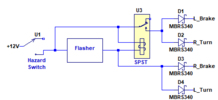
Okay, so here's my take on a circuit to do that using one relay and four diodes for isolation:
The diagram shows a SPDT relay but you can use a standard SPST vehicle relay.
When the flasher is off, the small coil current goes through the low resistance of the unlit incandescent bulbs to energize the relay.

1731989510694.png
 
Last edited:

AnalogKid

Jun 10, 2015
3,045
Joined
Jun 10, 2015
Messages
3,045
I like the #14 approach, but I would move D3 and D4 to the U3 NC contact. Other than that -

Doesn't this approach require that the "normal" wiring from the brake and turn circuits to those lights be diode- or relay-isolated? I would prefer diodes, but a 4PDT relay would eliminate all 8 diodes.

ak
 
Last edited:

crutschow

May 7, 2021
984
Joined
May 7, 2021
Messages
984
I would move D3 and D4 to the U3 NC contact.
Well, you are welcome to do that, but then all the lights would go on at the same time (Look at the the relay coil connections. It is de-energized when the flasher output is 12V).
I did that so the common SPST vehicle relay could be used.
Doesn't this approach require that the "normal" wiring from the brake and turn circuits to those lights be diode- or relay-isolated?
True.
The turn lamps would likely be isolated but the brake lamps not.
 

crutschow

May 7, 2021
984
Joined
May 7, 2021
Messages
984
But the TS has been AWOL since Saturday, so perhaps this is all moot.
 

RW74_Valiant

Nov 15, 2024
17
Joined
Nov 15, 2024
Messages
17
Check your local regulations. Modifying the standard light setup in this way may invalidate the approval to use the car on public roads.
No such regulation exists because
A: the flash pattern does not change intermittently or at all.
and
B: the flash pattern is too slow per emergency light regulations.

As the local traffic court told me, after I explained and showed a video that I animated for illustration purposes, "that's fine."

I have it in writing, that the altered four way flash pattern is legal.
 

RW74_Valiant

Nov 15, 2024
17
Joined
Nov 15, 2024
Messages
17
But the TS has been AWOL since Saturday, so perhaps this is all moot.
Diode isolated. I'd apready been planning for it and there will be a second positive lead from each brake light socket.

There will be a diode in each original positive lead, as well as each additional lead.

Feedback has too much destructive potential not to isolate each system individually.

Also, I like your use of "AWOL."
 

RW74_Valiant

Nov 15, 2024
17
Joined
Nov 15, 2024
Messages
17
Okay, so here's my take on a circuit to do that using one relay and four diodes for isolation:
The diagram shows a SPDT relay but you can use a standard SPST vehicle relay.
When the flasher is off, the small coil current goes through the low resistance of the unlit incandescent bulbs to energize the relay.

View attachment 65213
Yes, I believe so.

I'll definitely test it.

If it works, I've got yellow fog lights on the front and will be, applying the same method to the front flashers and fog lights.

I'm going to be using a flasher for commercial vehicles as I don't think that a standard automotive flasher can handle the load.
 
Top