Sherldonnnn
- Jul 21, 2016
- 4
- Joined
- Jul 21, 2016
- Messages
- 4
This is a sharing of a portable speaker design project. Have you ever thought about designing and building your own portable speaker? A project like this is both easy and cheap if you source your parts wisely and have basic knowledge of electronics, soldering, and box construction.
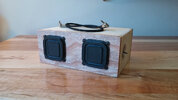
The first question you have to ask is, "What do you want this to do?" If you want 40 Hz bass extension, then you will have to design for it. If you want high SPL, again, you will have to select an amplifier and loudspeaker combination that can provide that. What did I want? I wanted a portable, battery-powered stereo speaker of moderately high fidelity. Bass extension was not a concern, but "punch" was. From this, a sealed enclosure was selected.
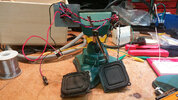
Before building the version you see above, I prototyped the circuit on a breadboard with an enclosure made from a wooden quill box that I cut two holes in with a box cutter. The basic circuit diagram for this prototype was nothing more than connecting the audio to the amplifier and the amplifier to the speakers (well, provide the power too). For reference, the diagram is shown below.
(THIS IS NOT THE FINAL DESIGN, SCROLL DOWN FOR THE FINAL ITERATION)
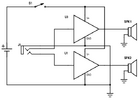
The amplifier here is a 3W stereo IC-based audio amplifier that I ordered from a Chinese website(http://www.kynix.com/Detail/647721/PAM8403.html). It cost me $2. For $2, I figured I would give it a try.
Pretty simple, right? Just connect it together the logical way. Now that I've shown how it went together, maybe I should share the parts list of the V1 electronics. There will be more components added in a minute.
Parts List V1
Being as excited as I was, I quickly shoved the electronics in the quill box. I added a mute switch along the way, which was just a momentary switch connected to ground and a pin on the amplifier. It looked like this.
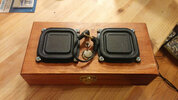
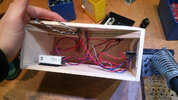
Opening the box and exposing my hurried soldering and poor wire management... Some of the connections are twisted and taped together since I planned on transplanting it into a proper enclosure.
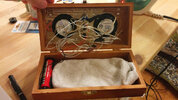
Notice the clean sock.
So, I built the skeleton of the enclosure that same night out of aspen, a soft wood that you would not normally build an enclosure out of, but it was what I had on hand and is very forgiving when I make mistakes.
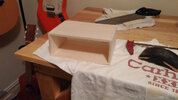
You can use whatever material you like to construct the box, but a common choice is MDF. MDF is made from sawdust and glue, with the mixture being compressed into the boards you buy at the store. The product is perfect for this purpose since the material is not of uniform density and does not sympathetically vibrate at frequencies we are concerned about. I chose the aspen, which you have already seen, for the sides and red oak for the front and back faces.
I have tools available on this site for enclosure design, and they work great for calculating necessary box volume on a project like this. My box was build from the output of the tool and then the dimensions increased ever so slightly to lower the system resonance at the expense of system Q. I lost some of the "punch" in the bass I mentioned I was after, but I gained a deeper reach.
Then I glued the rear face on the box.
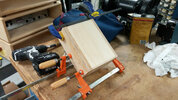
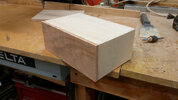
Designing as I went, I decided to add an "X" brace to the top of the enclosure to help minimize the low frequency energy lost to the panel. It was made from strips of 1/2" plywood and glued to the inside.
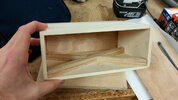
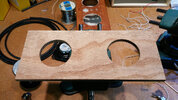
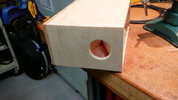
Using a forstner bit, I cut two holes for the speakers on the front panel and one on the side for the audio jack and power switch. It would have been easier to cut the hole for the steel panel prior to gluing the box together, but you live and learn.
Electronics V2
To mitigate the distortion at high volumes, the 3.7V 18650 was swapped for a rechargeable 9V. Since the amplifier only accepts voltages up to 5.5V, a 5V regulator was necessary. A filtering capacitor was also added to the circuit even though there is minimal noise from a battery power source.
This was when the issue of charging the 9V became a problem. I had originally purchased a micro-USB charging module that would have charged the 18650, but the module's fully charged voltage was 4.7V. The regulator needs altleast 5V to let current pass.
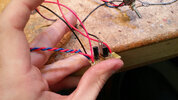
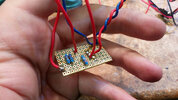
So, I had to design a charger myself. Googling a circuit to charge a 9V yielded a number of possibilities, but for simplicity I chose to go with a single 20 Ohm resistor to limit the current into the battery. There is no protection for the battery this way, but I included an LED that will turn off when the battery is fully charged. This charger also charges very slowly (approximately 14 hours for a full charge), which minimizes the risk of me leaving it on the charger too long. You will need any 9V wall-wart to supply power. The regulator and charging circuit are shown below.
I then drilled two holes in an 1/8" steel plate and mounted the switch and audio jack to it. After wiring it all together, it just needed to be test one final time and mounted in the box.
Parts List V2
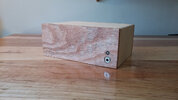
Now it is done! Do you want to have a try? Then go on with it! If you have any question, please leave a comment below~Thanks for reading.
The first question you have to ask is, "What do you want this to do?" If you want 40 Hz bass extension, then you will have to design for it. If you want high SPL, again, you will have to select an amplifier and loudspeaker combination that can provide that. What did I want? I wanted a portable, battery-powered stereo speaker of moderately high fidelity. Bass extension was not a concern, but "punch" was. From this, a sealed enclosure was selected.
Before building the version you see above, I prototyped the circuit on a breadboard with an enclosure made from a wooden quill box that I cut two holes in with a box cutter. The basic circuit diagram for this prototype was nothing more than connecting the audio to the amplifier and the amplifier to the speakers (well, provide the power too). For reference, the diagram is shown below.
(THIS IS NOT THE FINAL DESIGN, SCROLL DOWN FOR THE FINAL ITERATION)
The amplifier here is a 3W stereo IC-based audio amplifier that I ordered from a Chinese website(http://www.kynix.com/Detail/647721/PAM8403.html). It cost me $2. For $2, I figured I would give it a try.
Pretty simple, right? Just connect it together the logical way. Now that I've shown how it went together, maybe I should share the parts list of the V1 electronics. There will be more components added in a minute.
Parts List V1
- Stereo 3W Audio Amplifier (PAM8403) x1
- 3.7V 1860 Li-Ion Battery & Battery Holder x1
- 1/8" Stereo Jack (or whatever you would like to use for the input) x1
- SPST (single pull, single throw) Switch x1
- Loudspeaker x2 (preferably 4 Ohm, I used 8 Ohm)
Being as excited as I was, I quickly shoved the electronics in the quill box. I added a mute switch along the way, which was just a momentary switch connected to ground and a pin on the amplifier. It looked like this.
Opening the box and exposing my hurried soldering and poor wire management... Some of the connections are twisted and taped together since I planned on transplanting it into a proper enclosure.
Notice the clean sock.
So, I built the skeleton of the enclosure that same night out of aspen, a soft wood that you would not normally build an enclosure out of, but it was what I had on hand and is very forgiving when I make mistakes.
You can use whatever material you like to construct the box, but a common choice is MDF. MDF is made from sawdust and glue, with the mixture being compressed into the boards you buy at the store. The product is perfect for this purpose since the material is not of uniform density and does not sympathetically vibrate at frequencies we are concerned about. I chose the aspen, which you have already seen, for the sides and red oak for the front and back faces.
I have tools available on this site for enclosure design, and they work great for calculating necessary box volume on a project like this. My box was build from the output of the tool and then the dimensions increased ever so slightly to lower the system resonance at the expense of system Q. I lost some of the "punch" in the bass I mentioned I was after, but I gained a deeper reach.
Then I glued the rear face on the box.
Designing as I went, I decided to add an "X" brace to the top of the enclosure to help minimize the low frequency energy lost to the panel. It was made from strips of 1/2" plywood and glued to the inside.
Using a forstner bit, I cut two holes for the speakers on the front panel and one on the side for the audio jack and power switch. It would have been easier to cut the hole for the steel panel prior to gluing the box together, but you live and learn.
Electronics V2
To mitigate the distortion at high volumes, the 3.7V 18650 was swapped for a rechargeable 9V. Since the amplifier only accepts voltages up to 5.5V, a 5V regulator was necessary. A filtering capacitor was also added to the circuit even though there is minimal noise from a battery power source.
This was when the issue of charging the 9V became a problem. I had originally purchased a micro-USB charging module that would have charged the 18650, but the module's fully charged voltage was 4.7V. The regulator needs altleast 5V to let current pass.
So, I had to design a charger myself. Googling a circuit to charge a 9V yielded a number of possibilities, but for simplicity I chose to go with a single 20 Ohm resistor to limit the current into the battery. There is no protection for the battery this way, but I included an LED that will turn off when the battery is fully charged. This charger also charges very slowly (approximately 14 hours for a full charge), which minimizes the risk of me leaving it on the charger too long. You will need any 9V wall-wart to supply power. The regulator and charging circuit are shown below.
I then drilled two holes in an 1/8" steel plate and mounted the switch and audio jack to it. After wiring it all together, it just needed to be test one final time and mounted in the box.
Parts List V2
- Stereo 3W Audio Amplifier (PAM8403) x1
- 9V Rechargeable Battery
- 1/8" Stereo Jack (or whatever you would like to use for the input) x1
- SPST (single pull, single throw) Switch x1
- 5V Regulator
- 10 uFarad Capacitor
- 20 Ohm resistor for 9V Charger
- Barrel Jack for charger
- Loudspeaker x2 (preferably 4 Ohm, I used 8 Ohm)
Now it is done! Do you want to have a try? Then go on with it! If you have any question, please leave a comment below~Thanks for reading.


