ECG circuit design

mert

May 23, 2014
9
Joined
May 23, 2014
Messages
9
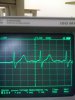
u can use this circuit diagram.. i get nearly original ecg signal.
circuit diagram of ECG.jpg output.JPG
 

Arouse1973

Adam
Dec 18, 2013
5,178
Joined
Dec 18, 2013
Messages
5,178
As a PQRST responce that's not bad. The P and Q are a bit low and theT is too high. But very good.
Adam
 

mert

May 23, 2014
9
Joined
May 23, 2014
Messages
9
it is my ecg signal and it is not extremely good :) .device was tried on lots of people and there were different PQRST waveforms..
 

(*steve*)

¡sǝpodᴉʇuɐ ǝɥʇ ɹɐǝɥd
Moderator
Jan 21, 2010
25,510
Joined
Jan 21, 2010
Messages
25,510
And of course you optocoupled the signal to the scope, right?

It would be interesting to see if one of these could be designed using a quad op-amp package (using 3 to make an instrumentation amp).
 

mert

May 23, 2014
9
Joined
May 23, 2014
Messages
9
no i did not..
ad620 is an instrumentation amplifier so 741 is not for this work.. 741 uses for just increasing gain because ins. amp. gain is not enough to see all waveforms of PQRST..
 

(*steve*)

¡sǝpodᴉʇuɐ ǝɥʇ ɹɐǝɥd
Moderator
Jan 21, 2010
25,510
Joined
Jan 21, 2010
Messages
25,510
no i did not..

But I assume you know why I said that.

ad620 is an instrumentation amplifier so 741 is not for this work.. 741 uses for just increasing gain because ins. amp. gain is not enough to see all waveforms of PQRST..

True, but you can make an instrumentation amp from 3 op-amps. I was wondering if that could be dome well enough to make this circuit using just jellybean components.
 

mert

May 23, 2014
9
Joined
May 23, 2014
Messages
9
i couldnt do that just jellybean components because i had not special cables for human body. i used copper cable and -as u can guess- loss is too much if u wanna amplify 1mV.. may be it is possible but i tried to make ins. amp. with "jellybean" components and they could not sense signal.. if u can i wanna learn how it is done..
 

Harald Kapp

Moderator
Moderator
Nov 17, 2011
14,272
Joined
Nov 17, 2011
Messages
14,272
Stve has a valid point about decoupling the signal from the amplifier to the scope, e.g. by using an optocoupler. Since the amplifier is directly connected to a human body, you need to do everything possible to protect the human from a malfunction and possibly hazardous currents and/or voltages.

i used copper cable and -as u can guess- loss is too much
Could you explain this in more detail? The instrumentation amplifier draws a negligible input current (max. 4nA over the full temperature range). Therefore the losses in the cables leading to the human subject should be negligible, too (e.g. even at 100 Ohm the voltage drop will be <= 400nV, much less than the millivolts you expect to measure).

Here is one article about rolling your own instrumentation amplifier and here is some basic material on ins. amps.
 

(*steve*)

¡sǝpodᴉʇuɐ ǝɥʇ ɹɐǝɥd
Moderator
Jan 21, 2010
25,510
Joined
Jan 21, 2010
Messages
25,510
As an interesting aside, here is a datasheet that describes the use of optocouplers for isolating linear signals.

It is interesting to note that there are two transistors, one of which is used in the feedback loop on the input side.
 

mert

May 23, 2014
9
Joined
May 23, 2014
Messages
9
by the way, of course i should have do isolation circuit for this app. but i hadnt enough time and i had not facility to buy something for isolation circuit
 
Top