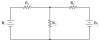
how to calculate voltage drop at R1 , R2 ,R3??

allocate23

Feb 11, 2013
1
Joined
Feb 11, 2013
Messages
1
how to calculate voltage drop at R1 , R2 ,R3?? the diagram is in attachment..:)
please show me complete working...tq in advance...
 

Attachments

  • 00207.png
    00207.png
    1.9 KB · Views: 137

Harald Kapp

Moderator
Moderator
Nov 17, 2011
14,272
Joined
Nov 17, 2011
Messages
14,272
Use the superposition principle:
1) replace B1 by a short circuit and calculate volategs and currents. This should be easy now: only one source left.
2) re-insert B1 and replace B2 by a short. repeat the calculations. Easy again.
3) superimpose the two solutions to find the total solution.

A thorough explanation is here.
 

Laplace

Apr 4, 2010
1,252
Joined
Apr 4, 2010
Messages
1,252
The straightforward method is to write the node equation(s) for the circuit and solve that. Here there is only one node (at the junction of the 3 resistors) so there is only one equation for the node voltage. Superposition is a gimmick that can reduce the amount of work involved but only if you're doing a numerical solution. For a closed form solution, algebraic superposition can be more complex and error prone than solving the node equation directly, especially so if using a computer algebra system (CAS) to manipulate the node equation. There is really no excuse for not using CAS given the availability of free software such as Maxima. Attached is a solution for Vn using MathCAD.
 

Attachments

  • B1B2.png
    B1B2.png
    5.8 KB · Views: 121

Harald Kapp

Moderator
Moderator
Nov 17, 2011
14,272
Joined
Nov 17, 2011
Messages
14,272
Superposition is a gimmick
hey Laplace, that's a bit hard.
I think it is a useful tool. Homework of this type is meant to teach the principles. Otherwise it would be much more complex. Superposition is just one principle among others.

Of course, solving the node equations directly is also a valid method. In the end, both methods will give the same result.

And of course I didn't mean a numerical solution. I generally prefer closed algebraic solutions.

About CAS: to be able to apply a CAS correctly, you need to know the principle. And it doesn't harm to go the way a few times manually before switching to a CAS. I have the same stance with simulations: If you have no feeling for the expected result and trust the SW too much, you can get lost.
 
Last edited:

Laplace

Apr 4, 2010
1,252
Joined
Apr 4, 2010
Messages
1,252
One of the hard facts of life is that I was taught many such principles for the purpose of reducing the work necessary to solve circuit problems back when the only calculation aid was a slide rule - and I have forgotten them. But node equations I can remember. And I can attest that I have gotten lost more often with shortcuts and manual calculations than I have with node equations and CAS. Simulations are another matter; I still have not learned to trust a simulation engine.
 

Phiber

Sep 14, 2012
12
Joined
Sep 14, 2012
Messages
12
try source transformation on the 2 voltage sources
the resistor will now be parallel to the current source. current source 1= b1/r1
(for the right voltage source)

do the same for the left Vsource. [Csource2 = b2/r3]

the circuit will now be 2 current source and 3 resistors in parallel.
then use KCL for upper node. =)
you can now get the voltage for every resistor
 

Laplace

Apr 4, 2010
1,252
Joined
Apr 4, 2010
Messages
1,252
Great, now I can add source transformation to the list of gimmicks lost in my fuzzy memory.
 

Harald Kapp

Moderator
Moderator
Nov 17, 2011
14,272
Joined
Nov 17, 2011
Messages
14,272
Laplace, don't worry, we're all not getting younger.

Look at it as just another tool in the box. Not every tool fits every situation and personal preferences are just as important. Those starting the game need to be shown the possibilities and need to make up their minds as to which method suits them best.
 
Top