flippityflop1
- Jan 27, 2009
- 135
- Joined
- Jan 27, 2009
- Messages
- 135
alright, i've set out almost exactly a year ago to build the 0-30V power supply in the project section (or at least a slightly modified version of it). well, a year afterwards i'm finally getting on with it (took me long enough, but i was preoccupied with other things).
anyways, i'm building it in modular units so i can mix match and borrow sections for other projects. i'm assembling the dead easy rectifier unit (the diode bridge, capacitor and a small LC filter -- the filter just for kicks).
as for the diode bridge i have 3 of these:
https://www.digikey.ca/product-search/en?vendor=0&keywords=641-1383-ND
i've always meant to use them in parallel, so to increase the current rating. i`ve tried 2 together in parallel, months ago and what it did was to overheat very quickly, so i unplugged it immediately. thankfully neither of the bridges burnt out. then that was the only time i decided to read up a bit and found out that a slight difference in voltage drop causes significant difference in heating and with NTC, ends to a slippery slope of over-currenting.
but i happen to see this:
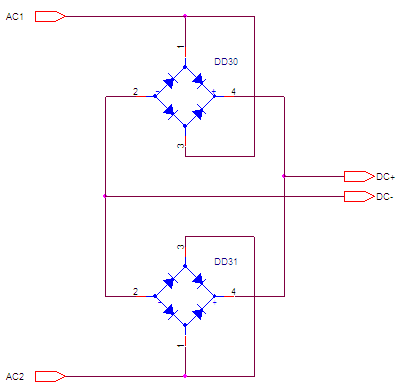
would this work to increase the current rating as simply the sum of each bridge??
anyways, i'm building it in modular units so i can mix match and borrow sections for other projects. i'm assembling the dead easy rectifier unit (the diode bridge, capacitor and a small LC filter -- the filter just for kicks).
as for the diode bridge i have 3 of these:
https://www.digikey.ca/product-search/en?vendor=0&keywords=641-1383-ND
i've always meant to use them in parallel, so to increase the current rating. i`ve tried 2 together in parallel, months ago and what it did was to overheat very quickly, so i unplugged it immediately. thankfully neither of the bridges burnt out. then that was the only time i decided to read up a bit and found out that a slight difference in voltage drop causes significant difference in heating and with NTC, ends to a slippery slope of over-currenting.
but i happen to see this:
would this work to increase the current rating as simply the sum of each bridge??
Last edited by a moderator:


