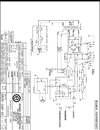
Part Identification in a radiosurgical unit (RSU)

bahnss

Jan 23, 2025
2
Joined
Jan 23, 2025
Messages
2
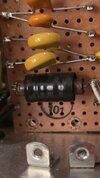
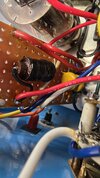
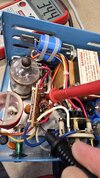
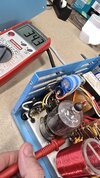
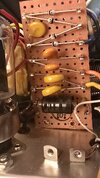
I was asked to look at this RSU when it began to blow fuses. I have provided a few pictures to hopefully help me identify the faulty part. Picture 01 is of the circuit board, picture 02 is a close up of the part in question. Picture 03 is of the faulty part. Picture(s) 04 & 05 show the value(s) in ohms of the part. I had access to a second fully functioning unit (pics 04 & 05). I believe the part I'm looking at is an RF choke, but I'm not sure if that is correct. I cannot find any descriptors or values on any of the four parts in question (there are two per unit). Whatever the part happens to be, how do I go about ordering the correct replacement part? the unit is an Ellman RSU FFPF.

besides testing resistance, is there any other values I should be checking, or are there any resources you recommend?
 

Attachments

  • 20250112_01.jpg
    20250112_01.jpg
    283.4 KB · Views: 9
  • 20250112_02.jpg
    20250112_02.jpg
    175.5 KB · Views: 9
  • 20250111_03.jpg
    20250111_03.jpg
    264.8 KB · Views: 9
  • 20250111_04.jpg
    20250111_04.jpg
    361.6 KB · Views: 10
  • 20250111_05.jpg
    20250111_05.jpg
    368.2 KB · Views: 9

shrtrnd

Jan 15, 2010
3,901
Joined
Jan 15, 2010
Messages
3,901
I don't know where in the world this instrument is located, but will submit that a specific certification is required in the US to 'repair' medical instruments, and I suspect that the US is not alone in this requirement. This to prevent unauthorized personnel from 'taking a look at' medical grade equipment that they are unfamiliar with.
 

Delta Prime

Jul 29, 2020
2,987
Joined
Jul 29, 2020
Messages
2,987
Welcome to Maker Pro.
I prefer gamma knives than an RF scalpel.Invite your superior, to the conversation.what you have been charged with is dangerous & your lucky considering the inappropriate test probes he authorized you to use!:mad:

IMG_0232.jpeg :mad:
 

Bluejets

Oct 5, 2014
7,374
Joined
Oct 5, 2014
Messages
7,374
I don't know where in the world this instrument is located, but will submit that a specific certification is required in the US to 'repair' medical instruments, and I suspect that the US is not alone in this requirement. This to prevent unauthorized personnel from 'taking a look at' medical grade equipment that they are unfamiliar with.
I would take a guess and say it would not conform with any medical grade certification given the board is a bit of old veroboard type material, bit like a knock-up proto-type.
 

bahnss

Jan 23, 2025
2
Joined
Jan 23, 2025
Messages
2
Thank you to everyone who has responded so far. Once repaired, this unit will be used medically again. This unit will get repaired by a certified lab. This unit is a generation prior to the schematic provided above.

I was asked to look at it, and having access to a second unit that is fully functional, the "RF choke" was the outlier for everything I could test. This RSU was interesting for me to look at and learn a few things, but at the end of the day patient safety is top priority. As simple as it appears to repair, I don't have the correct instrumentation, and knowledge to verify the systems safety. With that being said, I will seldom pass up the chance to learn something new. The unit will get sent off and hopefully, the lab will share what the problem was.
 

shrtrnd

Jan 15, 2010
3,901
Joined
Jan 15, 2010
Messages
3,901
Bluejets,
I understand your point, but want to say I can't tell you how many 'prototype' high-end instruments I've worked on that were first-run products of a company trying to rush their new design to market to justify their initial investment. Many times I've found obviously hand-built instrument sections, or whole stages, inserted into first product run equipment that was sold to buyers as 'new'. The engineers came
up with a design that did the job, the management is deciding whether or not to invest in full production, and in the meantime the money
guys want to recoup what it cost to design and build the equipment by selling what the engineers came-up with.
In my younger days I worked as a TV repairman. I kept seeing a specific brand 19" B&W TV come in for repair, one day I received a 12" come in from the same company. Opened it up, and found the brand had sawed their 19" motherboard in half, hard-wired the second half of the board and mounted it vertically along one side of the chassis. Apparently they decided there was a market for a smaller version of
their best-seller, but didn't want to retool any more than they had to.
 

Bluejets

Oct 5, 2014
7,374
Joined
Oct 5, 2014
Messages
7,374
Regardless, it would be unusual for a series inductor coil in power section to cause fuse to blow.
 

shrtrnd

Jan 15, 2010
3,901
Joined
Jan 15, 2010
Messages
3,901
I second that prognosis. Hence my thought that maybe a certified medical equipment technician should be in on the repair/maintenance instead of a no-doubt otherwise fully qualified engineer 'taking a look at' some other design engineer's product.
One of my first jobs was working electronic repair for a county Health Department. My boss was a chemistry Ph.D I had no doubt the guy
was a brilliant chemist, and he even taught a second job at the local college. However I was mystified at some of the decisions he made
concerning how he thought I should be doing my electronic repair job. Not the same as the situation bahnss found himself in with his boss,
whom I would assume was a paper-pusher manager instead of an engineer himself, but reminded me of how laissez-faire some people are about equipment that they actually know very little about. Even in my younger days I realized there isn't a magic wand I could wave to make some things as inconsequential as my bosses thought they were. Medical/Health instrumentation is serious stuff if it's not working the way the designers created it to be.
 

Bluejets

Oct 5, 2014
7,374
Joined
Oct 5, 2014
Messages
7,374
If such a thing exists, I doubt you'll find such a thing here.
Maybe try instructables.....
 
Top