Price versus quality

poormystic

Jul 23, 2023
187
Joined
Jul 23, 2023
Messages
187
Hi Peeps :)
I need to set an analogue voltage to a very fine adjustment. I've been window shopping at Mouser, and Radio Spares, and wherever else I can find good potentiometers for sale. There are many, many pots on sale - and at some amazing prices - a single turn linear pot can cost a couple of hundred US dollars.
I want to get a voltage right to about 1 part in 500, if possible.
What kind of potentiometer should I buy, please?
 
Last edited:

Alec_t

Jul 7, 2015
3,817
Joined
Jul 7, 2015
Messages
3,817
Even if you find a suitable pot, how stable is your power source supplying the pot? It would need to vary by no more than 1 part in 500.
 

shrtrnd

Jan 15, 2010
3,901
Joined
Jan 15, 2010
Messages
3,901
I second Alec_t's observation. I've found a lot of manufacturer specs must have been made under lab test conditions, 'cause they often
don't hold-up in real world situations. A good pot is needed, but an accurate input voltage regulator for that type of accuracy is a must.
In my humble opinion.
 

poormystic

Jul 23, 2023
187
Joined
Jul 23, 2023
Messages
187
You are quite right.
However, given that I might want excellent results, what's the best available pot? (I don't believe that price is always a reliable indicator of quality.)

I would like to set my e.g. 1k pot to e.g. 500 Ohms, then reset to say 800 Ohms, then go back to 499 Ohms, without encountering a worn-in spot at the first setting very nearby.

O Boy! This does look like being an expensive project... I can see 1000's... it's but a dream...
Sometimes, dreams get realised.
 
Last edited:

danadak

Feb 19, 2021
1,063
Joined
Feb 19, 2021
Messages
1,063

danadak

Feb 19, 2021
1,063
Joined
Feb 19, 2021
Messages
1,063
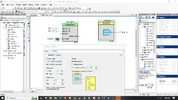
Above was PSOC solution, all onchip, including precision Vref. Most chip resources
still not used, available for other tasks.....
 

danadak

Feb 19, 2021
1,063
Joined
Feb 19, 2021
Messages
1,063
Note edits no longer allowed to posts ? Have to do a new reply....?
 

poormystic

Jul 23, 2023
187
Joined
Jul 23, 2023
Messages
187
Thanks danadak.
10 bits of precision is very good.
Edit: And it is waaay cheaper than the equivalent pot!
Thanks

Mark
 
Last edited:

danadak

Feb 19, 2021
1,063
Joined
Feb 19, 2021
Messages
1,063
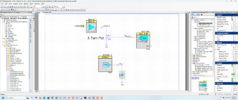
Another approach, a little better precision. Note Vref is +/- .1%, if you need
more accuracy use external Vref.

This approach uses multiturn pot.

1745160622788.png


Again one chip solution. Right hand window shows resources used/left, very little was used of chip.

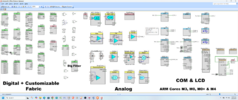
Other stuff onchip, multipoles in most cases :

1745160489784.png

Board to use, ~15, CY8CKIT-059


Regards, Dana.
 
Last edited:

poormystic

Jul 23, 2023
187
Joined
Jul 23, 2023
Messages
187
:)
Thanks everyone.
danadak - that is a dudely suggestion, for which I thank you very much.

Whoof!
My old trade of circuit board electronics has gone through such a set of revolutions... I hardly know a thing about what people are actually doing. I would never have discovered danadak's board for myself because I would never have suspected that such a board would exist.

That kind of helpful sharing is one of the good things :)
 

poormystic

Jul 23, 2023
187
Joined
Jul 23, 2023
Messages
187
:)
My health tends to break down when I get involved with computers - I have to take a very light approach to my electronics work. So it's true to say that I haven't kept up with technology.
However I imagine that I can get quite good results using a few combinatorial chips.

This project is just for fun, so maybe I'll write it up and put it on the forum as a kind of blog, somewhere.
That'll wait a few days, until I can use some drawing software - to make a lie of what I said above :)

Mark
 

Delta Prime

Jul 29, 2020
2,987
Joined
Jul 29, 2020
Messages
2,987
That'll wait a few days, until I can use some drawing software - to make a lie of what I said above :)
You’re too modest… I like your style & your straight shooter!
You employ a scientific method that positivity reinforces & fuels a self reinforcing objectivity. :cool:
 

danadak

Feb 19, 2021
1,063
Joined
Feb 19, 2021
Messages
1,063
I wont "push" anymore on PSOC as it would take a couple of videos to watch to
learn how to navigate. But its largely drag and drop, drag a resource out of its
catalog, like a gate or a flop or a pwm, drop onto schematic, dbl click, set its
parameters if any. The using simple wiring wizard wire to other resources and/or
out to pins. Then code, largely using its prewritten f() calls spelled out in datasheet.

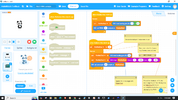
But another approach, also quite useful, block language programing. An example of
a need to convert a V to a PWM duty cycle or a servo position.

1745245160250.png


This is Arduino type board, Nano or Uno. So blocks are dragged out of
2'ond indo, dropped into right hand window, and configured. Then upload
button is clicked, and mBlock converts blocks to Arduino code and burns
it into Arduino board processor. Done.

Top group is just 4 blocks, reads the POT V, and writes that to its PWM.

Bottom group is essentially same but pot V controls the angle on a RC
servo.

Cant get much simpler than that. NANO board, uses USB data cable to
interface to PC, is ~$3.

There are many block language variants, here is a simple talking voltmeter
done with Snap4Arduino.


Good luck.
 

poormystic

Jul 23, 2023
187
Joined
Jul 23, 2023
Messages
187
I wont "push" anymore on PSOC as it would take a couple of videos to watch to
learn how to navigate. But its largely drag and drop, drag a resource out of its
catalog, like a gate or a flop or a pwm, drop onto schematic, dbl click, set its
parameters if any. The using simple wiring wizard wire to other resources and/or
out to pins. Then code, largely using its prewritten f() calls spelled out in datasheet.

But another approach, also quite useful, block language programing. An example of
a need to convert a V to a PWM duty cycle or a servo position.

View attachment 65942


This is Arduino type board, Nano or Uno. So blocks are dragged out of
2'ond indo, dropped into right hand window, and configured. Then upload
button is clicked, and mBlock converts blocks to Arduino code and burns
it into Arduino board processor. Done.

Top group is just 4 blocks, reads the POT V, and writes that to its PWM.

Bottom group is essentially same but pot V controls the angle on a RC
servo.

Cant get much simpler than that. NANO board, uses USB data cable to
interface to PC, is ~$3.

There are many block language variants, here is a simple talking voltmeter
done with Snap4Arduino.


Good luck.

Well, thank you, dana. I've already done the circuit design for my machine, but this alternative might suit me in future.
I'd better check it out :)
Mark
 
Top