Rebuilding tube radio

travellingblue

Oct 19, 2011
10
Joined
Oct 19, 2011
Messages
10
1000063104.jpg

I have a resistor question I need answering. A lot of the resistors in this unit have a 20% tolerance. I think there are some at 4.4M at 30% tolerance. But it seems like I can't source (easily) bulk resister packs that come close to that wide margin of tolerance.

Was the wide tolerance resisters used because of mass production/affordability? And the era of the 1950's? This thing has true domino mica capacitors from the war that the manufacturing industries were trying to use/get rid of.

Or is it the fact that this unit takes a 67.5V battery and can operate as low of a voltage as 40V. Does the voltage drop and the wide margin tolerances go hand in hand?

At the moment I can get 5% and 1% easily. Even 10% is hard to find as a full kit.

The one kit has all the higher ohms I need 1M to 10m ohm but it's 1/4W at 1% tolerance.

I was able to get a kit with 4.4M at 1/2W with 5% tolerance.


Just an FYI I'm no math wiz and would just need laments dumb down explanation. This is my first rebuild and have many ideas for this unit but I also don't want to make it more of a paperweight than it already is.
 

bertus

Moderator
Nov 8, 2019
3,835
Joined
Nov 8, 2019
Messages
3,835
Hello,

Why do you want to replace resistors?
They only fail when they have to dissipate more than the powerrating.

It is no problem to use resistors with a lower tolerance.
It means that the resistors are closer to the mentioned value.
It can be a problem when you use resistors with a higher tolerance.

Bertus
 

travellingblue

Oct 19, 2011
10
Joined
Oct 19, 2011
Messages
10
Thanks for the reply!

Something happened to this unit. It's not powering up but I'm currently trying to trace the source. I think some of the resistors/capacitors are dead. I'll confirm that once I buy a better multimeter.

I have another radio coming in the mail. I want to use this one as a Frankenstein unit where I replace components and do some other swaps/upgrades as a practice run and then keep the other one as close to factory as possible.

It's amazing where technology has gone. The original 10uf 150V capacitor is pretty big. The new one I bought is a fraction of the size. Honestly I was weary about its function because of how compact it is.

Same goes for the resistors. Compared to what's in there now they are pretty small.
 

bertus

Moderator
Nov 8, 2019
3,835
Joined
Nov 8, 2019
Messages
3,835
Hello,

Do you have the brand and type of the radio?
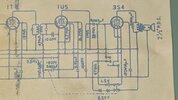
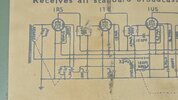
There might be a schematic to be found.

The powerratings for the resistors may be higher as the mentioned 1/4 watt.
The size usualy shows the powerrating.
See this page about size versus powerratings:

Perhaps the following thread will help you identify the resistors and capacitors:

Bertus
 

travellingblue

Oct 19, 2011
10
Joined
Oct 19, 2011
Messages
10
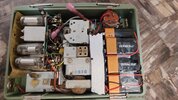
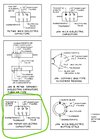
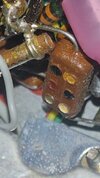
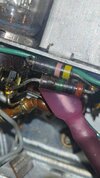
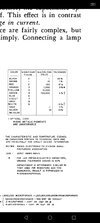
Thanks for the sizing chart! They measure 11mm putting them in the 1W class. I now have a bunch of resistors I can't use xD. I'm still learning about all this. The Jan paper dielectric capacitors don't have a voltage rating on it. As far as I know anyway. If there's some crazy math I have to do well that'll be my Achilles' heel. Here's some pictures and resources.
 

Attachments

  • aviary-image-1735761845687.jpeg
    aviary-image-1735761845687.jpeg
    376.6 KB · Views: 5
  • IMG_20250101_150737.jpg
    IMG_20250101_150737.jpg
    163.8 KB · Views: 5
  • IMG_20250101_140948.jpg
    IMG_20250101_140948.jpg
    227 KB · Views: 7
  • IMG_20250101_153710.jpg
    IMG_20250101_153710.jpg
    180.3 KB · Views: 7
  • IMG_20250101_153718.jpg
    IMG_20250101_153718.jpg
    192.3 KB · Views: 6
  • Screenshot_20241230_170931.jpg
    Screenshot_20241230_170931.jpg
    119.2 KB · Views: 5

bertus

Moderator
Nov 8, 2019
3,835
Joined
Nov 8, 2019
Messages
3,835
Hello,

As the radio is build for 67.5 volts, capacitors of 100 volts or more will likely work.

Bertus
 

travellingblue

Oct 19, 2011
10
Joined
Oct 19, 2011
Messages
10
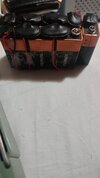
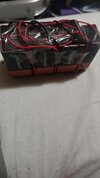
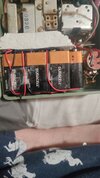
7 9V batteries in series. I super glued them together then I properly crimped the red/black leads and used heat shrink on the joints.

All the batteries brand new with them being higher than 9V the total is 67.5. this radio can keep working right down to 40V. I also took off the original bigger gage 9V battery clip as it wasn't compatible with the newer standard and put slider clips for easy plug in and out.

I've had this modal of radio in the past it was my first tube radio. I was lucky as that one worked when I got it. Hopefully the other one I bought works.
 

Attachments

  • IMG_20250101_183635.jpg
    IMG_20250101_183635.jpg
    210.1 KB · Views: 4
  • IMG_20250101_183652.jpg
    IMG_20250101_183652.jpg
    159.4 KB · Views: 4
  • IMG_20250101_183719.jpg
    IMG_20250101_183719.jpg
    184 KB · Views: 4

Bluejets

Oct 5, 2014
7,374
Joined
Oct 5, 2014
Messages
7,374
They will last about as long as it took to put them there given they will be trying to drive the HV as well as the valves heaters given the 9v has around 580mAh capacity.
Makes a battery replacement cost up around AUS$35 for , at best when working, of about 60 hours (some say) maximum before it falls off the 40v cliff.
 
Last edited:

travellingblue

Oct 19, 2011
10
Joined
Oct 19, 2011
Messages
10
The radio takes a 1.5V D battery as well. looking at the schematics it seems like the connections go right to the tubes so that might be for the heater elements.

I was going to go for rechargeable lithium 9V but they are expensive and to find ones that are reliable are hard to come by. Lots of off brands on Amazon but I didn't want to ruin the radio. Energizer is about $20 per battery!!!
 

Bluejets

Oct 5, 2014
7,374
Joined
Oct 5, 2014
Messages
7,374
Rechargable would be the way to go.....lithium as used in rc is reliable. Via an appropriate regulator.
Still, you have to get it working first up.
 

shrtrnd

Jan 15, 2010
3,901
Joined
Jan 15, 2010
Messages
3,901
Are your tubes at least lighting-up?
If the tube heaters aren't lit, you have to check to make sure the tubes are fully seated in their sockets
(and that none of the tubes are cracked). Even then, a bad tube will cause you problems.
My experience with caps is that any wet electrolytics will dry out and die first.
 
Top