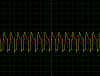
Sinewave (~1.5 Mhz range) switching.

Mono

Jan 6, 2012
11
Joined
Jan 6, 2012
Messages
11
Hello.
I need to design a circuit that will allow me to get a signal that is a sinewave (1.5 Mhz) which is "on" and "off" during certain periodic sets of time. (please see attached image).

I have already built a circuit for generating the sinewave and I also have a circuit that generates a pulse signal to control the "on" time of the sinewave.
My problem is that i don't know how to make these two signals interact in order to form the kind of signal I'm looking for.
What is the intelligent way to achieve this kind of signal (like the one in the attachment)? It is very important to maintain 0V during the sinewave's "off" time.
Thanks in advance!

 

Attachments

  • Signal.png
    Signal.png
    4.4 KB · Views: 199

BobK

Jan 5, 2010
7,682
Joined
Jan 5, 2010
Messages
7,682
How you wouild do this depends on the voltage and current you want to switch and the frequency at which you want to switch it.

Bob
 

Mono

Jan 6, 2012
11
Joined
Jan 6, 2012
Messages
11
Hi Bob.
The switching frequency is ~1kHz, but the pulse is not symetrical (200us on time, 800us off time).
The voltaje can go from -0.5V..0.5V to -8V..+8V (I can control that) . I also will have to amplify the signal to somewhere near 21V p-p (after the switching), but first I wanted to learn to switch it properly.
 

Resqueline

Jul 31, 2009
2,848
Joined
Jul 31, 2009
Messages
2,848
Maybe a CMOS analog/bilateral switch or analogue multiplexer/demultiplexer will do what you need.
Look in the 4000 or the DG range of IC's. Examples are: 4016, 4051, 4052, 4053, 4066, 4067, DG200 & up to DG3000 series, etc.
Remember their power supply always has to exceed the signal amplitude.
 

OLIVE2222

Oct 2, 2011
690
Joined
Oct 2, 2011
Messages
690
Hi Mono,

Is your sinus genrator an analog one or do you sine re-shape a digital signal?

Olivier
 

Mono

Jan 6, 2012
11
Joined
Jan 6, 2012
Messages
11
Hi!
The sinus generator is analogue.

In respect to the CMOS switch, I have some 4066 at disposal.
Since the signal (sinewave) goes, for example, from -5V to 5V : should the voltage supplied to the 4066 be at least -5V and 5V ?? And what about the control signal? Can it just be a 0-5V analogue pulse signal??

Thanks!
 

OLIVE2222

Oct 2, 2011
690
Joined
Oct 2, 2011
Messages
690
Hi Mono,

You can go for a SPDT(2:1) Mux of the DG serie as stated by Resqueline and supply it symetrically. The unused mux connection must be grounded. Then the tricky part is to implement a zero crossing detection circuit to ensure you don' t "cut" a sine cycle when switching.

Olivier
 

Resqueline

Jul 31, 2009
2,848
Joined
Jul 31, 2009
Messages
2,848
I have some 4066 at disposal.
Since the signal (sinewave) goes, for example, from -5V to 5V : should the voltage supplied to the 4066 be at least -5V and 5V ?? And what about the control signal? Can it just be a 0-5V analogue pulse signal?

Yes, if the sinewave has to be bipolar and referenced to ground - so will the power supply have to be.
The IC has only two supply connections Vdd (+) & Vss (-). The digital control signal is referenced to Vss, and its switchpoint is half the total supply voltage (Vdd-Vss).
So you'll have to make a level translator/shifter for the digital pulse signal.
 

Mono

Jan 6, 2012
11
Joined
Jan 6, 2012
Messages
11
Ok.
So something like this would work then? :
photo (8).jpg

If the answer is yes, the I have the two following rookie questions:

a) How to design a -5V..5V pulse generator? I was using the following design (which allows me to control the on and off time with potentiometers):
http://www.doctronics.co.uk/555.htm#more_astables
Is using this design from 0V to 10V and then offset it with -5V a good idea?? How does one achieve a simple -5V offset on a signal? (sorry for my noobness)

b) Let's consider both above issues resolved. I still need to amplify the resulting signal (switched sinewave) to 21 V peak to peak. What is the good way to do this??

THANKS!!
 

OLIVE2222

Oct 2, 2011
690
Joined
Oct 2, 2011
Messages
690

Resqueline

Jul 31, 2009
2,848
Joined
Jul 31, 2009
Messages
2,848
Yes, that's the way to do it.
You just connect the 555 generator's 0V to -5V instead, and the +3-15V to +5V, nothing more to it.
You'll need at least a +/-12V supply and a good op-amp in a 2.1x configuration to get 10.5V peak out.
Olivier has good suggestions that you can consider. The DG series are often used in professional equipment.
 

Mono

Jan 6, 2012
11
Joined
Jan 6, 2012
Messages
11
Thanks!
I will try the -5V..5V pulse with the 4066 and will see how it goes in the lab.
Also will buy some TTL compatible switches online, for future circuit refinement. (it takes like 3 weeks for them to arrive)

For the amplification I have some LM318s , which are some hi-speed opamps. The supply voltage rating is of +- 20V. What kind of amplifier configuration would you recommend? (you can just point the name of the configuration and I can read further. No need to spend too much time schooling this noob, haha)
 

Mono

Jan 6, 2012
11
Joined
Jan 6, 2012
Messages
11
I built the circuit with the 4066 and it worked perfectly!!!

I have it implemented so that the sinewave (f=1.5MHz) has 8V peak to peak (centered at 0V).
I need to take this signal to 21V peak to peak, in order to drive an ultrasound transducer.

What kind of amplifier circuit would you recommend??
Thanks!
 

Resqueline

Jul 31, 2009
2,848
Joined
Jul 31, 2009
Messages
2,848
Nice! :)

Like Olivier said there are many options in amplifiers, depending on load impedance. I'd look for an op-amp with a high slew-rate and a high full-power bandwidth.
LM318?
 

Resqueline

Jul 31, 2009
2,848
Joined
Jul 31, 2009
Messages
2,848
It should give something out, if not full amplitude.
Have you looked in the datasheet? Notice that it seems to like to have a 5pF cap across the feedback resistor (which must be at least 5kΩ).
If you look at the Large Signal Frequency Response graphs you'll see that you have to use Feedforward Compensation to get a sufficient output swing.
The first circuit on page 6 in the National datasheet seems to coax the absolute maximum out of that op-amp (150V/µs).
The Fast Summing Amplifier on the bottom of page 7 will presumably also work but has no margin left for the amplitude & frequency you need.
 
Last edited:

Mono

Jan 6, 2012
11
Joined
Jan 6, 2012
Messages
11
Hi.
On the simulator I implemented the following circuit:
photo (11).jpg

The output (yellow) I get (it is similar for different resistors and capacitors):
Graphs.png

Should I try the "feedforward compesation" circuit provided in the datasheet instead??
(page 9)
http://www.ti.com/lit/ds/symlink/lm118-n.pdf
 
Top