Design with Eagle quad-Op-AMp

luke67

Mar 18, 2012
46
Joined
Mar 18, 2012
Messages
46
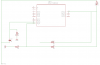
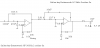
Hi people ! I'am new to the world of electronic but i have a work for the university to do : design for 60 channels the following circuit with EAGLE (see image)

I want to realize a little board (max 4x3,15 inch) so i was thinking to use a quad-opamp (so : 2 opamp for every channel (as you see from the image) = 30 quad-opamp)

Now the problem is the space : someone can help designing just one of these quad-opamp with his relative capacitors/resistors ??

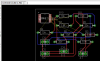
This is what I made (value of resistors/capacitors is not important) (see image)

Thank you all , people !!!!!!!!!!!
 

Attachments
  • job.png
    job.png
    21.8 KB · Views: 463
  • myex.png
    myex.png
    13.5 KB · Views: 433
Last edited:

Harald Kapp

Moderator
Moderator
Nov 17, 2011
14,273
Joined
Nov 17, 2011
Messages
14,273
I think this should go in the homeworks section, therefore I will not give a too detailed answer.
Anyway: how exactly do you expect us to help? You've got everything you need right in front of you.
Take the schematic of the sallen key filter and use OpAmps A and B of the Quad package for the first filter, OpAmps C and D for the second filter. Connect all capacitors and resistors as shown in the sallen key schematic. Note that the OpAmp "+" and "-" inputs fo the sallen key schematic are labeled +In_A (B/C/D) and -InA (/B/C/D) on the Quad OpAmp symbol in your second schematic.
Connect V+ and V- (pins 4 and 11) to a suitable power supply, e.g. +-5 V (thats where this OpAmp is specified, see datasheet). Don't forget to add a 100nF ceramic capacitor from each of the supply pins to GND. This will improve noise stability of the circuit.

Harald
 

luke67

Mar 18, 2012
46
Joined
Mar 18, 2012
Messages
46
ok ! thx! But the problem is that in this way wire are going to cross... how to solve this problem ??
 

(*steve*)

¡sǝpodᴉʇuɐ ǝɥʇ ɹɐǝɥd
Moderator
Jan 21, 2010
25,510
Joined
Jan 21, 2010
Messages
25,510
ok ! thx! But the problem is that in this way wire are going to cross... how to solve this problem ??

This isn't Ghost Busters. You're allowed to cross the lines.

Or are you talking about designing a printed circuit board (I don't think you are) If so, you can place traces under resistors and capacitors (between their leads).
 

Harald Kapp

Moderator
Moderator
Nov 17, 2011
14,273
Joined
Nov 17, 2011
Messages
14,273
ok ! thx! But the problem is that in this way wire are going to cross... how to solve this problem ??

On a PCB, use double sided layout. Eagle does support that. On different layers wires may cross.

Harald
 

luke67

Mar 18, 2012
46
Joined
Mar 18, 2012
Messages
46
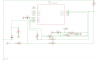
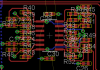
what do you think about these schematic /board that I made ? Why autorouting command don't create vias for the opamp?? MAny thanks !
 

Attachments

  • 1.png
    1.png
    15.8 KB · Views: 391
  • 2.png
    2.png
    23.6 KB · Views: 356

Harald Kapp

Moderator
Moderator
Nov 17, 2011
14,273
Joined
Nov 17, 2011
Messages
14,273
Like,
you should use either a dual OpAmp or you should connect the unused inputs of the OpAmp by a series resistor to GND.
As to why Eagle doesn't create vias I don't know. But you can halp yourself by manually placing vias next to the OpAmps Pins and connect them via a short manual route to the OpAmp. Eagle will then use these vias for autorouting.

Some Notes:
1) Consider using a through-hole Opamp. This makes routing easier since you can contact on both sides of the PCB. It is also easier to solder than SMD.
2) Avoid using the autorouter for analog signals. Try to optimize placement and routing manually while minimizing the length of the routes at the same time. As it is, your layout has long routes that are sensitive to coupling of noise.
3) It seems that the OpAmp is not connected to a power supply (Pins 1 and 4 are left open/unconnected). Correct this and add a 100nF bypass capacitor directly at the pins of the OpAmp to improve the stability of the supply at the OpAmp.


Harald
 

luke67

Mar 18, 2012
46
Joined
Mar 18, 2012
Messages
46
in order to achieve an ordinatic schematic i was thinking to separate the in/out pin of the opamp from their components (resistors and capacitors). Do you know how to di it ? i was thinking to name the wire of the components ... any idea ?? thank you very much !!
 

Harald Kapp

Moderator
Moderator
Nov 17, 2011
14,273
Joined
Nov 17, 2011
Messages
14,273
Sorry, I do not understand this. Can you explain in a bit more detail?
The components need to be connected for the circuit to work. Normally you use the wire in Eagle to connect components. You can also use named nets: right click on a net to open the context menu. Chose "name" from the contect menu. Something like N$xxx (xxx being any number) will show. You can overwrite N$xxx by a meaningful name, e.g. IN or OUT. You can do this for any net. If the name you type in already exists, you'll be asked if you want to connect these nets. If you answer yes, then these nets will be logically connected (and show as a single trace in the PCB) although you will not see the connection in the schematic. However, use this function with caution. The schematic will become almost unreadable because people are used to looking for wires, not net names.

Harald
 

luke67

Mar 18, 2012
46
Joined
Mar 18, 2012
Messages
46
ok people. That's a sample of my pcb. What do you think about it ? More in detail, what do you think about decoupling capacitor (C29 for V+ and C30 for V-)? Should they be more close to their respective pin or is it ok?
 

Attachments

  • ex.png
    ex.png
    30.6 KB · Views: 278

CocaCola

Apr 7, 2012
3,635
Joined
Apr 7, 2012
Messages
3,635
The should be fine where they are, just make sure to route them ;) Also double check the dimensions of the IC to make sure you are not crowding it too closely... A lot of times I print the board out and place the components on there to make sure they are easy to place before run the board...
 

luke67

Mar 18, 2012
46
Joined
Mar 18, 2012
Messages
46
And what about putting all the two capacitors at the bottom of the IC so the supply before linking to the IC reach the two capacitors ? Is this a better idea in order to reduce problems or will be the same ?
Thank you !!!!
 

CocaCola

Apr 7, 2012
3,635
Joined
Apr 7, 2012
Messages
3,635
I believe you may be over thinking and worrying about it... Location does matter but one has to consider the overall effect, moving the cap a mm this way or that way likely isn't going to make any significant effect if any at all in most cases...

Also you have to consider electrical current is the movement of electronics within a conductor, notice I said within not through, so when you start defining before and after in a parallel circuit a lot of it become arbitrary, just like defining up and down when standing on opposite sides of the planet... I'm not saying that the flow of electricity doesn't have a potential direction, as it does, but it's not an absolute direction... With that said, 'before' might have some measurable effect vs 'after' but again, is the difference anything that is going to influence the circuit significant enough to be measured or noticed? Probably not so much...
 

luke67

Mar 18, 2012
46
Joined
Mar 18, 2012
Messages
46
ok ! Just another thing : the supply. Considering the supply will be about 6 V what do you think about supply tracks dimension (0.8128 mm) and distance V+ from V- ? THX !
 

Attachments

  • supply.png
    supply.png
    18.6 KB · Views: 208
Top