Capacitor and LED question.

Korvette88

Aug 28, 2013
9
Joined
Aug 28, 2013
Messages
9
Hi,
I am currently learning about capacitors. I came across a basic circuit that tries to explain the charge/discharge effect of a capacitor. Basically you push switch 1 and it charges the capacitor and makes LED1 flash. Then you push switch 2 and LED2 flashes as the capacitor charges. What is confusing me is why doesn't LED1 flash also?
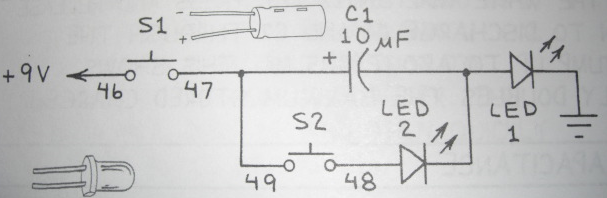
Cap-LEDcircuit_zps44656aa7.png


Can anyone explain why only the one LED lights up on discharge?
Thanks,
Ben
 

(*steve*)

¡sǝpodᴉʇuɐ ǝɥʇ ɹɐǝɥd
Moderator
Jan 21, 2010
25,510
Joined
Jan 21, 2010
Messages
25,510
Because the power flows out of the capacitor and through LED2. Think of C1 as being a battery that gets charges when S1 is closed, and discharges when S2 is closed.

When S1 is closed the current flows through C1 and Led1. When S2 is closed, through C1 (the other way) and LED 2.
 

Korvette88

Aug 28, 2013
9
Joined
Aug 28, 2013
Messages
9
Thanks for the reply. Let me see if I can clarify my confusion.
I know that C1 discharges through LED2. My thinking is that as the capacitor discharges through LED2 that discharge would continue through LED1 as it goes to ground. Right?
 

Korvette88

Aug 28, 2013
9
Joined
Aug 28, 2013
Messages
9
Wait, I think I got it. Current flows from negative to positive, not positive to negative. So the current is going clockwise around the secondary circuit. Which would mean that the current wouldn't go through LED1. Right?
 

(*steve*)

¡sǝpodᴉʇuɐ ǝɥʇ ɹɐǝɥd
Moderator
Jan 21, 2010
25,510
Joined
Jan 21, 2010
Messages
25,510
Current requires a complete circuit.

Regardless of anything else, if S1 is open, no current can pass through LED 1.

Don't concern yourself about which way it flows because it actually flows the opposite way to the way we usually say it does. As a practical matter, it's not relevant as long as we have a convention. That convention is +ve to -ve, and that's the way arrows point in symbols (in Diodes for example).

Inside a battery the circuit is not broken. Electrons that come in one electrode are accelerated and pumped out the other electrode. (this isn't anything like exact, but it may give you the idea).
 

Korvette88

Aug 28, 2013
9
Joined
Aug 28, 2013
Messages
9
Cap-LEDcircuit2_zpsd47c27e8.png


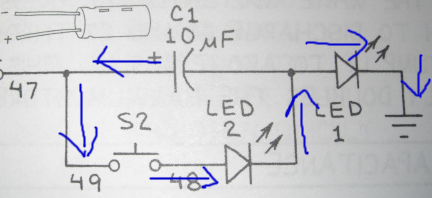
When I think that the Capacitor is discharging, this is what I think its doing. S1 is open and S2 is closed obviously.

Current is going from C1 through the switch, through LED2, through LED1, and then to ground.

I have build the circuit, and this is obviously not happening. LED1 doesn't light up. So I'm trying to figure out why its not happening. I must have some fundamental wrong in my train of thought.
 

john monks

Mar 9, 2012
685
Joined
Mar 9, 2012
Messages
685
You may have better luck by placing 47 ohm resistors in series with the LEDs.
 

john monks

Mar 9, 2012
685
Joined
Mar 9, 2012
Messages
685
I think you missed Steve's point. The current only goes in a loop. You must have a complete circuit. LED1 can only light when S1 is close. The current passes through the 9 volt battery into the ground, then through LED1, then current passes into and out of C1 through S1 and back into the battery. The LED does not stay on because electricity does not pass through the capacitor. Electrons go onto one plate and gets depleted from the other plate for a little while and then the current stops.
Where are you confused?
 

Korvette88

Aug 28, 2013
9
Joined
Aug 28, 2013
Messages
9
I think you missed Steve's point. The current only goes in a loop. You must have a complete circuit. LED1 can only light when S1 is close. The current passes through the 9 volt battery into the ground, then through LED1, then current passes into and out of C1 through S1 and back into the battery. The LED does not stay on because electricity does not pass through the capacitor. Electrons go onto one plate and gets depleted from the other plate for a little while and then the current stops.
Where are you confused?

I understand this part. This is when the capacitor is charging. The part I don't understand is when you close S2. This discharges the capacitor through LED2. Would the current not pass through LED1 after LED2 as it goes to ground?
 

(*steve*)

¡sǝpodᴉʇuɐ ǝɥʇ ɹɐǝɥd
Moderator
Jan 21, 2010
25,510
Joined
Jan 21, 2010
Messages
25,510
No, it's like this:


attachment.php


With only S1 pressed, current flows along the red lines. Note there is a circuit. I have drawn the line through the battery with one set of dashed lines because special stuff happens there. I have also drawn the line through the capacitor as a dashed line because special stuff happens there too. Current only flows until the capacitor is charged (that's the special part). Because S2 is open, there is no way for the current to get through LED2 -- S1 breaks the circuit.

When you press only S2, current flows along the green lines. note there is again a circuit. The dotted lines through the capacitor are special. Current only flows while there is some charge in the capacitor (essentially until it is empty). Because S1 is open, no current can flow through LED1 because S1 breaks the circuit.

When you press both S1 and S2, current flows as shown in magenta. Both LEDs will light, and the capacitor will also get charged (although for reasons I won't go into right now, it won't get charged very much).

The note about resistors is important because they prevent too much current flowing through the LEDs. In particular, if you press both S1 and S2 at the same time you could damage the LEDs. (the same is true for both S1 and S2 pressed individually, but the duration is very short and if you're using a normal 9V battery your LEDs will probably not be too fussed.
 

Attachments

  • Cap-LEDcircuit-flow.jpg
    Cap-LEDcircuit-flow.jpg
    24.9 KB · Views: 278

Korvette88

Aug 28, 2013
9
Joined
Aug 28, 2013
Messages
9
Ok.

I understand the first part, the red lines. And I understand the third part, the magenta lines.
I also understand the need for resistors, next to the diagram the book says not to close both S1 and S2 for exactly the same reasons as you said.

The green lines help to clarify some of my confusion. Let me see if I get this.

The reason why LED1 doesn't light up is because the capacitor doesn't discharge to the battery, but to itself. So the capacitor is like a temporary battery. Right?
 

(*steve*)

¡sǝpodᴉʇuɐ ǝɥʇ ɹɐǝɥd
Moderator
Jan 21, 2010
25,510
Joined
Jan 21, 2010
Messages
25,510
The reason why LED1 doesn't light up is because the capacitor doesn't discharge to the battery, but to itself. So the capacitor is like a temporary battery. Right?

Kinda. The capacitor stores charge and some technicalities aside, it does behave like a rechargeable battery (albeit with very low capacity).

However the main reason that LED 1 doesn't light up is that the only way it can is if current can flow through S1. So if S1 is open, LED 1 is off.

There are other reasons too. If we removed the battery and connected a piece of wire in its place and closed S1 as well, LED1 would still not light because the current would be trying to flow in the wrong direction (it can only go through a LED in one direction).
 

(*steve*)

¡sǝpodᴉʇuɐ ǝɥʇ ɹɐǝɥd
Moderator
Jan 21, 2010
25,510
Joined
Jan 21, 2010
Messages
25,510
Great!

This is not a particularly simple example because there are capacitors, reversing current flows, and half of the circuit is not shown.

I'm not surprised it wasn't clear at first!
 
Top