nice link..why odd harmonics are being choosed to form square wave
Think of it like this:
You want a square wave. and all you have is a bunch of sine waves.
First you start with a sine wave at the same frequency as the square wave you want. It's kinda right, but the leading and trailing edges are not very fast, and the top and bottom is certainly not very flat.
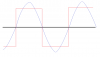
You want what's in red, but you've only got what's in blue. It's an estimate, but not a good one.
So what can we do. what we want to do is make the rising and falling edges rise and fall faster, and to bring down the peak at the top of the sine wave.
So we look for a frequency that is rising at the same time we want our waveform to rise, falling at the same time we want it to fall, and low in the middle to negate some of the effect of the peak at the top of the original sine wave.
And here is an example:
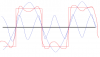
Now we've added the second sine wave at three times the frequency of the original. (that's an odd harmonic, because 3 is an odd number). Added together we get the wobbly orange line.
And that's better than the sine wave. It has a faster rise time and is flatter along the top. But it's still far from perfect.
So we look for the next frequency that tends to counter all the differences between this and a square wave. It turns out to be 5 times the original frequency (that's another odd harmonic).
Wee add that, and the result looks better. Then we add the 7th harmonic, the 9th, the 11th, 13, 15, 17, 19, 21... And eventually the waveform looks pretty square.
Here is a video with better drawing but poorer explanation:


