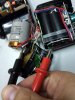
Camera Flash - how do I trace circuit from power supply?

kcroy

Jan 29, 2012
31
Joined
Jan 29, 2012
Messages
31
I am attempting to repair a canon 420ex camera flash. I purchased this item broken - while there were indications power was working, the flash cap would not charge. however, at one point I rotated it slightly, and it started working - but after I reassembled, it stopped working. I would now like to trace the power supply, and see where it stops - hopefully to find something obvious to fix.

I have a signal generator and an oscilloscope, as well as a digital MM. My thought was to set up the signal generator where the battery goes, and trace the signal using the oscope. Is this the normal process?

I don't want to use a battery and accidentally be feeding into the capacitor and shock the hell out of myself at some point. NOTE: I do drain the cap each time I work on it.

0) Canon 420EX

1) What is the fault -- Flash powers up and I can see LED, but I do not hear the capacitor charging. Pilot light does not come on ( indicating cap is charged and ready to go )

2) History of the fault. Was broken at purchase. Accidentally got it to work while rotating the head around while disassembled. However after re-assembling it no longer works.

3) Actions unspecified in the manual. unsure. After taking it apart a second time, I did accidentally pull apart one solder on the IR unit at the bottom. I re-soldered it and it appears to be connecting ok.

4) Does anything look or smell burnt? Not that I can see.

5) Do any components look "wrong". not that I can see.

6) PHOTOS -- Please give us some good photos of any areas obviously affected.

http://imgur.com/a/rGzA8

Happy to add more!
 

(*steve*)

¡sǝpodᴉʇuɐ ǝɥʇ ɹɐǝɥd
Moderator
Jan 21, 2010
25,510
Joined
Jan 21, 2010
Messages
25,510
Excellent description of the problem! I'm pretty sure I can tell you what the fault is. I'm betting It will be a broken connection to the capacitor or a poor connection on the inverter board.

The "ready" light is typically just a measure of voltage on the capacitor. So it not going on tells you that the capacitor isn't getting charged.

You've probably noticed that the sound of the charging changes in pitch as the capacitor charges. Without a load (if the connection to the capacitor is broken) the pitch will be very high, probably inaudibly so.

If the inverter is not running it will likewise make no sound.

In about the center of the first image, a green transformer is visible. This will be part of the inverter. Wires leading from there to the capacitor will be the charging path. Look for a poor connection on this wire, or even a broken led on the transformer.

There will be other wires, possibly going via that coil on top of the capacitor to the flash tube and there will be a trigger circuit. On some units the inverter and the trigger circuit are almost indistinguishable at first glance. The trigger connects to a piece of wire or a metal plate close to the flash tube. It will also have connections to the main capacitor or the inverter.

Be very careful powering up the flash without the covers on. The cap holds enough power when charged to kill you. If you're lucky you'll just get the belt of your life and possibly throw the unit across the room.

More pictures around that transformer would be good if you can't see anything.
 

Gryd3

Jun 25, 2014
4,098
Joined
Jun 25, 2014
Messages
4,098
Try to find out how the pilot light is connected to the Capacitor. Some cameras/flash units will have a small neon light in parallel with the capacitor. Remember that the equivalent resistance of a capacitor will go up as it charges... if the capacitor itself is not connected, in theory the pilot light would get lit by the charging circuit. (You would have a large potential voltage across the Capacitor at full charge, and you would have a large potential voltage across an open circuit) Of course that is the case with a neon indicator light, but I am unsure how your pilot light circuit is constructed.

And please keep *Steve*'s advise in mind. El-cheap-O disposable cameras pack over 300V and can deliver an astonishing amount of amperage if given the opportunity.
 

(*steve*)

¡sǝpodᴉʇuɐ ǝɥʇ ɹɐǝɥd
Moderator
Jan 21, 2010
25,510
Joined
Jan 21, 2010
Messages
25,510
Try to find out how the pilot light is connected to the Capacitor. Some cameras/flash units will have a small neon light in parallel with the capacitor.

el-cheapo cameras use a voltage divider with the neon connected across the lower leg. WHen the voltage across the lower leg exceeds the breakdown voltage of the neon tube, it conducts (with a lower voltage across it) and the upper resistor acts to limit the current.

However this flash (I'm almost certain) has a red LED which comes on to show it is ready. It will use a more complex circuit. It is possible that the sense wire is broken, and if so, the capacitor will be (likely) fully charged.

And please keep *Steve*'s advise in mind. El-cheap-O disposable cameras pack over 300V and can deliver an astonishing amount of amperage if given the opportunity.

Yeah, 50A is a reasonable current to expect. This unit has an inductor which I suspect is used to reduce peak current to the flash tube.
 

kcroy

Jan 29, 2012
31
Joined
Jan 29, 2012
Messages
31
... If the inverter is not running it will likewise make no sound.

In about the center of the first image, a green transformer is visible. This will be part of the inverter. Wires leading from there to the capacitor will be the charging path. Look for a poor connection on this wire, or even a broken led on the transformer.

There will be other wires, possibly going via that coil on top of the capacitor to the flash tube and there will be a trigger circuit. On some units the inverter and the trigger circuit are almost indistinguishable at first glance. The trigger connects to a piece of wire or a metal plate close to the flash tube. It will also have connections to the main capacitor or the inverter.

Be very careful powering up the flash without the covers on. The cap holds enough power when charged to kill you. If you're lucky you'll just get the belt of your life and possibly throw the unit across the room.

More pictures around that transformer would be good if you can't see anything.

Hi! Thanks for the fast and knowledgeable reply!

First of all - I'm definitely being careful. I read through the service manual on how to discharge the capacitor, and have done so every time I've put any power through it. It is a 330V capacitor.

When powering the flash up, I do not hear any noise from the cap ( no charging white ). The flash uhm.. focus? does click and adjust slightly when I power up - so I assume power is getting to that part of the flash ( top unit where the bulb is ) shown in the lower left corner of this first image.

http://imgur.com/a/UK23Q

I also took 2 more photos of what I think is the inverter you are referring to.

I can also upload a PDF of the service manual / electrical schematic, but not sure where I can put a 20 meg pdf.

I am hesitant to take off the pcb where the inverter is - looks like I'll have to take a part a bunch of stuff to get it out ( I was thinking of inspecting the bottom for bad connections ) .

Is there a way that I can test the route the power goes, and see where it falls off? I was hoping that was a way to use the signal generator and oscilloscope - that I could follow the signal and see where it disappears.

For example, I would like to see if the red/black lines going into the capacitor are receiving power... I would like a way to find this out without putting batteries in and possibly shocking the hell out of myself, or doing damage to the electronics.

Thanks again!
 

kcroy

Jan 29, 2012
31
Joined
Jan 29, 2012
Messages
31
Try to find out how the pilot light is connected to the Capacitor. Some cameras/flash units will have a small neon light in parallel with the capacitor. Remember that the equivalent resistance of a capacitor will go up as it charges... if the capacitor itself is not connected, in theory the pilot light would get lit by the charging circuit. (You would have a large potential voltage across the Capacitor at full charge, and you would have a large potential voltage across an open circuit) Of course that is the case with a neon indicator light, but I am unsure how your pilot light circuit is constructed.

And please keep *Steve*'s advise in mind. El-cheap-O disposable cameras pack over 300V and can deliver an astonishing amount of amperage if given the opportunity.

Thanks!! I will check out the schematic - but I do not see the pilot light coming on. Normally it will not come on until the Capacitor is charged, correct? If the cap and light were in parallel, wouldn't the light come on right away?
 

(*steve*)

¡sǝpodᴉʇuɐ ǝɥʇ ɹɐǝɥd
Moderator
Jan 21, 2010
25,510
Joined
Jan 21, 2010
Messages
25,510
Can you tell me how you're discharging the main cap?

Do you have a multimeter that you can use to measure the voltage (CAREFULLY) on the main cap (either before you discharge it, or while the flash is powered up)?

The wires that are most suspect are the ones leading from the board with the green transformer on it to the main capacitor. Check both ends carefully, and after discharging the main cap, use your multimeter to measure the resistance of these wires in case one has broken internally.

Something that got stress on it when you twisted the top of the flash made contact, and the wires (or the joins at the end) are the prime suspects.
 

(*steve*)

¡sǝpodᴉʇuɐ ǝɥʇ ɹɐǝɥd
Moderator
Jan 21, 2010
25,510
Joined
Jan 21, 2010
Messages
25,510
Looking closer at the images, it looks like the red/blue/brown wires go between the cap and the inverter. Another weak spot is the connector or where the wires enter the plug.
 

kcroy

Jan 29, 2012
31
Joined
Jan 29, 2012
Messages
31
Can you tell me how you're discharging the main cap?

Do you have a multimeter that you can use to measure the voltage (CAREFULLY) on the main cap (either before you discharge it, or while the flash is powered up)?

I'm using an 8 ohm 50 w resistor to bleed it, using these instructions:
bleed cap.jpg
Is it safe to check the voltage on the capacitor while it is in circuit ( or afterwards ) ? I don't want to damage my multimeter.

Is it ok to put the batteries in, turn it on, and check for power on the various wires?
 

Gryd3

Jun 25, 2014
4,098
Joined
Jun 25, 2014
Messages
4,098
I'm using an 8 ohm 50 w resistor to bleed it, using these instructions:
View attachment 13839
Is it safe to check the voltage on the capacitor while it is in circuit ( or afterwards ) ? I don't want to damage my multimeter.

Is it ok to put the batteries in, turn it on, and check for power on the various wires?
Just be sure that your multimeter is set to an appropriate setting before poking around, and try not to accidentally bridge anything with the probes.

As far as the indicator light is concerned from above. You are right, but it depends on how the indicator is wired.
I would be really interested in the service manual
 

(*steve*)

¡sǝpodᴉʇuɐ ǝɥʇ ɹɐǝɥd
Moderator
Jan 21, 2010
25,510
Joined
Jan 21, 2010
Messages
25,510
OK, with an 8 ohm resistor, you'd be expecting a current of 41A if the cap was fully charged, and well over 10A even if it only had a charge of 100V. You should see sparks if the capacitor is charged.

I'm betting you don't.

Also note that the instructions recommend a 500Ω resistor, not an 8Ω resistor.

Oh, and most important when making the voltage measurement is to ensure that you DO NOT hold one probe in one hand and the other probe in the other hand. If anything goes wrong you've set yourself up for the capacitor to discharge across your arms. I hope I don't need to warn you about where your heart is. Either hold both probes in one hand (not easy unless you're a chopstick guru) or clip one or both probes to the points and do the measurement as hands-off as you can.

The way to check voltages is to:

1) remove batteries and discharge the cap
2) place meter in a voltage range (if you have to set a range, set it to 500V or higher)
3) connect the black probe of your meter to the ground terminal (as shown in the instructions)
4) place the batteries in the unit
5) place one hand in your pocket and keep it there
6) turn on the flash with your free hand.
7) pick up the probe with your free hand and carefully probe for voltages.

The hand in the pocket trick is typically used for high voltages, but given the low impedance nature of the capacitor, I'd do it just out of respect for the energy potentially stored in it.

Probably more useful (once you've discovered that the capacitor isn't charging) is to get something insulated (a plastic rod or a dry wooden stick -- not a pencil, the graphite is a conductor) and gently prod at the wiring, components and boards. See if you can find something that, when prodded, makes the capacitor charge (you'll hear it).
 

kcroy

Jan 29, 2012
31
Joined
Jan 29, 2012
Messages
31
sorry for the delay - havent been able to work on the project at all due to work!

I would be really interested in the service manual

Service Manual can be downloaded here: https://mega.co.nz/#!Us13HaQB!ZHcmYbe_C4Q8WQQslys3hG65Ul7fsH3XvhBIFbmE4HI

OK, with an 8 ohm resistor, you'd be expecting a current of 41A if the cap was fully charged, and well over 10A even if it only had a charge of 100V. You should see sparks if the capacitor is charged.

...

Probably more useful (once you've discovered that the capacitor isn't charging) is to get something insulated (a plastic rod or a dry wooden stick -- not a pencil, the graphite is a conductor) and gently prod at the wiring, components and boards. See if you can find something that, when prodded, makes the capacitor charge (you'll hear it).

Hi Steve,

I did the following before I read your reply:

Added in batteries - no charge to cap that I can tell. When power is first turned on, the flash focusing mechanism itself does a micro adjustment - so that is receiving power.

With Battery in, I tested for voltage like so - I was able to see about 2v from the + end of the battery to red/blue/brown/pink wires by the cap.

IMG_9006-1000.jpg

It is late, but I will re-read your reply tomorrow and try what you suggest.
 

kcroy

Jan 29, 2012
31
Joined
Jan 29, 2012
Messages
31
3) connect the black probe of your meter to the ground terminal (as shown in the instructions)

One end of the black probe goes into the black socket on the MM - where does the tip of the black probe go?
 

(*steve*)

¡sǝpodᴉʇuɐ ǝɥʇ ɹɐǝɥd
Moderator
Jan 21, 2010
25,510
Joined
Jan 21, 2010
Messages
25,510
See page 3.1 of the manual.

And make doubly sure the multimeter is in a voltage mode and that the red lead is plugged into the voltage socket on the multimeter.
 

kcroy

Jan 29, 2012
31
Joined
Jan 29, 2012
Messages
31
Red lead is in the voltage socket, and I'm in 200v DC mode.

Looking at the Manual, I am not seeing anything that discuss how to use the black tipped probe. https://bkpmedia.s3.amazonaws.com/downloads/manuals/en-us/388-HD_manual.pdf

I assume that I want to touch the red and black probes to different parts of the circuit, to measure the voltage that is going between them, right? Do I touch the black probe to the negative end of the circuit ( near the batter ) and then see how far the positive circuit goes?

I guess I'm looking for a troubleshooting process, that I can apply to other projects as well as this one.

As an aside - why does the Cap have that copper coiling going on the top?
 

(*steve*)

¡sǝpodᴉʇuɐ ǝɥʇ ɹɐǝɥd
Moderator
Jan 21, 2010
25,510
Joined
Jan 21, 2010
Messages
25,510
On page 3-1 there is a point labelled GND on the flash. That is where the black probe should be connected. It is part of the hot shoe.

The copper coil is there either to limit current through the flash (through inductance), or as part of the circuit to extinguish the flash. I'm not 100% certain.
 

(*steve*)

¡sǝpodᴉʇuɐ ǝɥʇ ɹɐǝɥd
Moderator
Jan 21, 2010
25,510
Joined
Jan 21, 2010
Messages
25,510
Oh, it's the same point that you do the discharge of the main cap to.

And I'd advise a range of 500V or higher.

flash.jpg
 

kcroy

Jan 29, 2012
31
Joined
Jan 29, 2012
Messages
31
ok great - I misunderstood which manual you were referring to!

What was also confusing me - if I attach to GND on the flash, and then test for voltage in areas... I assumed that any break in the circuit would prevent voltage from traveling through. But that clearly inst the case - I assume there are multiple paths to ground throughout the flash - so a break in one place does not stop the whole flash from working.
 
Top