Mercy Chong
- Jul 20, 2014
- 3
- Joined
- Jul 20, 2014
- Messages
- 3
Hello and welcome to Electronics Point
It's not a square wave; it's a very badly clipped sinewave. My guess is that the transistor is being overdriven and/or is incorrectly biased. Try reducing the amplitude of the VX and VY generators. If you still have problems:
1. What is the frequency, waveform, and amplitude of the VX voltage generator?
2. What is the frequency, waveform, and amplitude of the VY voltage generator?
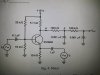
3. Can you show us the top part of the schematic, including the base bias resistor and the collector load resistor, and the supply voltage.
Those amplitudes are far too high. Try reducing them both to around 0.02V peak-to-peak. Or for a clearer output waveform, try setting them to integer multiples, and different amplitudes. For example, try this:
VX: f = 40 kHz; amplitude = 0.04V p-p;
VY: f = 200 kHz; amplitude = 0.01V p-p.
This should give you an interesting looking waveform at point A, showing the mixing of the two frequencies. This is probably not the aim of this lesson though, which is to show how sum and difference frequencies are produced by a mixer. Try these settings:
VX: f = 100 kHz; amplitude = 0.03V p-p;
VY: f = 101 kHz; amplitude = 0.02V p-p.
This will produce the messy waveform that you describe as a "thick" sinewave with many ripples at point A. At point B, and Vout, you should see a cleaner waveform at 1 kHz - the difference frequency.