LED TV - power circuit damaged after lightning strike

michalw

Sep 6, 2014
17
Joined
Sep 6, 2014
Messages
17
Hi all,

I'm repairing the LED TV damaged after the lightening strike.
I've started with creating simple scheme (see below) and testing the components.
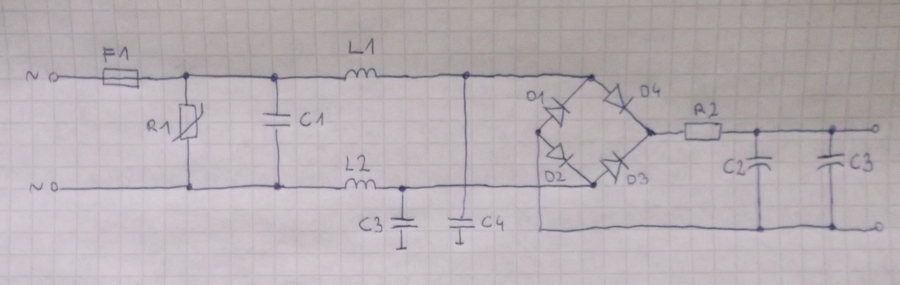
28wozeb.jpg


Only the fuse was blown (NSFT 2.5A 250V).
I replaced the fuse with the new one (<PS> E JET bel F2.5A 250V) and plugged the power, but the fuse immediately blew.

I suspect the problem may be with the type of the fuse: F2.5A probably means fast-blow, but I'm not sure whether NSFT is the slow-blow.
I've read that fuses used on the input are mostly the slow-blow, so I probably used the incorrect one, but I would like to be sure to use the slow-blow one.

I've tried to google the phrase "NFST 2.5A 250V", but found nothing helpful.

Does somebody know is "NSFT 2.5A" is rather slow-blow or fast-blow?

Thanks in advance,
Michał
 

KrisBlueNZ

Sadly passed away in 2015
Nov 28, 2011
8,393
Joined
Nov 28, 2011
Messages
8,393
Assuming it's a switching power supply, which it almost certainly is, the usual problem is destruction of the switching device (usually a MOSFET) that drives the primary of the transformer, due to overvoltage from the surge. Other semiconductors on the primary side, and possibly also the secondary side, may have been destroyed as well. The driver IC usually survives.
 

davenn

Moderator
Sep 5, 2009
14,470
Joined
Sep 5, 2009
Messages
14,470
A fast blowing mains fuse is usually a result of a failed bridge rectifier
I have seen that so many times

after checking the bridge rectifier ( may be 4 separate diodes or a single package)
then move on to Kris's suggestions which would then be the next most likely choices :)

Dave
 

KrisBlueNZ

Sadly passed away in 2015
Nov 28, 2011
8,393
Joined
Nov 28, 2011
Messages
8,393
Ah yes, thanks Dave. The bridge rectifier is the best place to start.
 

michalw

Sep 6, 2014
17
Joined
Sep 6, 2014
Messages
17
I've checked the bridge rectifier and the diodes are working properly.

There was also failed resistor (R2 on the scheme above, 1.2 Ohm ceramic) - I've replaced it with 1.5 Ohm (haven't had 1.2 Ohm, but I guess it shouldn't be a problem).

As I understand you said that the problem was not related with the type of the fuse, am I right?
 

KrisBlueNZ

Sadly passed away in 2015
Nov 28, 2011
8,393
Joined
Nov 28, 2011
Messages
8,393
Probably not. I guess the 1.2 ohm resistor was between the negative side of the bridge rectifier and the source of the MOSFET, right? In that case the MOSFET is almost certainly toast. What's the part number?
 

michalw

Sep 6, 2014
17
Joined
Sep 6, 2014
Messages
17
The 1.2 Ohm resistor is between the positive side of the bridge rectifier and the transformer.

I found on the PCB that the fuse should be "T2.5AL" so it's definitely the slow blow fuse and I need to buy one.
 

KrisBlueNZ

Sadly passed away in 2015
Nov 28, 2011
8,393
Joined
Nov 28, 2011
Messages
8,393
OK, that still points to the MOSFET.

When you're getting a new slow-blow fuse, get a pack of them :)
 

michalw

Sep 6, 2014
17
Joined
Sep 6, 2014
Messages
17
Hi,

I've found the MOSFET near the transformer's primary, it's TK5A65D. The measured D-S resistance (in both directions) is ~0.6 Ohms without the gate voltage, according the datasheet it should be 1.2 Ohms with the gate voltage, so it seems to be dead.
I've found also the short-circuit on the diode connected with the source of that transistor.

I've examined (with the 'diode test' function of the multimeter) the bridge rectifier diodes and it shows the volatege ~0.550 V in both directions on every diode, so I guess the diodes should be also replaced.
But as far as I remember they were not damaged when I was testing them on Saturday - maybe soldering slow-blow fuse and plugging the power cable killed them...
 

KrisBlueNZ

Sadly passed away in 2015
Nov 28, 2011
8,393
Joined
Nov 28, 2011
Messages
8,393
Yes, it's possible that replacing the fuse and powering it up with the MOSFET still short circuit could have forced enough current through the bridge rectifier diodes to take them out as well.

Have you identified a suitable replacement for the MOSFET? If you want suggestions, add your location to your profile so we know what suppliers to look at.
 

michalw

Sep 6, 2014
17
Joined
Sep 6, 2014
Messages
17
I haven't found the replacement yet, but as far as I know the most important parameters are:

Drain-source voltage >= 650 V
Gate-source voltage ~ ±30 V
DC Current >= 5A
Pulse Current >= 20A
Drain power dissipation >= 40W
 

KrisBlueNZ

Sadly passed away in 2015
Nov 28, 2011
8,393
Joined
Nov 28, 2011
Messages
8,393
Right. And a matching package (TO-220) and polarity (N-channel). Gate-source voltage is unlikely to be important. Aim for one that's not too over-rated for current - high-current MOSFETs switch more slowly.
 

michalw

Sep 6, 2014
17
Joined
Sep 6, 2014
Messages
17
I've examined all diodes and found one more (probably) dead - it's RS1GJTB (fast recovery rectifier).
The multimeter diode test shows the voltage ~0.300 V in both directions.

I found a scheme for the TV set - link.
On the page 10-3 there's detailed scheme of the power supply unit - it's D610 probably dead.
 

Angelo

Sep 10, 2014
30
Joined
Sep 10, 2014
Messages
30
Seems the link is broken, almost for me.
Yes, the diode seems damaged, but de-solder it to be sure and measure it off board, since there can be something in parallel.
Also, for lightning issues, do a very well eye-check for broken tracks. As krisbluenz said, the mosfet driving the transformer on the primary side is one of the parts that often shorts.
But, since you had a lightning, i would test quite all the semiconductors of the primary (quiet fast, tester and some experience, leaving them on board), and measure all the resistors also, since some of them can have an altered higher value, or can be open.
Measuring on-board, keep always in mind that resistance that you measure can be lower of the expected value (something in parallel) but never greater.
Then a brief check on secondary side rectifiers diodes.
Then a prayer, and try to power on. Let us know.
 

michalw

Sep 6, 2014
17
Joined
Sep 6, 2014
Messages
17
Little update:

I've de-soldered the RS1GJTB diode and it turned out the diode is working.
I've found few resisotrs dead, I'm going to replace them and hope that will be enough...

Let you know.
 

michalw

Sep 6, 2014
17
Joined
Sep 6, 2014
Messages
17
I've replaced all damaged elements and still not working. I suspect the MOSFET is damaged again short circuit between Drain and Source.
Could be the MOSFET destroyed during soldering / using multimeter ?
 

HellasTechn

Apr 14, 2013
1,579
Joined
Apr 14, 2013
Messages
1,579
This problem almost sounds same as my psu problem.

just for the information. Have you checked the varistors ? usually when they blow you can tell but some times you never know. Or look for inflated capacitors.
 

michalw

Sep 6, 2014
17
Joined
Sep 6, 2014
Messages
17
The capacitors are good.
Regarding the varistor: how to test it properly? De-solder and measure the resistance?
 
Top