Koford (Slot Car) Bench Power Supply Project

Gryd3

Jun 25, 2014
4,098
Joined
Jun 25, 2014
Messages
4,098
Great! One less component to worry about!

I was doing some more testing today and it looks like the voltage jumping around may be due to a loose connection on the potentiometer... One of the colder tabs is loose (Which is why I am ordering a new one), and I put a drop of solder on it to hold it in place until the replacement shows up.. I was testing today and the voltage would just completely at random spike to like 14 volts..

So I messed around with that wire and when it was making good contact, the voltage was solid, didn't move more than .01v over a 10 minute period..

So it seems I may not even need the 100uF capacitor, I may throw it in there anyway, but it looks like that wasn't the underlying problem..
Your call... That large input capacitor will smooth out the input voltage, so instead of varying between say 13V and 12V, it may only wiggle about from 12.25V to 12.75V. **Please note I made those numbers up...
The bigger cap will help flatten the input, and will help maintain that flattened input when you are drawing a lot of current. I would not worry about the input one at all anymore.
The 100uF capacitor that you have is 'helpful', in that it would filter out the smaller little spikes that occur. This would not do much with large jumps from 5V to 12V if it was any more than a fraction of a second. If you have a solder braid, or solder pump, you could remove the wire from your potentiometer, clean it off and rejoin it. That may solve the need to replace the whole part.
I changed the original capacitor from I believe 3500uF to 4700uF, which would have made since I went from a 6A Transformer to an 8A transformer..

But maybe I didn't go large enough? Though maybe it's not affecting anything... I assume if the capacitor was not large enough it would cause pretty noticeable voltage droops?


Before I go and order the new 10v transformer... This idea of installing another rectifier.. I can pick one of those up at Radio Shack.. If that a viable solution? From the sound of it, it would drop my current 14v down to 12v which is what I hoped to accomplish with the 10v transformer. How would I hook that up? Wouldn't that effectively make it a 1/2 wave rectifier instead of a full wave rectifier, thus creating bigger droops between phases?

-TheChad
That extra bridge idea wont make your system a half wave.
The first bridge will rectify the full wave, and then pass DC to the second bridge. This will result in the second bridge only using 2 of its 4 internal diodes.
To do this, you need to disconnect the + and - from the first bridge and connect it to the AC1 and AC2 of the second bridge. The second bridge will then have its + and - connected back to the rest of the circuit.
 

davenn

Moderator
Sep 5, 2009
14,470
Joined
Sep 5, 2009
Messages
14,470
hi TheChad

a 5600uF would be minimum for a PSU capable of 5 - 6 amps. personally I would use a 6800uF

ALWAYS use the 100 uF on the output of the regulator ( linear reg's like the 78xx series, 317 etc series)
and its preferable to always use those smaller values I spoke of as well.

Gryd3 .... that 1000uF / Amp is one of those things most electronics guys learn early on, passed down from senior to junior tech :)
I have seen it written in text a few times over the years
 

(*steve*)

¡sǝpodᴉʇuɐ ǝɥʇ ɹɐǝɥd
Moderator
Jan 21, 2010
25,510
Joined
Jan 21, 2010
Messages
25,510
I was doing some more testing today and it looks like the voltage jumping around may be due to a loose connection on the potentiometer... One of the colder tabs is loose (Which is why I am ordering a new one), and I put a drop of solder on it to hold it in place until the replacement shows up.. I was testing today and the voltage would just completely at random spike to like 14 volts..

Technically we call that "broken"

So it seems I may not even need the 100uF capacitor, I may throw it in there anyway, but it looks like that wasn't the underlying problem..

It may not have been the underlying problem, but it's worth having nonetheless.

I changed the original capacitor from I believe 3500uF to 4700uF, which would have made since I went from a 6A Transformer to an 8A transformer..

But maybe I didn't go large enough? Though maybe it's not affecting anything... I assume if the capacitor was not large enough it would cause pretty noticeable voltage droops?

It's large enough at present. Don't fix anything that's not broken.

This idea of installing another rectifier.. I can pick one of those up at Radio Shack.. If that a viable solution?

It's largely pointless.

From the sound of it, it would drop my current 14v down to 12v

That would be voltage.

which is what I hoped to accomplish with the 10v transformer. How would I hook that up? Wouldn't that effectively make it a 1/2 wave rectifier instead of a full wave rectifier, thus creating bigger droops between phases?

No, it just acts like a 1.2V (ish) voltage drop. Might even be more at higher currents.

As suggested, your main problem will be that you have three voltage regulators in parallel, they're too close and they're not well heatsinked.

What is likely to happen is that as soon as you have everything wired up, you'll be asking why the voltage drops all by itself after the unit has been in use for some time.

A single 5A regulator would be better than three lower current regulators, but it makes it *more* important rather than less to heatsink it properly.

What would be better is to have a transfomer that was 12V centre tapped. You could install a switch to switch between the 6V and the 12V tap as you go from a low output voltage to a higher one. Some power supplies do this automatically, but it would probably be too much of an ask to get you to make a circuit to do this.
 

(*steve*)

¡sǝpodᴉʇuɐ ǝɥʇ ɹɐǝɥd
Moderator
Jan 21, 2010
25,510
Joined
Jan 21, 2010
Messages
25,510
Gryd3 .... that 1000uF / Amp is one of those things most electronics guys learn early on, passed down from senior to junior tech :)
I have seen it written in text a few times over the years

Essentially it is a way of maintaining a given amplitude of ripple. (how much do you think that is Dave?)

Let's assume f Hz mains, and a capacitor of c F, and a current of i A. If we make the assumption that it's a sawtooth with a zero rise time and a downward slope proportional to a presumeably constant current, we can calculate the amplitude using the equation:

v(t)=(1/C)It+v(0)

The period of the ripple is 1/(2f), so that is our time. We're not interested in V(0) because we're really only interested in the magnitude of the change (and likewise we don't need to worry about the fact that the current would actually be negative.

so we have:

Vr = i / (2cf)

Now, we've assumed 1000uF per amp of i, so we can further simplify this to

Vr = 500 / f

For 60Hz mains, that's 8.3V of ripple! (It will actually be slightly less than that because the assumptions made about the rise time are incorrect)

What this is saying is that your input voltage to the regulator needs to be 8.3V + the dropout voltage of the regulator to maintain regulation.

But for a slot car, I wouldn't really worry
 

TheChad

Sep 23, 2014
114
Joined
Sep 23, 2014
Messages
114
As suggested, your main problem will be that you have three voltage regulators in parallel, they're too close and they're not well heatsinked.

What is likely to happen is that as soon as you have everything wired up, you'll be asking why the voltage drops all by itself after the unit has been in use for some time.

A single 5A regulator would be better than three lower current regulators, but it makes it *more* important rather than less to heatsink it properly.


I can't use a single regulator, 5A isn't big enough, I could use 2 5A regulators..

I could install them all to their own heat sink and put them further apart.... But it was mentioned earlier that there is a reason for them to be mounted close and to the same heat sink, to prevent any of them from "running away"..

All the testing I have been doing in the last couple if days, it hasn't gotten more than luke warm...

Maybe it's because I have the case off and it's getting good air flow... Maybe it's because I haven't connected any of my faster motors that draw more amps yet...

I was going to order the 5A regulators anyway, just because I figured if nothing else it won't be taxing them as much, maybe they will run cooler, maybe they won't..

-TheChad
 

(*steve*)

¡sǝpodᴉʇuɐ ǝɥʇ ɹɐǝɥd
Moderator
Jan 21, 2010
25,510
Joined
Jan 21, 2010
Messages
25,510
I can't use a single regulator, 5A isn't big enough, I could use 2 5A regulators..

How much current do you need?

I could install them all to their own heat sink and put them further apart.... But it was mentioned earlier that there is a reason for them to be mounted close and to the same heat sink, to prevent any of them from "running away"..

These regulators do not "run away".

All the testing I have been doing in the last couple if days, it hasn't gotten more than luke warm...

Maybe it's because I have the case off and it's getting good air flow... Maybe it's because I haven't connected any of my faster motors that draw more amps yet...

Remember that the power is proportional to current. So yes, a higher current motor (especially a low voltage one) will cause the regulators to heat up.

I was going to order the 5A regulators anyway, just because I figured if nothing else it won't be taxing them as much, maybe they will run cooler, maybe they won't..

Why don't you get a good design before you go out and buy lots of stuff?

Have you looked at the datasheets for these devices? They typically have designs for high output currents.

Take a look here (and more information here). The top design should do what you want, however it is NOT protected from short circuit outputs! (do you need that protection -- I guess you do)

With designs like these, you would probably be better off with your existing 12V transformer.
 

Gryd3

Jun 25, 2014
4,098
Joined
Jun 25, 2014
Messages
4,098
These regulators do not "run away".
This was mentioned by myself earlier in the thread as I understood that many components like transistors, FETs, LEDs etc when run in parallel can change their operating characteristics when warm or hot. This change results in the 'hotter' component drawing more current and getting hotter and ... etc. To mitigate this, keeping all of the components mounted to the same heat sink will keep them all at the same operating temperature and help prevent this from happening. This is no substitute for an appropriate heat-sink of course.

Was I wrong? If so, are there other methods to prevent components like these from becoming unbalanced during operation and heating up excessively more than others?
 

(*steve*)

¡sǝpodᴉʇuɐ ǝɥʇ ɹɐǝɥd
Moderator
Jan 21, 2010
25,510
Joined
Jan 21, 2010
Messages
25,510
In a runaway situation, one component might hog the current and the situation worsens as it heats up.

These regulators have an overtemp and overcurrent protection. In the worst case, one regulator will hog the current until it starts to go into overtemp shutdown. At this point current sharing will improve.

It's not a great situation, but it's not as bad as thermal runaway.

Because one regulator will be more stressed than the others, it may fail sooner. What happens next is anyone's guess.
 

TheChad

Sep 23, 2014
114
Joined
Sep 23, 2014
Messages
114
How much current do you need?

Well up to about 6 amps.


Why don't you get a good design before you go out and buy lots of stuff?

That's kind of what I'm doing here... The basic design was already done, as it was a store bought power supply. However it did not meet my needs as it didn't have enough power. So I modified it, perhaps blindly, by adding a larger transformer. Now I am looking to fix/modify it correctly..

Have you looked at the datasheets for these devices? They typically have designs for high output currents.

Yes, I even posted the data sheet for the LM338 regulators I was looking to get. But then it was suggested that putting 5A regulators instead of 3A regulators wouldn't really make any difference, as they would both still have to burn the same amount of current off.. I was considering doing it anyway, as it'll only cost a few $ and IF by chance it did run cooler, AWESOME! If not, no shade off my back...


So, I was thinking of using heat sinks like these: http://www.mouser.com/ProductDetail/Wakefield/274-1AB/?qs=sGAEpiMZZMuFYi0ZsYM5P3Ur7zp00wPz

Unless you can suggest a better one.. I was going to separate the 3 regulators, put them all on their own heat sink, still they would only be maybe an 1/2"-1" apart, as there's only soo much room.... I canned that idea when Gryd3 suggested the runaway and to keep them all on the same heat sink, but it sounds like maybe that's not going to be a problem?

The other thing is obviously the case of the power supply is acting like a heat sink. If I put the regulators on their own heat sink, while some of the heat will still transfer to the case, some of it will instead radiate off inside the case, which has no airflow. I cannot put a fan as the case just isn't big enough., So the other concern is that using a heat sink instead of the power supply's case, will cause more problems with internal heat.

Okay, looking at the pages you suggested, it's saying to install and transistor, what does this do? How does this work?

Thanks!

-TheChad
 
Last edited:

(*steve*)

¡sǝpodᴉʇuɐ ǝɥʇ ɹɐǝɥd
Moderator
Jan 21, 2010
25,510
Joined
Jan 21, 2010
Messages
25,510
OK, so you want up to 6A and a voltage variable up to 12V. We're talking 72W here, which is a lot for a linear power supply. Let's see if we can do it.

Just take it from me that placing several voltage regulators in parallel is not a great idea unless you can ensure that they share the current more or less equally. The problem is not so much the amount of heat (it will be the same in all cases) but that it is spread evenly over the devices you're planning on using

I'm also conscious that you've already bought some stuff and that reusing as much as possible would be a good thing.

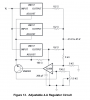
Here is a way of paralleling several regulators so they share current:


adjReg.png
The 0.2 ohm resistors help the regulators share the current. These are 1.5A regulators, so this circuit is rated at just a little under 3 x 1.5A. You have several 3A regulators, so you should be able to get 6A easily.

Now, there are some complexities here that result in good regulation, but that's probably not your primary concern.

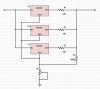
I would recommend you try this:


adjReg2.png

This won't regulate the voltage quite so well. The voltage will sag by about 0.2V at 6A, but that's reasonably small.

Note that I have not shown any capacitors. The input and output capacitors that you had before are still required.

The VERY important thing to note is that the case of the regulator is connected to the output terminal so you will have to insulate the LM338's from the heatsink. The heatsink you've selected is *way* too small. I'll suggest one in a minute.

Let's assume you have a 12V secondary when bridge rectified, you will get a peak voltage of about 15V under load (it will be higher without load). For a 12V output, you need an input voltage of 14.5V, so in theory you need 100,000uF of filter caps to keep the ripple below 0.5V.

Now you have said that you really only want up to 6V, so for this you could get away with 10,000uF.

Now let's look at the total power dissipation. At a reasonable maximum (supplying 2V at 6A), the regulators are dissipating 12.5 * 6 = 75W. Let's assume a 25C ambient temperature and a maximum die temp of 115C. If the heat is being spread between the three of them, we can assume about 1.5 degC/W junction to heatsink. So the heatsink needs to be about (115-25)/75 - 1.5 = -0.3 degC/W -- in other words it can't be done!

A 10V transformer would be better, but it still wouldn't work.

Maybe if you used the TO-3 versions of these devices AND the lower voltage transformer... you would need a 2 degreeC/W heatsink FOR EACH DEVICE.

This is a 2 degC/W heatsink... http://www.digikey.com/product-detail/en/HS14/598-1373-ND/1761997 <-- you need three of these!

This is why you do calculations before you design stuff.

I would now recommend a switchmode power supply.
 

TheChad

Sep 23, 2014
114
Joined
Sep 23, 2014
Messages
114
I appreciate all the great information...

What you suggest makes since, however this is a bench power supply, not a power supply that runs constantly or for long periods..

The longest I would probably ever have it turned on under load is maybe 20 minutes...

I can't stress enough how much I appreciate the information, I think I am going to add the output capacitor, increase the input capacitor to 6800uF, change the regulators to LM338's and go from there...

-TheChad
 

(*steve*)

¡sǝpodᴉʇuɐ ǝɥʇ ɹɐǝɥd
Moderator
Jan 21, 2010
25,510
Joined
Jan 21, 2010
Messages
25,510
Heh, I'm not suggesting a bench power supply, just something that has a chance of working.

I'm assuming that you're telling me everything. Perhaps you're not. Will the average current (say over 10 seconds) ALWAYS be lower than 6A? If so, what is the highest this average will be?

This will allow you to reduce the heatsink size.

20 min is easily enough for these devices to go into shutdown mode. Without heatsinks they wouldn't last 30 seconds at the minimum voltage and maximum current.
 

TheChad

Sep 23, 2014
114
Joined
Sep 23, 2014
Messages
114
Heh, I'm not suggesting a bench power supply, just something that has a chance of working.

I'm assuming that you're telling me everything. Perhaps you're not. Will the average current (say over 10 seconds) ALWAYS be lower than 6A? If so, what is the highest this average will be?

This will allow you to reduce the heatsink size.

20 min is easily enough for these devices to go into shutdown mode. Without heatsinks they wouldn't last 30 seconds at the minimum voltage and maximum current.


I will likely NEVER run minimum voltage at maximum current.... I'm not even sure how I could pull that much current at low voltage....

Typically my 'Fast" motors pull about ~4A @ 4v. Slower motors will pull 1.5-3A @ 4v.

Typically if I am breaking in a motor I will run it from 3v-5v for ~10 minutes. If I am using my armature lathe or tire lathe, I may run them for 3-5 minutes.

Other then that, I typically will only use it to do quick tests, rev a motor a few times, etc.

I honestly don't know that I would ever pull more than 5A, there are faster motors than mine, I don't think they pull more than 5A - 6A @4v..


The 6.3v transformer may actually have been fine voltage wise, I think the problem was the amperage.. 6A A/C converts to what after rectification?

I truly only need ~10v 5-6A DC. Unless I'm revving a motor to test it, I typically wont go over 4v-6v DC.

I think that's all the Information I can give? I don't know what other useful information I can offer?

Does it matter heat wise how much amps the transformer can put out?

I can get a 7.5v 15A transformer, knowing I will never go over 6A, will having the 15A capacity cause more heat?

Thanks,

-TheChad
 
Last edited:

TheChad

Sep 23, 2014
114
Joined
Sep 23, 2014
Messages
114
Okay, I just ran a slightly hotter motor than I was testing with before. I was using a motor that barley drew .5A, now I tested a motor that drew 1.25A. The regulators got slightly to the warm side of luke warm, except 1, which got hot enough that I didn't want to keep my finger there for more than about 10-15 seconds.. I couldn't locate my infrared temp gun at the moment to get a temp reading. I ran the motor for about 8 minutes @ 5v.

So it looks like the 1 regulator on the end (It's at the end of the 3 regulators, furthest from where the power comes in the circuit) is working harder than the other 2.....

I don't know if that means it's bad? or just that it's not balanced? I'm wondering if using only 2 of the LM338's would help, only having 2 to balance the load instead of 3...

-TheChad
 

TheChad

Sep 23, 2014
114
Joined
Sep 23, 2014
Messages
114
Okay.. I was digging threw my old Slot Car stuff, and FOUND the capacitor I took out.... It is a 33000uF...

I replaced a 33000uF with a 4700uf, I think I did this because the 33,000uF is only rated to 10V, but I'm not sure why I did a 4700uF, unless I thought it was 3300uF not 33000uF....

So with new information! Even though the 4700uF seems to work okay... I think I should atleast put a 33000uF capacitor back as it was engineered that way for a reason.... But should I go larger?

Thanks,

-TheChad
 

(*steve*)

¡sǝpodᴉʇuɐ ǝɥʇ ɹɐǝɥd
Moderator
Jan 21, 2010
25,510
Joined
Jan 21, 2010
Messages
25,510
The regulators got slightly to the warm side of luke warm, except 1, which got hot enough that I didn't want to keep my finger there for more than about 10-15 seconds.

Wow. I didn't see that happening </sarcasm>
 

TheChad

Sep 23, 2014
114
Joined
Sep 23, 2014
Messages
114
Wow. I didn't see that happening </sarcasm>

Thanks for the sarcasm. We all KNEW they would get warm/hot... That's kind of what started everything....

So the problem now is that 1 is hotter then the other 2... I am still going to get a real temp once I find my infrared temp gun.. But the LM350 is rated up to 150-Degree's Celsius, which is 257-Degrees Fahrenheit. I KNOW it's not getting that hot..

Anyway, does the one getting hotter then the others mean that the one getting hot is bad, or something else?
 

(*steve*)

¡sǝpodᴉʇuɐ ǝɥʇ ɹɐǝɥd
Moderator
Jan 21, 2010
25,510
Joined
Jan 21, 2010
Messages
25,510
I did warn you (multiple times) about connecting multiple regulators in parallel.

You have ignored all of my advice, so all I can suggest is that you read back over what I have said.

Check posts 3, 11, 48, and 50.
 

TheChad

Sep 23, 2014
114
Joined
Sep 23, 2014
Messages
114

I did warn you (multiple times) about connecting multiple regulators in parallel.

You have ignored all of my advice, so all I can suggest is that you read back over what I have said.

Check posts 3, 11, 48, and 50.


Sometimes what you say has been contradictive to me... You said the regulators "DON'T" run away, but then you said not to run them in parallel unless I make sure they are balancing the load.. So that to me seems like a contradiction.

I also am not sure you are fully reading my posts... I don't know how many times I can express.. *I* did not build this power supply. It was built by an company which happens to be an Electrical Engineering company that also has a Slot Car division..

You are basically saying that even UNMODIFIED, the power supply was not built right and shouldn't have been built that way... Well you'll have to take that up with the manufacture...

All I want to do is modify it to work better for my needs. Is it going to be perfect? No, not unless I completely start from scratch. I don't need or want to do that at this point, just make it work BETTER for my needs...

At this point, I have identified that 1 of the regulators is hotter then the other 2, which means I need to fix that so they are equally sharing the load..

I can't replace the 3 regulators with 1, It's not possible for the amount of current I have. The best I could do is replace the 3 regulators with 2, which may or may not help with the load sharing? I am going to order a lower voltage transformer, which from the advice given, will remove some of the heat issue.

But I'm trying to figure out if I should order a 10v 8A transformer, or a 7.5v 15A Transformer. Either of them will have enough voltage and enough amperage. But will the extra Amperage of the 15A transformer cause more heat? or does it matter as long as I'm not actually drawing that much amperage?

Honestly, I've read and appreciate every bit of advice you have given. I have no doubt you are telling me the BEST and PROPER way to do things, but what I know is what I already have works, I just want to change a couple of things to make it a little better, with out rebuilding or redesigning the entire power supply...

With the 6.6v 6A transformer they used a 33000uF capacitor, So I *think* a 56000uF capacitor would be good for the 10v 8A transformer I am looking at ordering. But that is a guess and probably wrong?

I don't completely understand the schematics and what not, so while you may look at them and it makes perfect since, a lot of it might as well be in another language to me. So I apologize if my questions or project are upsetting you,

-TheChad
 

davenn

Moderator
Sep 5, 2009
14,470
Joined
Sep 5, 2009
Messages
14,470
Sometimes what you say has been contradictive to me... You said the regulators "DON'T" run away, but then you said not to run them in parallel unless I make sure they are balancing the load.. So that to me seems like a contradiction.

note the 2 diagrams in Steve's post #50 .... see the resistors on the outputs of the regulators ?
these are there to balance the loads. If not there, load sharing will not be equal, and because of manufacturing variations, one regulator will try and supply all the load ( which it cant)
its going to get really hot and go into thermal shutdown mode. Then the other 2 reg's are going to try and supply the load and are also going to fail to do so and there will be a cascade of the reg's going into thermal shutdown

At this point, I have identified that 1 of the regulators is hotter then the other 2, which means I need to fix that so they are equally sharing the load..

so are you using resistors on their outputs as shown ?

With the 6.6v 6A transformer they used a 33000uF capacitor, So I *think* a 56000uF capacitor would be good for the 10v 8A transformer I am looking at ordering. But that is a guess and probably wrong?

were they really using 33000uF or was it really 3300 uF ? 33,000uF is a BIG cap !
for an 8 A supply somewhere from 10,000 to 20,000 uF would be ample ( keeping in mind the minimum of 1000uF / amp)
and DONT FORGET the 0.1 uF caps on the input and output of each of the reg chips ( mounted as close to the chip pins as possible)

cheers
Dave
 
Top