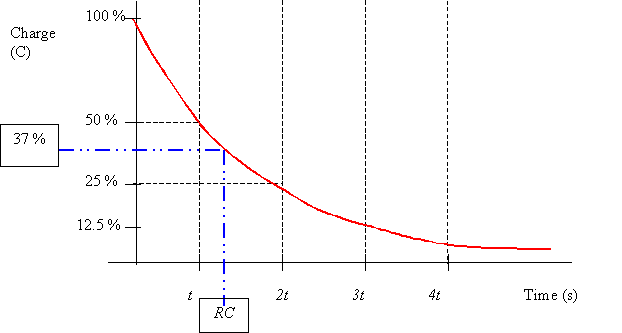
A Capacitor discharge rate is non-linear, so it will discharge quickly at first and taper off.
You can see that for every
t amount of time, the charge will halve. Which eventually results in it only loosing 25%, then 12.5% then 6%... and
To mess with numbers, if you use a 750Ω resistor across the capacitor, you will be providing ~15V to it directly from the transformer.
So to do some basic math, we can determine that there will be 15V / 750Ω = 20mA of current passing through the resistor as a result of the voltage across it's pins.
We can use that to determine the power required for the resistor now. At 20mA, and 15V we end up with 15V * 0.2A = 0.3Watts
So a quarter watt resistor is not rated high enough, and will burn out, but a half watt should hold up. There is no downside that I am aware of for using a resistor that's rated for a higher wattage than required other than price.
This proposed solution will constantly draw an extra 0.3Watts that will no longer be available for your motors. The smaller the resistor Ω value, the more current it will draw, which will also result in it getting hotter.
Power = Voltage * Current
Current = Voltage / Resistance
Therefore Power = Voltage^2 / Resistance
Be very careful with using potentiometers like this... because there will be a point where you lower the resistance too much and the current that flows through will damage it... I've seen one of my peers at school release the smoke from one bad enough to watch a flicker of a flame shoot out...
Also, as you decrease the resistance, the affect of the capacitor will diminish. You have selected quite a large capacitor though due to the current draw requirements which is ideal... but to have it drain quickly you would require a smaller one, or wasting more energy through a capacitor... (I would leave the large one in there and explore other options like a resistor value, or a relay...)