Assistance with Transistor Theory

Status
Not open for further replies.

LvW

Apr 12, 2014
604
Joined
Apr 12, 2014
Messages
604
Non-linear transconductance is not transconductance at all, it is just distortion.

Transconductance gm is the slope of the curve Ic=f(Vbe). As such, it is of course a small-signal parameter and not a fixed value but depending on the DC value for Ic.
The non-linearity for large-signal operation can be observed, in particular, for class A-B and class B operation. However, this behaviour cannot serve as a counter argument against voltage control properties of the BJT.
 

Arouse1973

Adam
Dec 18, 2013
5,178
Joined
Dec 18, 2013
Messages
5,178
Shame on Winfield Hill for allowing that misstatement to creep into his book. That is certainly not what he is saying now. Ib is an indication of the collector current when a BJT is in the active region, not a control of Ic. When my bedside clock says 5:30 AM, the sun rises. However, I do not assume that my clock is controlling the sunrise. Same with the relationship of Ic and Ib.

Ratch

Yes I like that one Ib is an indication of collector current.
Adam
 

Ratch

Mar 10, 2013
1,102
Joined
Mar 10, 2013
Messages
1,102
It could also be said that the base current is a defect that demolishes the hopes and dreams of those who fervently believe in the BJT as a transconductance device, leaving them a mere ten millivolt slice of base-emitter voltage as their linear refuge.

No, it is not the leakage that causes the nonlinearity. It is the diffusion mechanism of the BJT. It is true in other physics problems not involving a BJT that diffusion is not a linear process. The waste leakage in a BJT just means that the source has to be able to sink and source a small amount of current. 20 mV P-P at an amplification of 50 is 1 V P-P. Other configurations using multiple BJT's or transformers can give higher gains.

Ratch
 

Laplace

Apr 4, 2010
1,252
Joined
Apr 4, 2010
Messages
1,252
The waste leakage in a BJT...
One way to view the base current is waste leakage. Another way is to consider it as the control current that generates Vbe across the PN junction. The BJT is current controlled because it just would not work to apply a voltage source to the base to bias the transistor.
 

LvW

Apr 12, 2014
604
Joined
Apr 12, 2014
Messages
604
.................
The BJT is current controlled because it just would not work to apply a voltage source to the base to bias the transistor.
.

---would not work? OK - it is not pratical to connect a battery with 0.65234 voltas across the B-E path. However, we would have a corresponding Ic, or not?
 

Ratch

Mar 10, 2013
1,102
Joined
Mar 10, 2013
Messages
1,102
One way to view the base current is waste leakage. Another way is to consider it as the control current that generates Vbe across the PN junction. The BJT is current controlled because it just would not work to apply a voltage source to the base to bias the transistor.

It does work to apply a voltage (Vbe) to the base through a voltage source and resistor divider network. You cannot get away from the fact that Vbe controls the current in both the base and collector. A Vbe can be calculated assuming a particular Ic or Ib, but what does that get you? Some folks design a circuit assuming a minimum ratio of Ic to Ib, but Winfield Hill suggests that this current-centric method is not the best way to design something.

Ratch
 

Laplace

Apr 4, 2010
1,252
Joined
Apr 4, 2010
Messages
1,252
Winfield Hill suggests that this current-centric method is not the best way to design something.
That is certainly true; however, in some circumstances the current-centric method is good enough.
 

Arouse1973

Adam
Dec 18, 2013
5,178
Joined
Dec 18, 2013
Messages
5,178
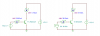
Well I think we can do both, drive it with a voltage source or a current source. Only one of these methods shows the true controlling factor.
Adam

I and V 2N222A.PNG
 

Ratch

Mar 10, 2013
1,102
Joined
Mar 10, 2013
Messages
1,102
Well I think we can do both, drive it with a voltage source or a current source. Only one of these methods shows the true controlling factor.
Adam

View attachment 17873

Neither of those circuits show what is controlling the BJT. You have to get involved with the physics of the BJT to do that. Those two circuits are just that, two circuits.

Ratch
 

Arouse1973

Adam
Dec 18, 2013
5,178
Joined
Dec 18, 2013
Messages
5,178
Well the fact that without a voltage you wouldn't have a current would you? So if you increase the current the Vbe would increase. Apart from resistance changes, current is a direct result from applied voltage. Voltage is the controlling factor in it all. If you control the current you are effectively controlling the voltage are you not?
Adam
 

Arouse1973

Adam
Dec 18, 2013
5,178
Joined
Dec 18, 2013
Messages
5,178
Now how do you make the transistor work, i.e., do anything useful, with its base held at a constant voltage?

Well you could wiggle the voltage from say 0.6 to 0.7 volts and wouldn't you get a change in collector current?
Adam
 

LvW

Apr 12, 2014
604
Joined
Apr 12, 2014
Messages
604
Yes I like that one Ib is an indication of collector current.
Adam
I like it too. Much better (and clearer) than "current gain". Do you know that we find the term "current gain" also in some FET datasheets? Crazy...
 

KrisBlueNZ

Sadly passed away in 2015
Nov 28, 2011
8,393
Joined
Nov 28, 2011
Messages
8,393
That interpretation is likely referring to the definition of DC current gain: hFE=IC/IB.
I see that. The important distinction is whether IB causes IC (through multiplication by hFE), in which case it's most meaningful to say IC = IB × hFE, or whether IB is not essential for the transistor's operation and is a by-product of it, as a roughly constant fraction of IC, in which case it's most meaningful to say IB = IC / hFE.
 
  • Like
Reactions: LvW

Merlin3189

Aug 4, 2011
250
Joined
Aug 4, 2011
Messages
250
Wow! I just pop off for a turkey, a few bottles of wine and a mince pie, then I come back to this!
Well there have been so many points made that I can't air my ignorance on all of them (but I expect there'll be plenty of chance later!), so can I just ask a question?
Sometimes I think that there is a Vbe of about 0.7V, or 0.6V, or about half a Volt, but a lot of the time, if the supply is 9V or 12V or 15V or more, I totally ignore Vbe. And I'd always assumed Vbe was FIXED at whatever the correct value is - though I now know from your comments is wrong. And this seems to work for the simple circuits I build. (*)
So the question I would like to ask of all readers is, "have you EVER thought about setting Vbe precisely or thought about delta Vbe in designing a circuit?"
I guess there are some pro designers here who would say yes, but I can hand on heart say, "No, never" and I'd bet that's true for most amateurs and therefore for people like OP who just want to know how a transistor WORKS (in a circuit.)

(*) Can't resist commenting on LzW's comment that he's talking about transistors on their own, not transistors in circuits. I'm pretty sure that transistors don't do anything at all unless they are in a circuit.
I sat and watched one for ages today and as far as I could see, it did nothing. Then I realised, of course, that the transistors in my radio LOOK as if they're doing nothing, even though I can hear that they are. So I realised I needed to look at them with a meter or an oscilloscope to see what they are doing .... but that would be a circuit! So how can I find out whether transistors do something if they're not in a circuit?
 

Ratch

Mar 10, 2013
1,102
Joined
Mar 10, 2013
Messages
1,102
="Arouse1973, post: 1636882, member: 33717"]Well the fact that without a voltage you wouldn't have a current would you?

No, not a sustainable current. The current would stop when the uncovered charges from the diffusion process attained a high enough back-voltage.

So if you increase the current the Vbe would increase.

The only way you can increase the current is to increase the Vbe. That is self defining.

Apart from resistance changes, current is a direct result from applied voltage.

In the case of a BJT, current is the direct result of diffusion. Vbe controls the diffusion, so current is a secondary result of Vbe.

Voltage is the controlling factor in it all. If you control the current you are effectively controlling the voltage are you not?
Adam

That means you are driving the BJT with a current source, which applies a voltage to the BJT. Because the current source contains a resistance external to the BJT, you now have a circuit, not just a "naked" BJT.

Ratch
 

Ratch

Mar 10, 2013
1,102
Joined
Mar 10, 2013
Messages
1,102
Wow! I just pop off for a turkey, a few bottles of wine and a mince pie, then I come back to this!
Well there have been so many points made that I can't air my ignorance on all of them (but I expect there'll be plenty of chance later!), so can I just ask a question?
Sometimes I think that there is a Vbe of about 0.7V, or 0.6V, or about half a Volt, but a lot of the time, if the supply is 9V or 12V or 15V or more, I totally ignore Vbe. And I'd always assumed Vbe was FIXED at whatever the correct value is - though I now know from your comments is wrong. And this seems to work for the simple circuits I build. (*)
So the question I would like to ask of all readers is, "have you EVER thought about setting Vbe precisely or thought about delta Vbe in designing a circuit?"
I guess there are some pro designers here who would say yes, but I can hand on heart say, "No, never" and I'd bet that's true for most amateurs and therefore for people like OP who just want to know how a transistor WORKS (in a circuit.)

I never said, and I don't think anyone else did either, that you should be concerned about the miniscule changes that occur in Vbe when large changes happen Ic. Setting the voltage across Re determines the current in Ic and Vbe takes care of itself. Just set the Vb bias around 0.7 volts higher to compensate for the static Vbe drop. As for the last question, I said before that in the active region, the BJT acts like a transconductance amplifier. If you have any questions about this, read this thread again carefully.

(*) Can't resist commenting on LzW's comment that he's talking about transistors on their own, not transistors in circuits. I'm pretty sure that transistors don't do anything at all unless they are in a circuit.
I sat and watched one for ages today and as far as I could see, it did nothing. Then I realised, of course, that the transistors in my radio LOOK as if they're doing nothing, even though I can hear that they are. So I realised I needed to look at them with a meter or an oscilloscope to see what they are doing .... but that would be a circuit! So how can I find out whether transistors do something if they're not in a circuit?

We are talking about a practical functional circuit like a current amplifier, voltage amplifier, transconductance amplifier, or transresistance amplifier. We consider a transistor with only a voltage source connected to the base-emitter terminals and another voltage source connected up between the base-collector terminals to be a test circuit with no practical function. If additional passive components like resistors, coils, or capacitors are added, then the circuit becomes practical for some application, and the transistor's behavior cannot be isolated any more. The practical circuit must then be analyzed as a whole.

Ratch
 
Status
Not open for further replies.
Top