how can I create a positive logic pulse from a steady high input?

Old Steve

Jul 23, 2015
734
Joined
Jul 23, 2015
Messages
734
Two gates of a 4093 can be used as a set-reset flip flop, then the two remaining gates could be used in series to provide the Schmitt trigger buffer for the positive pulse to the S-R 'set' input
 

Old Steve

Jul 23, 2015
734
Joined
Jul 23, 2015
Messages
734
I just grabbed a bit of paper and was going to roughly draw it up working from your schematic when it disappeared??? Can't do it now.

Now no one will have any idea what I was talking about in my last two posts.
 

Skidood

Aug 24, 2015
35
Joined
Aug 24, 2015
Messages
35
That would work. To cut the component count still further, you could remove the oscillator and the AND gate, drive an NPN transistor from the S-R flip-flop's Q output and have it switch a buzzer that beeps on and off automatically, something like this one:-
http://www.altronics.com.au/p/s6112-3-15v-pulsating-tone-piezo-chassis-mount-buzzer/

Something I noticed is that in this version, the alarm won't trigger if a sensor wire breaks or becomes disconnected.

You could also replace the OR gate with two diodes followed by a tie-down resistor.

And a single NPN transistor could replace the inverter.

Now the only IC would be the S-R flip-flop.

Steve, I deleted the post with the circuit drawing you are referring to, sorry, I realized I needed to make a couple changes. I havent really woken up yet.
I am reworking it, and will re-post...
 

Skidood

Aug 24, 2015
35
Joined
Aug 24, 2015
Messages
35
Here...I appreciate very much your input regarding the other ways to implement the same circuit using different types of components...those comments will definitely influence how I end up building it.
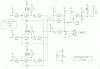
alarm schema-mine.png
 

AnalogKid

Jun 10, 2015
3,045
Joined
Jun 10, 2015
Messages
3,045
Ran into a small logic issue. What happens if an alarm happens, you hit the silence button, then another alarm happens before the first alarm input line returns to the safe state? My guess is that you want the alarm to go off again. This changes the set circuits. More later.

Also, in post #13 you said the inputs had 47K pull DOWNs and go low on alarm.

ak
 

Skidood

Aug 24, 2015
35
Joined
Aug 24, 2015
Messages
35
Ran into a small logic issue.

1. What happens if an alarm happens, you hit the silence button, then another alarm happens before the first alarm input line returns to the safe state? My guess is that you want the alarm to go off again. This changes the set circuits. More later.

2. Also, in post #13 you said the inputs had 47K pull DOWNs and go low on alarm.

ak
Thanks.

1. Good point but I actually don't care if that scenario occurs. The purpose of the system (for my application) is just to alert when any one of the monitored supplies goes down..if a 2nd one goes down, it is pretty well irrelevant at that point......your point is worthy, but the extra complexity and functionality is not necessary.

2. Yes I know ...needed design change ...sorry...,
 

Skidood

Aug 24, 2015
35
Joined
Aug 24, 2015
Messages
35
Just to add, I will see if I can eliminate the AND gate by using the high output from the flip flop and connect it to the RESET pin on the 555 oscillator...I think this will work as the reset pin is normally tied high when you configure a 555 as astable clock generator...pretty sure it doesnt do anything when the reset pin is low.
I dont really want to use the self-pulsed beeper .
alarm schema-mine.png
 

Skidood

Aug 24, 2015
35
Joined
Aug 24, 2015
Messages
35
That trick worked...so I now am truly down to just the flip flop as I will use the diodes instead of OR gate and the transistor instead of inverter as OldSteve suggested.
 

AnalogKid

Jun 10, 2015
3,045
Joined
Jun 10, 2015
Messages
3,045
First pass at the alarm circuit. Remember when I said the circuit could be designed with just about anything? This is what happens when I'm bored at work.

All active components are sections of two ULN2004 darlington transistor arrays. I've used it as a logic device many times in industrial situations because the little puppy is just about indestructible. Except for the LEDs and beeper, every part on the schematic is rated for 50V operation. Plus, the inputs have current limiting and reverse polarity transient protection built in.

There are four pulse formers, one latch, one oscillator, and a power-on reset. The three input pulse formers are OR-ed together to set the latch and sound the alarm. They also are AND-ed together into a fourth pulse to reset the latch and quiet the alarm. This covers a logic condition in a previous post. With every alarm there is a time period when the alarm is silenced with the Reset button but the alarm condition has not yet been cleared. If another alarm comes in on a different line, this system starts beeping again. This is the advantage of three input pulse formers - no alarms are lost or masked. OTOH, you said you wanted the system to quiet itself if an alarm condition cleared itself before intervention. Because there could be two overlapping alarm conditions, I figured you'd want the system to quiet itself only if all lines were clear. That is why the three inputs are AND-ed into the reset pulse former. The oscillator freq is 1 sec. The beeper and LED are 1/2 sec. on, 1/2 sec. off. Oops, the oscillator components are selected for a 12 V battery.

A circuit like this is easier to build than it appears. Most of the resistors can be commoned together into 1 K and 10K resistor networks. I'll probably fiddle with some of the component values, but this is the basic plan.

ak
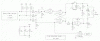
PressureAlarm-3-ch.gif
 

Attachments

  • PressureAlarm-3-c.pdf
    16.8 KB · Views: 62
Last edited:

Skidood

Aug 24, 2015
35
Joined
Aug 24, 2015
Messages
35
Holy cow..very impressive..!! If I built that and it worked first time out, I would be shocked, I can't even get my flip flop working properly right now..I think i smoked it...thanks so much for this.
 

AnalogKid

Jun 10, 2015
3,045
Joined
Jun 10, 2015
Messages
3,045
Yeah, I thought it might scare you. Don't panic, that was just me fooling around. BTW on your diagrams are two grey boxes, Trigger and Silence. Are these the pulse forming circuits or something else?

ak
 

Skidood

Aug 24, 2015
35
Joined
Aug 24, 2015
Messages
35
Just a followup-

Old Steve, I am going to use a 4093 as you suggested to make another F-F (mine is toasted, I stupidly reversed the polarity of the supply and ground and I dont think it appreciated that since it rewarded me with an acrid odor.

Analog, have you ever noticed that Peart's drumming "riff" during the chorus of Digital Man (while Lee is singing "He's got a force field and a flexible plan" is virtually the same as that during the chorus of My Hero by the Foo Fighters? Since I used to listen to Rush A LOT, I picked up on it right away when the Foo Fighters tune came out. Rush was the first concert I ever attended...and BTW, in case you are in the Cleveland area, I grew up right across Lake Erie from there, watching WEWS and other over-the-air TV stations. Thank God, cuz we only got about 4 TV stations then, American programming was so much better, and generally still is....I digress...and that particular word reminds me, if you are looking for some new rock music, I STRONGLY recommend the new album "Ghosts" by Big Wreck.
 

AnalogKid

Jun 10, 2015
3,045
Joined
Jun 10, 2015
Messages
3,045
OK, this probably is more like what you envision your circuit to be. It does not have the logical tightness of the previous post, but it covers the basics.

Note that there are two output stages. Either connect the high side of the alarms to the 555 and the low side to GND, or the low side to the FET and the high side to Vcc (and eliminate the 555).

ak
PressureAlarm-4-ch.gif
 

Attachments

  • PressureAlarm-4-c.pdf
    20 KB · Views: 75

Skidood

Aug 24, 2015
35
Joined
Aug 24, 2015
Messages
35
Excellent..!! I will keep the 555 as I want to pulsate the beeper.
-is there any way you can post a BMP or TIFF or PNG or JPEG? (or email to [email protected]) If not, no big deal.
-I can now appreciate your love for those nifty Darlington arrays. I may use them to drive the RED LEDs which "monitor" the individual inputs (high on alarm). the green ones can simply be driven by the input's ground connection (thru the switches) and Vcc.

Thanks again !!
 

AnalogKid

Jun 10, 2015
3,045
Joined
Jun 10, 2015
Messages
3,045
The posted image is a GIF, which any graphics program can handle. GIF files do not show compression artifacts the way JPGs do, especially with fine line drawings.

If you are committed to using the external switch to ground to complete the input LED indications, there is a circuit trick that gets you Red/Green indications with NO drivers. I'll post that later.

I think you misunderstood. Output option 2 pulses the beeper exactly the same as with a 555, but it uses the 4th NAND gate as the oscillator, saving the cost and complexity of another chip. Hysteretic gates have all kinds of fun inside.

ak
 

Old Steve

Jul 23, 2015
734
Joined
Jul 23, 2015
Messages
734
OK, this probably is more like what you envision your circuit to be. It does not have the logical tightness of the previous post, but it covers the basics.

Note that there are two output stages. Either connect the high side of the alarms to the 555 and the low side to GND, or the low side to the FET and the high side to Vcc (and eliminate the 555).

ak
View attachment 21744

Wow, this thread's been busy. For some reason I've stopped getting alerts and email notifications for some of the threads I'm involved in, including this one.

This circuit is more what I was thinking of. Looks good.

Skidood, how come you don't want to use a self-pulsing buzzer/beeper? It would simplify things even more.
 

Skidood

Aug 24, 2015
35
Joined
Aug 24, 2015
Messages
35
The posted image is a GIF, which any graphics program can handle. GIF files do not show compression artifacts the way JPGs do, especially with fine line drawings.

If you are committed to using the external switch to ground to complete the input LED indications, there is a circuit trick that gets you Red/Green indications with NO drivers. I'll post that later.

I think you misunderstood. Output option 2 pulses the beeper exactly the same as with a 555, but it uses the 4th NAND gate as the oscillator, saving the cost and complexity of another chip. Hysteretic gates have all kinds of fun inside.

ak

OK yes I right-clicked on the image this time...I had previously been downloading the file which comes as PDF.
I didn't realize that 4th NAND gate was an oscillator!


Wow, this thread's been busy. For some reason I've stopped getting alerts and email notifications for some of the threads I'm involved in, including this one.

This circuit is more what I was thinking of. Looks good.

Skidood, how come you don't want to use a self-pulsing buzzer/beeper? It would simplify things even more.
Well, call me old-school, but I just plain don't trust it to be as reliable as reliable as a normal piezo beeper, plus I don't like the higher profile..the one I have here is pretty flat.

I breadboarded the pulse generator/Schmitt trigger and the NAND gate flip flop , it works properly....BUT I had to remove the connection between R4 and Pin 13 and put a pull-up resistor on Pin 13 before it would latch properly.
Unfortunately it wont turn off the beeper if the incoming alarm condition clears up on its own...not sure that's a huge problem. I am going to muddle around some more...
I also went to a 1 uF cap instead 0.1 on the Schmitt trigger input. This gave me a pulse that lasted around 50-60 mS as opposed to around 5, but I kinda doubt that was necessary...5 mS on the set input should be long enough for the FF to flip, right?? Also I wonder if using a 1 uF would create too much instantaneous current draw on the relevant diode right before it when an input goes high....
 
Last edited:

Old Steve

Jul 23, 2015
734
Joined
Jul 23, 2015
Messages
734
You don't have to worry about reliability of pulsing buzzers. They're as reliable as anything else. After all, the buzzer already has internal drive circuitry, otherwise it would need a drive frequency to make any sound at all, rather than simply applying DC. Fair enough if size is an issue though.

Now, the more serious problem. It's a small fault in the logic that AK overlooked. You found the right fix immediately, (your logic skills must be improving), but as you say, it won't reset now if the fault disappears.
I'm just looking to see what can be done about that. (But you might come up with an answer first - I'm doing several other things at the same time. I just bought a new Li-ion battery for my electric bike, and need to modify the mountings to make it fit.)

An inverter after R4, followed by a series resistor, is what immediately comes to mind but I haven't thought it right through yet.
No, that won't do, will it?
 
Last edited:

Old Steve

Jul 23, 2015
734
Joined
Jul 23, 2015
Messages
734
What about a series diode, with it's cathode toward R4? Again, not fully thought out.
And still using a pullup R on pin 13.
 
Top