Ni-MH charging circuit query

Cirkit

Oct 28, 2015
155
Joined
Oct 28, 2015
Messages
155
I am trying to work out how a charging circuit for a Ni-MH battery pack is operating and determine why there are powder deposits on one of the terminals of the cells of the battery pack. I have been told that the unit is new so I'm surprised that one of the cells has powder on the positive contact - perhaps due to overcharging? The 4.8V battery pack consists of 3 x AAAs in series.

The charging circuit is essentially a zener diode and J3Y transistor. The anode of the zener is connected to ground and the cathode is connected to a 100 Ohm resistor. The other end of the resistor is the input voltage of ~7.7V which is also connected to the collector of the J3Y transistor. The cathode of the zener is connected to the base via a 0 Ohm resistor.

The voltage to the base is ~6.3V and the voltage at the emitter (battery positive terminal) is ~5.6V.

There is some sense circuitry on the input and battery positive rail based around an ST 393 connected via potential divider resistors. The outputs go to what looks like a microcontroller of some sort. Possibly to flash the charging bi-colour LED and indicate when the battery is charged?
 
Last edited:

BobK

Jan 5, 2010
7,682
Joined
Jan 5, 2010
Messages
7,682
The powder is probably due to overcharging and venting.

First of all, 3 NiMH cells is 3.6V not 4.8V.

And it seems to be connected to a 5.6V constant voltage source (the zener + tratnsistor), which is horrible, the current needs to be controlled for proper charging.

Bob
 

Audioguru

Sep 24, 2016
3,656
Joined
Sep 24, 2016
Messages
3,656
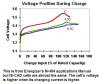
The charging voltage of a Ni-MH cell depends on the amount of charging current. Here is from the datasheet if an Energizer Ni-MH cell:
 

Attachments

  • Ni-Cad and Ni-MH voltage.PNG
    Ni-Cad and Ni-MH voltage.PNG
    25.8 KB · Views: 113

Cirkit

Oct 28, 2015
155
Joined
Oct 28, 2015
Messages
155
The powder is probably due to overcharging and venting.

First of all, 3 NiMH cells is 3.6V not 4.8V.

And it seems to be connected to a 5.6V constant voltage source (the zener + tratnsistor), which is horrible, the current needs to be controlled for proper charging.

Bob

Sorry, I meant to say 4xAAA's in series. It's a 3xAAA pack and a single AAA connected together.

I thought the sense circuitry would regulate the charging too but it seems that the base is driven by the zener voltage so there is no chance of that?

Would it be worth adding a resistor in series to reduce the charge current?
 

BobK

Jan 5, 2010
7,682
Joined
Jan 5, 2010
Messages
7,682
What is the source of the 7.7V going into the regulator? Perhaps the current is limited at the source. Is this a transformerless supply where the current might be limited by a capacitor?

Bob
 

Cirkit

Oct 28, 2015
155
Joined
Oct 28, 2015
Messages
155
What is the source of the 7.7V going into the regulator? Perhaps the current is limited at the source. Is this a transformerless supply where the current might be limited by a capacitor?

Bob

The 7.7V source consists of a cheap SMPS with a rectifier diode and 4.7 Ohm resistor in series from one of the terminals of the secondary output on the transformer. This is the positive charge output terminal to the unit. There is also an electrolytic and ceramic capacitor across the positive and other transformer terminal (negative charge output).
 

BobK

Jan 5, 2010
7,682
Joined
Jan 5, 2010
Messages
7,682
The 4.7Ω resistor would limit the current. At 1A it would drop 4.7V bringing the voltage down to 3.0, which would not give you much charge current, so I think it probably limits the current to well below 1A which might be enough (AA sized NiMH cells should be able to take 1A charging current) but the condition of the batteries says otherwise...

Bob
 

Audioguru

Sep 24, 2016
3,656
Joined
Sep 24, 2016
Messages
3,656
Recently I bought eight Duracell AA Ni-MH batteries at a Black Friday sale and they came with a "free" charger. The charger box says "Fastest Smart Charger" and it charges very fast. It says on it that its fast charge current is 1550mA (2 cells) and its slow current is 775mA (4 cells). Its charging current for AAA cells is 775mA for 2 cells and is 388mA for 4 cells and it did not vent my very cheap Chinese Ni-NH cells from my solar garden lights.
 

Cirkit

Oct 28, 2015
155
Joined
Oct 28, 2015
Messages
155
The 4.7Ω resistor would limit the current. At 1A it would drop 4.7V bringing the voltage down to 3.0, which would not give you much charge current, so I think it probably limits the current to well below 1A which might be enough (AA sized NiMH cells should be able to take 1A charging current) but the condition of the batteries says otherwise...

Bob

The ~7.7V is measured after the diode and resistor which is then supplied to the unit. The batteries are AAA rather than AA.
 

Audioguru

Sep 24, 2016
3,656
Joined
Sep 24, 2016
Messages
3,656
My new Duracell charger charges AAA Ni-MH cells fast at 775mA or slow at 388mA. It is a "smart" charger and it detects fully charged then shuts off the charging and lights a green LED.
 

Cirkit

Oct 28, 2015
155
Joined
Oct 28, 2015
Messages
155
I have replaced the entire pack and measured the charge current at 136mA.
 

BobK

Jan 5, 2010
7,682
Joined
Jan 5, 2010
Messages
7,682
If the batteries are venting though, it is not because there is too much charge current, but that the current continues after the battery is fully charged. Measure the current after the battery has been on the charger for 4 hours or more. If that is more than about 50mA, there is a problem.

Bob
 

Audioguru

Sep 24, 2016
3,656
Joined
Sep 24, 2016
Messages
3,656
The battery heats and increases its internal pressure when it continues over-charging. A trickle charge after it is fully charged is supposed to be limited to 1/40th its mAh rating. The charger is supposed to detect a full charge then shut off or switch to a low current trickle charge.

I think that cheapo batteries at The Dollar Store are already venting (leaking) before they are sold.
 

Cirkit

Oct 28, 2015
155
Joined
Oct 28, 2015
Messages
155
Thanks for your replies. The charging circuit just seems to consist of the transistor as a constant voltage source as described above. I do not think it regulates the current once the pack is fully charged?
 

BobK

Jan 5, 2010
7,682
Joined
Jan 5, 2010
Messages
7,682
The current is not regulated, but it will reduce as the batteries get closer to charged. It is definitely not a smart charger and I think the batteries probably vented because the trickle current was too high at end of charge.

Bob
 
Top