In need of direction...

Alln3w2m3

Jun 21, 2023
2
Joined
Jun 21, 2023
Messages
2
I have a small project that I've wanted to build for a while but I'm not quite sure where exactly to start. It's probably already been done several times and I'm just wanting to package it differently. I want a battery power light with a simple delay-ON via a clickable switch (pressing again turns it off). I'd like it to run off a CR123 in some way since I have a lot of them. Something in the 200-300 lumens would be great. Beyond that, I'm at a loss on where to begin. I have a couple books I've been studying but they are a bit advanced for what I'm doing. Any help would be appreciated.
 

AnalogKid

Jun 10, 2015
3,045
Joined
Jun 10, 2015
Messages
3,045
How long a delay?

User-adjustable?

Led part number / datasheet

The switch action you describe is called alternate-action. This can be done mechanically in the switch, of with an electronic circuit that takes closures from an ordinary momentary switch and produces a signal that toggles on and off.

ak
 

Alln3w2m3

Jun 21, 2023
2
Joined
Jun 21, 2023
Messages
2
How long a delay?

User-adjustable?

Led part number / datasheet

The switch action you describe is called alternate-action. This can be done mechanically in the switch, of with an electronic circuit that takes closures from an ordinary momentary switch and produces a signal that toggles on and off.

ak
3 to 5 second delay. User adjustable would be cool to know how, but a fixed delay will work fine.

I honestly don't know about the LED info. Presumably I'd use whatever I needed to achieve the output for the desired run time (1.5-2 hours). I'd like it all to fit a reasonably small package, something similar to an average flashlight.
 

AnalogKid

Jun 10, 2015
3,045
Joined
Jun 10, 2015
Messages
3,045
The delay part can be as simple as 1 resistor, 1 capacitor, and 1 small MOSFET.

But

The light will not snap on after the delay, it will come on slowly enough to see that it is coming on slowly. If you want it to snap on crisply after the delay, then for a simple one-off project I would go with a 555.

Now, about that alternate-action part.

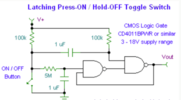
Electronically, this is a toggle flipflop, and the output drives a small MOSFET as above because most CMOS gates cannot drive a load with 20 mA (a typical LED operating current). Here is a typical toggle circuit using NAND gates:

1687360712030.png

This drives and R-C delay (another gate), and that output drives the MOSFET. So all of this fits in one quad gate package. Because the delay time is so long, use a CD4093 instead of the 4011. The 4093 has Schmitt trigger inputs that prevent output noise bursts with slowly-changing waveforms such as a 3 second R-C ramp voltage.

ak
 
Top