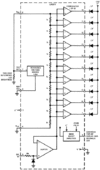
Actually I think for me it's easier for me to use a mic and a pre-amplifier then drive a row of bar graph LED's using an LM3914,
and then after that, put a filter inand try to get that to work at the specified frequency, say 45Hz, make another filter for column two and so on. The reason I am not doing the FFT and muxing is because nobody could tell me how to get it to work with the code I supplied to alter and modify for my needs and so I'm following the advice from anouther member who says this:
step-by-step approach.
build a signal amplifier that picks up the aufio signal from the source you are going to use (microphone, line-i, ...?) and amplifies it to a level the LM3914 can handle. You'll probably have to learn a lot while building tjis circuit. Opamps are deceptively simple when you look at the standard circuits, but opamps can nevertheless be tricky to handle when it comes to the fine details like e.g. stability of the amplifier without ringing or, worse, self-oscillation due to improper feednack circuits.
Build a single channel VU-meter to display the signal from the amplifier by the LM3914 in a way that pleases your estetics.
If necessary (very probable) debug these circuits and tweak components until it operates as your expect.
Build a first single filter e.g. for the bass range. Insert the filter into your signal chain and check that the response displayed by the LM3914 matches your expectations, which in this case should be a display of the bass tones' volume only.
Once this works go on and build the remaining filters and display circuits for the remaining channels. You may even consider designing a modular PCB with filter and display circuit which is customized to different frequencies by populating the filter with different components. The have 20 or so of these PCBs manufactures (not so expensive nowadays). The simply assemble the PCBs (solder components to them) and combine with power supply and signal amplifier (step 1 from above list) for the full spectrum analyzer.
In my opinion your chances to complete this project to your satisfaction are much better using such (or similar) modular approach.
That being said I am still open to suggestion, if you can come up with arduino code, or modify the one I suggested earlier, I have got esp32 dual-core arduino powerful enough and I have two T74LS257BI 88506 multiplexer chips. I have also ordered some quad-op-amps (TL074) I'm going to be using 16 columns by 20 rows. can you get the LM3914's to work with multiplexing? and back to the original question is it possible to split the current between regulators from a battery?
and then after that, put a filter inand try to get that to work at the specified frequency, say 45Hz, make another filter for column two and so on. The reason I am not doing the FFT and muxing is because nobody could tell me how to get it to work with the code I supplied to alter and modify for my needs and so I'm following the advice from anouther member who says this:
step-by-step approach.
build a signal amplifier that picks up the aufio signal from the source you are going to use (microphone, line-i, ...?) and amplifies it to a level the LM3914 can handle. You'll probably have to learn a lot while building tjis circuit. Opamps are deceptively simple when you look at the standard circuits, but opamps can nevertheless be tricky to handle when it comes to the fine details like e.g. stability of the amplifier without ringing or, worse, self-oscillation due to improper feednack circuits.
Build a single channel VU-meter to display the signal from the amplifier by the LM3914 in a way that pleases your estetics.
If necessary (very probable) debug these circuits and tweak components until it operates as your expect.
Build a first single filter e.g. for the bass range. Insert the filter into your signal chain and check that the response displayed by the LM3914 matches your expectations, which in this case should be a display of the bass tones' volume only.
Once this works go on and build the remaining filters and display circuits for the remaining channels. You may even consider designing a modular PCB with filter and display circuit which is customized to different frequencies by populating the filter with different components. The have 20 or so of these PCBs manufactures (not so expensive nowadays). The simply assemble the PCBs (solder components to them) and combine with power supply and signal amplifier (step 1 from above list) for the full spectrum analyzer.
In my opinion your chances to complete this project to your satisfaction are much better using such (or similar) modular approach.
That being said I am still open to suggestion, if you can come up with arduino code, or modify the one I suggested earlier, I have got esp32 dual-core arduino powerful enough and I have two T74LS257BI 88506 multiplexer chips. I have also ordered some quad-op-amps (TL074) I'm going to be using 16 columns by 20 rows. can you get the LM3914's to work with multiplexing? and back to the original question is it possible to split the current between regulators from a battery?
Last edited: