Need simple overvoltage protection - can I use a 7805?

Sidecar Bob

Dec 19, 2021
268
Joined
Dec 19, 2021
Messages
268
You may have seen my recent portable stereo rebuild project
Using one of these modules

That one is powered by a USB power bank and is working nicely.

But I was installing another small stereo built around one of these modules (this time with external speakers) today and when I connected it to a 12V supply the smoke got out. Literally. I opened it up and found the 4004A (voltage doubler) had turned to charcoal.
I re-read the specs and realized that it specifies a supply voltage of 3.7 to 5V
I've ordered another module (this was plainly my fault).

I would like to protect the next one from possible connection of a higher voltage power supply. I started off thinking about zener diodes but then thought it might be easier to use an LM7805.

Could it be as simple as this (found in a very old thread on this forum)?
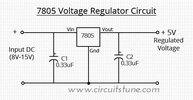
7805-Voltage-Regulator-Circuit-Diagram.jpg
 

Delta Prime

Jul 29, 2020
2,987
Joined
Jul 29, 2020
Messages
2,987
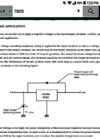
Application circuits page 16 of the data sheet..photo_1720751268530.png
 

Attachments

  • KIA7805AP (1).PDF
    155.7 KB · Views: 1

Sidecar Bob

Dec 19, 2021
268
Joined
Dec 19, 2021
Messages
268
So basically the schematic I posted with a diode added between input and output for protection? Can I use a 1N400X for that?
 

Harald Kapp

Moderator
Moderator
Nov 17, 2011
14,271
Joined
Nov 17, 2011
Messages
14,271
Can I use a 1N400X for that?
Definitely.

But if your gadget is going to be battery-powered and you want to increase operating time from a single battery charge, use a step-down converter (module) instead.
I can't access the link to the module from your post #1, but assuming 100 mA current draw, the 7805 will dissipate [imath]P = (12 V - 5 V) × 100 mA = 700 mW[/imath]. The 7805 will need a small heat sink and those 700 mW are lost as heat.
A step-down module with a moderate efficiency of say 90 % will dissipate only 55 mW. No cooling required, 645 mW saved for longer battery endurance.
 
Last edited:

danadak

Feb 19, 2021
1,063
Joined
Feb 19, 2021
Messages
1,063
Protecting 3 Terminal regulators :


The above discusses protecting the regulator, eg. function of various diodes.

Note you are trying to protect the module I gather. So "normally" protection
would be at the load, although one can use Zener at input to regulator. However
as being discussed there is no current limit used for the Zener, so possible to
fry it. 3 terminal regulators have an output transient response where their output
can temporarily transient, bit its generally not an issue. See graphs in datasheet
of response.

There are techniques to crowbar a supply to a load that will either blow a fuse or
can be reset after over voltage ends. Google "crowbar over voltage protection",
many hits and circuits.


You can get 3 terminal regulators with higher input protection, somewhere in range of
50 - 60 V. Go to digikey or similar supplier and use their search tools to pick Vinmax.

An old handbook but still good ap notes :


Regards, Dana.
 
Last edited:

Sidecar Bob

Dec 19, 2021
268
Joined
Dec 19, 2021
Messages
268
The device is a class D stereo amp with FM receiver and MP3 player, rated at 3W per channel.
I'm not sure why the link in post #1 doesn't work but this one should be OK

Running from a USB power bank and playing through tiny speakers the similar module in the portable stereo draws a max of 0.35A when playing louder than I normally prefer (perhaps a bit more on transient peaks in the audio that are shorter than the digital ammeter's sampling rate can measure).
This one will be playing into much larger (= more efficient) speakers so it should draw less.
At any rate it should be safe to assume less than 0.5A 99% of the time so heat dissipation in the 7805 shouldn't be a problem.

I'm not concerned about protection for the one that is battery (power bank) powered as it is connected to the battery by a USB plug. Battery longevity isn't an issue either; I've been using the same two 5300 mAh power banks since I put my original portable stereo together in 2020 and a charge lasts over 8 hours (I usually swap batteries when it is down to one indicator light).

This one (& another I have planned) will always be powered by a plug in power supply. I should be able to make sure that they are only used with suitable 5V supplies but mistakes happen and based on how fast the 4004A chip fried in this one I'd like to make sure it is protected.

While typing this I started to wonder if I could connect a flashing red LED somewhere in the circuit (between input & output perhaps?) to warn that the wrong power supply has been plugged into it.

But then it occurred to me that the simplest solution would probably be to just use USB ports for the power supply.
 

crutschow

May 7, 2021
984
Joined
May 7, 2021
Messages
984
But then it occurred to me that the simplest solution would probably be to just use USB ports for the power supply.
So are you going with that?

If you used a series regulator, such as the 7805, you must deal with the minimum voltage drop of the regulator which is about 2V, so that would not work with a 5V input.
You would need an LDO type regulator, some of which have a voltage drop of no more than a couple hundred mV.
 

Sidecar Bob

Dec 19, 2021
268
Joined
Dec 19, 2021
Messages
268
I only thought about using a 7805 because I have them on hand and could probably cobble up a circuit pretty quickly; I hadn't considered the voltage drop of the regulator. If I did I guess I could use a 7.5V or 9V power supply....

Thanks everyone for al of the help. I did learn a couple of things that may be useful later. And thanks to danadak for the voltage regulator handbook; I have downloaded it because I'm sure it will be useful to have.

The more I thought about it the more using a USB port sounded like the right solution so I had a look on Aliexpress to see if I could find something not terribly expensive that won't be too difficult to mount in a panel. The ones I ordered clip into a rectangular hope and even have wires with the correct connector to plug into the modules and were only $6.33 for 10 pcs.

Now about the module with the fried 4004a chip: These chips are not very expensive but un-soldering & re-soldering a6 pin SMDs is beyond my skill set.
I have attached what I believe is the appropriate datasheet and if I understand its function correctly it turns the 5V input into 10V to run the device. I wonder if it would be possible to bypass it and power that module with a 9V supply?
 

Attachments

  • HX4004A (the chip that fried).pdf
    217.9 KB · Views: 1
Last edited:
Top