Foot pedal speed control to handle pull switch?

Mystriss

Jan 2, 2025
6
Joined
Jan 2, 2025
Messages
6
Hello everyone, I'm a bit of a beginner, quite a bit of residential experience, got really into digital electronics and Arduino like 5 years ago, but then I got distracted by who knows what and never really got back to it, until now.

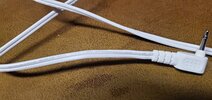
Long story short, I have a sewing machine that usually operates with a foot pedal; its an adjustable speed 3 wire setup; further you put the foot down, faster the machine goes, let foot off the pedal and it stops - but I am hoping to tinker up a squeeze handle to control the speed instead. I figured I could buy a second presser foot to pull out the PCB, 3.5mm jack cord/wiring, and any "other bits" that might be useful. I believe from my research on the thing it's probably 12v, could be 6v. When/if I order a second pedal I'll pop it open and get the Fluke on it. Though I do wonder if I could potentially just rig up something from scratch on a 3.5mm "extension" cable and just put a brick on the foot pedal.

I've only just started getting serious about this project in the past week, but I'm honestly not quite sure how to rig it up. I've worked with adjustable power/resistance -knobs-, but I'm not entirely sure what to even call a... "PWM handle" or "throttle handle switch" to even find what I'm looking for. The best thing I've come up with so far is a 3 wire ebike handle which might be useful, though the twist motion is probably not ideal, the other style were thumb controls (I think maybe I could convert a thumb paddle into a pull handle with some ducktape and a stick, but it sure wouldn't be pretty and probably not comfortable. Quilting takes hours to do, so thats not ideal either.)

Does anyone have time to help a noob out with this little project?

Thank you in advance!
 

Bluejets

Oct 5, 2014
7,374
Joined
Oct 5, 2014
Messages
7,374
Hello everyone, I'm a bit of a beginner, quite a bit of residential experience, got really into digital electronics and Arduino like 5 years ago, but then I got distracted by who knows what and never really got back to it, until now.

Long story short, I have a sewing machine that usually operates with a foot pedal; its an adjustable speed 3 wire setup; further you put the foot down, faster the machine goes, let foot off the pedal and it stops - but I am hoping to tinker up a squeeze handle to control the speed instead. I figured I could buy a second presser foot to pull out the PCB, 3.5mm jack cord/wiring, and any "other bits" that might be useful. I believe from my research on the thing it's probably 12v, could be 6v. When/if I order a second pedal I'll pop it open and get the Fluke on it. Though I do wonder if I could potentially just rig up something from scratch on a 3.5mm "extension" cable and just put a brick on the foot pedal.

I've only just started getting serious about this project in the past week, but I'm honestly not quite sure how to rig it up. I've worked with adjustable power/resistance -knobs-, but I'm not entirely sure what to even call a... "PWM handle" or "throttle handle switch" to even find what I'm looking for. The best thing I've come up with so far is a 3 wire ebike handle which might be useful, though the twist motion is probably not ideal, the other style were thumb controls (I think maybe I could convert a thumb paddle into a pull handle with some ducktape and a stick, but it sure wouldn't be pretty and probably not comfortable. Quilting takes hours to do, so thats not ideal either.)

Does anyone have time to help a noob out with this little project?

Thank you in advance!
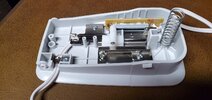
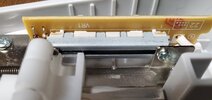
Show existing speed controller with case open.
Reason being older units can be 220v carbon stack design in series with the motor.
 

Mystriss

Jan 2, 2025
6
Joined
Jan 2, 2025
Messages
6
Show existing speed controller with case open.
Reason being older units can be 220v carbon stack design in series with the motor.

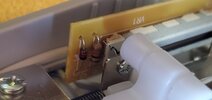
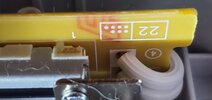
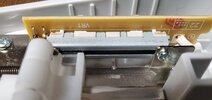
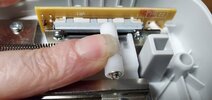
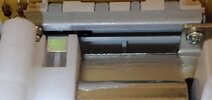
It's a newer machine, I was pretty sure it was electronically controlled and like 6V (power off the sewing machine rather than outlet) but after opening it IDK anymore. Does that look like a "mechanical" slider PWM? Like I've seen slider PWM switches before, but they always had clearly defined stops, this one is free sliding all the way up/down. (The last image would be showing the silver "tab" switch/slider activator?) I'm not sure I want to unscrew & take out the PCB because IDK if I could get it put back together with all the springs and bits connected to it. At least not until I have a second pedal anyway heh
20250102_134740.jpg20250102_140631.jpg20250102_134903.jpg20250102_135843.jpg20250102_135910.jpg20250102_134903.jpg20250102_134944.jpg20250102_140312.jpg
 

Mystriss

Jan 2, 2025
6
Joined
Jan 2, 2025
Messages
6
Brushing up on my noob skills a bit, VR at the top refers to the slider, probably voltage regulator in this case? I see there's a Diode and a resistor there, so I'm guessing it's like straight sending power down the 3.5mm cable yeah? VR regulates, through the resistor so it doesn't blow up the machine, diode says this is exit only? Machine gets sent straight up (though reduced) voltage and electronics in the machine deal with it from there? I'm guessing there's no signal wire in this setup, which shoots down a number of my ideas lol

Or actually, I guess I have it backwards sort-of... Power from machine, through the diode and resistor (so it doens't blow the PCB), to the regulator, then straight back to the machine?
 

Mystriss

Jan 2, 2025
6
Joined
Jan 2, 2025
Messages
6
Alright, I found a YouTube on a different style/brand foot and I was wrong, however, I "think" I know how it works at least. Power from machine, through diode, into variable resistor slider thing (not a voltage regulator - and I learned a new word too "Potentiometer"), then back to machine. So I should be able to, in theory, get a variable resister knob and put a twist handle on it to accomplish the proper circuit/control.

Seems to me then, that I need to find a variable resistor that is a push button, vs a slider style, yeah? Also, I'm not sure what R1 is doing exactly. I'll have to get a Fluke on it, but I think husband has ours at work so maybe tomorrow, then I can get values for the slider resistor and figure out which direction that diode is going for sure, and which side of the circuit the resistor 1 is on.

I guess I should have opened it up and sniffed around a bit more than I did before asking for help trying to figure out making the thing. On the plus side, I think I'm now at the point where I probably should have been to when I came here to ask questions HA
 

Bluejets

Oct 5, 2014
7,374
Joined
Oct 5, 2014
Messages
7,374
It's a variable carbon stack in series with the motor and will be same voltage rating as the motor, not 6v.

Best advice, given your lack of knowledge, , leave it alone.
 

Mystriss

Jan 2, 2025
6
Joined
Jan 2, 2025
Messages
6
It's a variable carbon stack in series with the motor and will be same voltage rating as the motor, not 6v.

Best advice, given your lack of knowledge, , leave it alone.
Well that's not very encouraging :( I guess I assume(d) that if I can work with house level voltages I could manage this.

So, then... Would an electrician be able to rig it up? Who would I call to make it for me then?
 

Bluejets

Oct 5, 2014
7,374
Joined
Oct 5, 2014
Messages
7,374
An experienced electrician would be a good start, yes.
Be aware there are some who only know how to wire a house with zero experience with motors and the like.
 

ivak245

Jun 11, 2021
143
Joined
Jun 11, 2021
Messages
143
If you can work out the resistance of the slide pot, remove it and replace it with a flying lead to a normal rotary pot of the same resistance. You could leave all the rest of the bits in the pedal housing, maybe block the pedal mechanically from moving. Just be careful and insulate everything that is mains potential.
 

Bluejets

Oct 5, 2014
7,374
Joined
Oct 5, 2014
Messages
7,374
If you can work out the resistance of the slide pot, remove it and replace it with a flying lead to a normal rotary pot of the same resistance. You could leave all the rest of the bits in the pedal housing, maybe block the pedal mechanically from moving. Just be careful and insulate everything that is mains potential.
"Normal" rotary pots of similar warrage would be like hens teeth........:rolleyes:
 

Harald Kapp

Moderator
Moderator
Nov 17, 2011
14,271
Joined
Nov 17, 2011
Messages
14,271
It's a variable carbon stack in series with the motor
How do you know? The connector at the end of the cable doesn't look like it is supposed to carry the full power of the motor. Also the sliding potentiometer doesn't look like a high power type. I strongly lean towards this being a low voltage/low power controller.
@Mystriss : Easy to check: measure the voltage across the sliding pot when it is set to "off" (but the machine being powered, naturally).
In that case the proposal by @ivak245 is perfectly viable.
 
Top