Fixing the Circuit for a DC Motor with Rechargeable battery?

AST

Feb 18, 2025
6
Joined
Feb 18, 2025
Messages
6
Hi friends of electronics

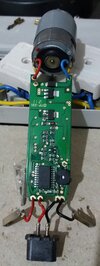
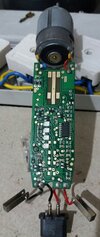
What you see in the attached pictures is a circuit for a DC motor with a rechargeable 3.6V battery (3 NiMH batteries in series).

When the Circuit was OK, its green LEDs lit up one at a time to show that the battery has charged more. But now that the circuit is flawed, LEDs light up this way: just the intensity of their light increases and decreases. When the light is more intensive, the voltage applied to the battery becomes 5.9, when the light is weaker, the voltage applied to the battery suddenly becomes 4.8 and decreases to 4.3; again the voltage becomes 5.9 and after a couple of seconds becomes 4.8 and decreases to 4.3, and so on and on (I took a video of the LEDs behaviour. Tell me to upload it if you need it). (I have another similar circuit which now works well, in which the voltage applied to the battery changes very very rapidly between 4.3 and 5.3 volts so that the digits on the voltmeter are hardly readable).

Another problem of the Circuit is that it is unable to run on battery alone (it only runs when the charger is plugged).

What is wrong with the circuit?
 

Attachments

  • Circuit (side A).jpg
    Circuit (side A).jpg
    173 KB · Views: 5
  • Circuit (side B).jpg
    Circuit (side B).jpg
    157.4 KB · Views: 5
  • video of LEDs' bahaviour.zip
    936.7 KB · Views: 2

ahsrabrifat

Jan 18, 2025
76
Joined
Jan 18, 2025
Messages
76
  • If you have a multimeter, please test the circuit with your meter. Measure the battery voltage without the charger. Measure it with the charger.
  • Inspect solder joints, especially on the battery terminals and LED circuit. Test if there is a broken trace in the board.
  • Look for burned or cracked components. If there's a capacitor near the charging circuit, replace it.
  • And if you are considering designing a new PCB by yourself and printing that, you can see here for potential cost estimation: https://www.allpcb.com/blog/pcb-ordering/pcb-cost-per-unit.html
 

Delta Prime

Jul 29, 2020
2,987
Joined
Jul 29, 2020
Messages
2,987
A single NiMH cell has a (nominal) or Standard Voltage of 1.2v.If you connect or stack, three cells in series, you get a battery pack with the nominal voltage of 3.6v & a maximum voltage of 4.5v.
How old are your batteries?
There are specific techniques of charging stages when charging a Nickel Metal Hydride battery.
From your,empirical evidence, observations and documentation of voltage values across the battery pack.
In the technique temperature sensing stage, the voltage will rise in your case 5.9v. when your battery pack has become fully charged you observed a drop in the voltage to 4.8v down to 4.3v.That raises the battery pack temperature rapidly as less of the charge source energy goes into actually charging of the battery pack, more of the energy turns into heat or I squared R losses do to battery chemistry which is the load your battery charger is connected to . The rapped increase of “temperature threshold “ the rate happens at roughly the same time as a decrease in voltage or from 5.9v to 4.8v ,4.3v & that is called Negative DeltaV. dT/dt threshold, 1°C/min.
Which is a fancy way of saying you have a bad charger. If your batteries are new..:)
 
Last edited:

Alec_t

Jul 7, 2015
3,817
Joined
Jul 7, 2015
Messages
3,817
Another problem of the Circuit is that it is unable to run on battery alone
The batteries are probably past their useful life and may have been damaged by a faulty charger.
 

AST

Feb 18, 2025
6
Joined
Feb 18, 2025
Messages
6
A single NiMH cell has a (nominal) or Standard Voltage of 1.2v.If you connect or stack, three cells in series, you get a battery pack with the nominal voltage of 3.6v & a maximum voltage of 4.5v.
How old are your batteries?
There are specific techniques of charging stages when charging a Nickel Metal Hydride battery.
From your,empirical evidence, observations and documentation of voltage values across the battery pack.
In the technique temperature sensing stage, the voltage will rise in your case 5.9v. when your battery pack has become fully charged you observed a drop in the voltage to 4.8v down to 4.3v.That raises the battery pack temperature rapidly as less of the charge source energy goes into actually charging of the battery pack, more of the energy turns into heat or I squared R losses do to battery chemistry which is the load your battery charger is connected to . The rapped increase of “temperature threshold “ the rate happens at roughly the same time as a decrease in voltage or from 5.9v to 4.8v ,4.3v & that is called Negative DeltaV. dT/dt threshold, 1°C/min.
Which is a fancy way of saying you have a bad charger. If your batteries are new..:)
what I described in the post #1, happens both with new and old batteries, and with two different special chargers for this circuit. All of the voltage changes I described in the post #1 happen with fully charged batteries. I have two similar circuits. In the other circuit that works well, both new and old batteries work well with both chargers.
 
Last edited:

AST

Feb 18, 2025
6
Joined
Feb 18, 2025
Messages
6
The batteries are probably past their useful life and may have been damaged by a faulty charger.
what I described in the post #1, happens both with new and old batteries, and with two different special chargers for this circuit. I have two similar circuits. In the other circuit that works well, both new and old batteries work well with both chargers.
 

AST

Feb 18, 2025
6
Joined
Feb 18, 2025
Messages
6
Next time start with that!
View attachment 65784

Post your two circuit schematics Please…
You said "Next time start with that!". My answer is that in the #1 post I mentioned the similar circuit.

You said "Post your two circuit schematics Please". My answer is that I do not have the schematic of these two circuits; I only have the PCBs. Will the pictures of the PCB of the second circuit be helpful?
 

poormystic

Jul 23, 2023
187
Joined
Jul 23, 2023
Messages
187
Hi AST and forum fellows :)
AST, it looks like your charger is faulty. You must have known that.
You could try fixing it, but my guess is that it's likely to be made of non-commercial parts.
It doesn't look cheap so I can see why you'd want to fix it. Personally, I'd soon conclude I was in for frustration, and flick it into the bin. Buhulious, I know.

What is the motor actually for, please?
 

AST

Feb 18, 2025
6
Joined
Feb 18, 2025
Messages
6
Hi AST and forum fellows :)
AST, it looks like your charger is faulty. You must have known that.
You could try fixing it, but my guess is that it's likely to be made of non-commercial parts.
It doesn't look cheap so I can see why you'd want to fix it. Personally, I'd soon conclude I was in for frustration, and flick it into the bin. Buhulious, I know.

What is the motor actually for, please?
Hello poormystic
Because of the following reason, it is highly unlikely that the fault is caused by the charger.
I have two similar circuits and two similar chargers, as I said in some of the above posts. One of the circuits works well but the other have the faults I described in #1 post. Both chargers work well with the good circuit, and the bad circuit work badly with both chargers.
 

Delta Prime

Jul 29, 2020
2,987
Joined
Jul 29, 2020
Messages
2,987
highly unlikely that the fault is caused by the charger.
And if there is a fault that we could pinpoint in your charger for a particular component that is easily replaceable and found on the Internet can you solder and solder that component?
I only ask because of the questions you ask.
Some of us give a educated guess given the information available because of our experience we ask questions to you to narrow it down for us the likelihood if it’s a battery fault or a charger fault and unfortunately, you’re just gonna have to buy a new one from a reputable maker of chargers for NiMH batteries.
Good luck to you! :)
It may be a misunderstanding on my part, or it may be a misunderstanding on your part or it may be both. Thank you..@Harald Kapp
But I know you’re not from Switzerland you’re so neutral.
My way of saying you are a consummate professional thank you for that!
 
Last edited:

AST

Feb 18, 2025
6
Joined
Feb 18, 2025
Messages
6
And if there is a fault that we could pinpoint in your charger for a particular component that is easily replaceable and found on the Internet can you solder and solder that component?
I only ask because of the questions you ask.
Some of us give a educated guess given the information available because of our experience we ask questions to you to narrow it down for us the likelihood if it’s a battery fault or a charger fault and unfortunately, you’re just gonna have to buy a new one from a reputable maker of chargers for NiMH batteries.
Good luck to you! :)
It may be a misunderstanding on my part, or it may be a misunderstanding on your part or it may be both. Thank you..@Harald Kapp
But I know you’re not from Switzerland you’re so neutral.
My way of saying you are a consummate professional thank you for that!
Just as I am trying to find the faulty components of the main PCB to replace them (by desoldering and soldering), so I will replace (desolder and solder)) any faulty component in the charger if detected.
In the previous posts I stated my reasons for thinking that it is highly unlikely that the fault is in the charger.

What are your reasons for guessing that the fault is in the charger, not in the main PCB?
 
Last edited:

Delta Prime

Jul 29, 2020
2,987
Joined
Jul 29, 2020
Messages
2,987
Just as I am trying to find the faulty components of the main PCB to replace them (by desoldering and soldering), so I will replace (desolder and solder)) any faulty component in the charger if detected
I believe you, but it’s not that simple!
I’m speaking only about myself and my capabilities. My response to you was in general as it cover every possible topic, but obviously is not effective. The only thing you have to go by is your observations which are very keen, but I have no use to others. Forgive me myself. I’m not a professor I don’t have time to break it down for you Because I myself must go to class in electronics.
so with great humidity, which is why I’m here to learn, I cannot help you,
I apologize.
 
Top