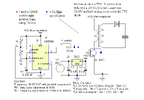
boost converter

A

Alun

Jan 1, 1970
0
Pulsed DC will do the job just as well as AC, you can get a couple of kV from a mains transformer as it will bahave as a flyback transformer.

You know how just using the back EMF from an indutor can give you a high voltage, a transformer is simply two inductors coupled to each other. The output in voltage is the ratio of primary turns to secondary, for example a 240V mains transformer with a 12V has a turns ratio of 20:1 so 240V at the primary becomes 12V at the secondary. If you use it the other way round and put 12V into what would normally be the secondary you'll get 240V at the primary (but you'd be using it as the secondary)

The flyback effect..
As I explained before the back EMF in a normal inductor when given pulses of DC current can be 100s of volts, the same is true with the mains transformer. Say for example if the mains 12V coil on a transformer gives a back EMF of 100V and the turns ratio is 1:20 then that 100V will be multiplied by 20 and give you 2000V - this is how ignition coils and TV fly back transformers work. You will need to limit the voltage to the maximum voltage rating of you components but this is easy enough to do with a comparator circuit.


scuba14c

Apr 23, 2005
43
Joined
Apr 23, 2005
Messages
43
How do I get the pulsed DC, a 555 timer with low frequency? From what you have said, this seems like it would be better than the boost converter. Will any type of transformer work? I have one sitting in the basement from a dehumidifier. How do you make the comparator? I've heard of them, but couldn't find a diagram of one online.


EdwardM

Apr 12, 2005
246
Joined
Apr 12, 2005
Messages
246
Hi scuba14c

I posted you some days ago but in looking back over it I didn't include the correct link, have a look at the application note, you will find that it is relevant

Best of Luck

Ed

AN19.pdf


Attachments

  • AN19.pdf
    690.1 KB · Views: 8

scuba14c

Apr 23, 2005
43
Joined
Apr 23, 2005
Messages
43
Couldn't figure out what happened, thanks for reposting it.

I've got a couple more questions about the pulsed DC and transformer. If it is pulsed DC, do I get DC or AC output? If it is AC, would I use an inverter to change it to DC? How much current could I expect to get from it? If it is powered with batteries, the current would have to be lower than the battery, right?


EdwardM

Apr 12, 2005
246
Joined
Apr 12, 2005
Messages
246
Hi scuba14c

pulsed DC usually refers to switching on and off the primary of a transformer which is supplied by a DC voltage such that when there is a change of current (switch on or off) that rate of change of current becomes available at the secondary.  The secondary is electrically separated from the primary and the on/off action induces a voltage which alternates, it's not a sine wave however, it's nearer a triangle wave. 

If it is AC, would I use an inverter to change it to DC?
No need,  use diodes to rectify the AC waveform to DC.

How much current could I expect to get from it?
This is the $64,000 question, the answer is that the amount of energy that you put into the primary circuit will be what you can expect from the secondary less any losses. ie you can't get out more than you put in!

Suppose that the most power that you can extract from a battery is 1 Watt (purely ficticious and just for argument) and the battery has a voltage of 10v, here I=P/V  = 100mA.  This means that if you apply this voltage and current to a perfect DC-DC converter you would be able to get the same power out, because you have a transformer you can increase the output voltage as much as you like. Suppose you wanted 1000v output, no problem, but the energy balance has to be maintained and you'll find that 100 times more voltage means that you have 100 times less current available. 

Look at the Joules per second level and suddenly it gets clearer

Best of Luck

Ed
 
A

Alun

Jan 1, 1970
0
EdwardM said:
No need,  use diodes to rectify the AC waveform to DC.
While you don't need to convert the AC to DC, you do need a diode to stop the capacitor discharging though the secondary.
 

scuba14c

Apr 23, 2005
43
Joined
Apr 23, 2005
Messages
43
The capacitors are DC. Don't they blow up when charged with AC?

Could you post a schematic of how I would rectify the output using diodes?

When something like this is charging, what should I expect for a charge time?

 
A

Alun

Jan 1, 1970
0
The output is plused DC not AC, the diode is just connected in series with the capacitor to stop it from discharging back into the transformer.


EdwardM

Apr 12, 2005
246
Joined
Apr 12, 2005
Messages
246
Hi Alun

The output is plused DC not AC, the diode is just connected in series with the capacitor to stop it from discharging back into the transformer.
Am I missing something, the output is pulsed DC...? are we at cross purposes?

Ed
 

EdwardM

Apr 12, 2005
246
Joined
Apr 12, 2005
Messages
246
I didn't wait long enough for my latest post to upload...  :p and it got lost ???

What I said was that the output from the transformer is AC.  And the action of the diode is to provide both DC and secondarily, a nice word for this time of night, to prevent the capacitor discharging back through the transformer secondary.

Ed

 
A

Alun

Jan 1, 1970
0
Well I woudn't call it DC since when I power a flouresent tube from a flyback transformer one of the ends of the tube goes black before the other because the cathode sputters and not the anode. This is why I always use a two transistor push-pull blocking oscilator in my low voltage flouresent lamp dirver circuits as opposed to a single transistor blocking osilator that outputs pulsed DC.


scuba14c

Apr 23, 2005
43
Joined
Apr 23, 2005
Messages
43
You lost me on the last post. Is the schematic you posted all I need to assemble to charge? If so I can get this done after school tomorrow and report back. Would it work if I just touched the battery to the transformer once a second, or do I need an electronically controlled switch to do this?

 
A

Alun

Jan 1, 1970
0
No, it's just the output stage, the switch is the transistor in your circuit.


scuba14c

Apr 23, 2005
43
Joined
Apr 23, 2005
Messages
43
I set it up without using a switch, and two 6V lantern batteries and it gave me about 25V off of a salvaged transformer. I'm not sure what the winding ratio is, but plan to make my own. The only problem I noticed was that it would lose voltage very quickly. The capacitor that I was using was a photoflash, 330V. I'm not sure if this was because the capacitor was low quality, but I did have an ultrafast diode connected to it. Can a transformer be wound on any type of ferrite core? Is there any way to electronically activate the batteries so I don't have to manually switch the power?

 
A

Alun

Jan 1, 1970
0
Just replace the "switch" in Edward's circuit with the transistor in your 555 circuit.


scuba14c

Apr 23, 2005
43
Joined
Apr 23, 2005
Messages
43
Okay, that's kind of what I thought I needed to do. I will test it tomorrow and get back to you.

 
Top