boost converter

A

Alun

Jan 1, 1970
0
What's the part number?

The answer's on the datasheet.


scuba14c

Apr 23, 2005
43
Joined
Apr 23, 2005
Messages
43
I need to see if I am connecting the leads to the right pins. For some reason it will only oscillate to 30V.

 
A

Alun

Jan 1, 1970
0
I need to know the part number on the transistor or else I can't help you.


scuba14c

Apr 23, 2005
43
Joined
Apr 23, 2005
Messages
43
I've been using 3 different kinds:

400V 8A NPN transistor TO-220 case
      http://www.alliedelec.com/cart/ProductDetail.asp?SKU=568-4088&SEARCH=MJE13007&ID=&DESC=MJE13007
***This one is the only one that will get to 30V, the other two reach 20-25V***

500V 14A Field Effect N channel power transistor TO-247AC case
      http://www.alliedelec.com/cart/ProductDetail.asp?SKU=273-9997&SEARCH=IRFP450&ID=&DESC=IRFP450

1200V 20A IGBT TO-247 case
      http://www.alliedelec.com/cart/ProductDetail.asp?SKU=273-7740&SEARCH=IRG4PH50K&ID=&DESC=IRG4PH50K

***The last two have to have the 555 timer going to charge and make a whining sound. For the first I touch it the back and right pin of the transistor once and it will go to 30V. If I try operating the 555 timer while it's charging, it stops.


A

Alun

Jan 1, 1970
0
I've located the data sheets for you:
MJE13007
IRFP450
IRG4PH50K
Firstly have you connect the connections to the right pins?

The problem with the MJE12007 was base series resistor (R3) is too small, 10ohms is fine for a MOSFET or IGBT but not for a bjt as the base will act as a short to ground. I recommend you keep the 10ohm resistor and go with the MOSFET.

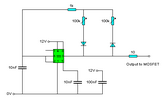
You are currently only varing the frequency at the moment, try using this circuit to alter both the frequency and duty cycle:
Also connect a big juicy 1000uF capacitor in paralel with the whole circuit.
Var_duty_pusle_gen.PNG


scuba14c

Apr 23, 2005
43
Joined
Apr 23, 2005
Messages
43
Part of the problem I am having is not being sure if I am connecting things to the switches the right way.

I will try the circuit you provided and see if it works.


scuba14c

Apr 23, 2005
43
Joined
Apr 23, 2005
Messages
43
  Is there a way to change the 100k resistors to lower values? The most I have are 20k power resistors.

  I am connecting the 555 timer output (+) to the back of the transistor and the (-) to the left pin. The center pin is connected to the output side of the inductor. The right pin is connected to the negative terminal of the capacitor. To start it I give it a pulse with the timer and then touch the negative side of the battery to the right pin of the transistor. This will get me to ~28V in less than a second, but it takes 10 seconds longer for it to reach the 32V maximum.

Is this the way it should be connected?

 
A

Alun

Jan 1, 1970
0
scuba14c said:
  Is there a way to change the 100k resistors to lower values? The most I have are 20k power resistors.
You don't need power resistors, two low power 100K potentiometers (variable resistors) are what you need.

  I am connecting the 555 timer output (+) to the back of the transistor and the (-) to the left pin. The center pin is connected to the output side of the inductor. The right pin is connected to the negative terminal of the capacitor. To start it I give it a pulse with the timer and then touch the negative side of the battery to the right pin of the transistor. This will get me to ~28V in less than a second, but it takes 10 seconds longer for it to reach the 32V maximum.

Is this the way it should be connected?
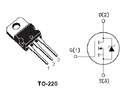
Look at the picture below:
Pin 1 to the output from the 555.
Pin 2 to the transformer.
pin 3 to 0V.

Connect the other end of the transformer to +V.

All the connections to the transformer I've talked about in this post involve the low voltage side of the transformer.

I hope this helps.mosfet_pinout.gif

 
Last edited:

scuba14c

Apr 23, 2005
43
Joined
Apr 23, 2005
Messages
43
I tried it but it didn't work. Was the ground from the timer supposed to go to the back of the transistor?

I have a circuit layout from someone else who built a boost converter, but am unsure of one of the components he used. The diagram for the boost converter does not show it. Could you identify the device on the upperleft hand side of the board?

View attachment 37145

 
A

Alun

Jan 1, 1970
0
scuba14c said:
I tried it but it didn't work. Was the ground from the timer supposed to go to the back of the transistor?
What do you mean the back of the transistor?
Source, Gate, Drain?
Do you mean the metal tab as it's connected to the drain as is pin 2.

I have a circuit layout from someone else who built a boost converter, but am unsure of one of the components he used. The diagram for the boost converter does not show it. Could you identify the device on the upperleft hand side of the board?
It could be a transistor or a voltage regulator but I can't tell without the part number.

Did you use stripboard this time, because connecting the components together with wires isn't the most reliable construction technique.
 

scuba14c

Apr 23, 2005
43
Joined
Apr 23, 2005
Messages
43
Yes, the one I meant was connected to pin 2.

I bought a breadboard and used this for as many parts as possible.

 
A

Alun

Jan 1, 1970
0
Beadboard isn't that good either as the contacts aren't always very reliable, stripboard your best bet and after that you can etch your own PCB if you want.


Anotherforummember

Aug 11, 2005
21
Joined
Aug 11, 2005
Messages
21
All is good now.  Scuba got my board, did a little toasting to it.  Board fixed and now in service.  Still in service Scuba? 

 
Top