LC tank circuit with HV driver

Kerrowman

Dec 13, 2020
70
Joined
Dec 13, 2020
Messages
70
Hi there,

I'm exploring resonance in LC tank circuits at radio frequencies and have a query about my observations.

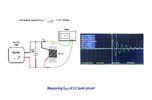
In the first picture, I have a 6𝜇H coil and a 4.8nF cap in parallel, and I have measured the f(sr) using the setup shown in the attached. The result, according to the scope, is 899.28 kHz (at the bottom). This fits well with the calculated value when you take into account the additional parasitic capacitance of the coil.
 
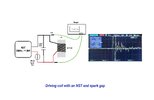
Now, when I drive this tank circuit with an NST at 1.5kV, at approx 35kHz and with a spark gap, I can see ringing on the scope with each irregularly spaced spark, but the frequency indicated is around 48MHz, as in the second attachment.
 
Is this just a harmonic of the fundamental frequency shown in the first slide, or something else? Also, perhaps relevant is the pic of what I take to be the sparking interval, which suggests around 1.3MHz, compared to the approx 35kHz of the NST, and somewhat random, as in the last attachment.
 
Lastly, substituting the spark gap for a 1kV GDT gives no trace at all.
 
I would appreciate any comments on what is going on, in particular:
 
1: Why does the fundamental f(sr) not appear when the NST is driving the circuit?
 
2: Why is the apparent spark frequency so much higher than the NST output?
 
3: Why does using a GDT appear to stop the resonance?
 
Thanks in advance.
 
 
View attachment 45322

View attachment 45323

View attachment 45324


HarryA1

Mar 4, 2009
481
Joined
Mar 4, 2009
Messages
481
Your first two jpegs (FSR and NST) are not showing up?


Kerrowman

Dec 13, 2020
70
Joined
Dec 13, 2020
Messages
70
I think these were the ones. I have sorted most of the issues except why using a GDT instead of a spark gap seems to stop the resonance occurring. The scope is basically a flat line.

Driving the LC with an NST.jpeg

Measuring the FSR.jpeg


Nicholas Shaffer

May 29, 2025
1
Joined
May 29, 2025
Messages
1
Hi there,

I'm exploring resonance in LC tank circuits at radio frequencies and have a query about my observations.

In the first picture, I have a 6𝜇H coil and a 4.8nF cap in parallel, and I have measured the f(sr) using the setup shown in the attached. The result, according to the scope, is 899.28 kHz (at the bottom). This fits well with the calculated value when you take into account the additional parasitic capacitance of the coil.
 
Now, when I drive this tank circuit with an NST at 1.5kV, at approx 35kHz and with a spark gap, I can see ringing on the scope with each irregularly spaced spark, but the frequency indicated is around 48MHz, as in the second attachment.
 
Is this just a harmonic of the fundamental frequency shown in the first slide, or something else? Also, perhaps relevant is the pic of what I take to be the sparking interval, which suggests around 1.3MHz, compared to the approx 35kHz of the NST, and somewhat random, as in the last attachment.
 
Lastly, substituting the spark gap for a 1kV GDT gives no trace at all.
 
I would appreciate any comments on what is going on, in particular:
 
1: Why does the fundamental f(sr) not appear when the NST is driving the circuit?
 
2: Why is the apparent spark frequency so much higher than the NST output?
 
3: Why does using a GDT appear to stop the resonance?
 
Thanks in advance.
 
 
View attachment 45322 Geometry Dash

View attachment 45323

View attachment 45324
The 48 MHz ringing observed could result from parasitic inductances and capacitances within the circuit or measurement setup, leading to high-frequency oscillations during spark events.

 
Last edited by a moderator:

Kerrowman

Dec 13, 2020
70
Joined
Dec 13, 2020
Messages
70
The 48MHz I have shown to be from the wide spectrum output caused by the spark gap. The LC resonance is clearly visible at around 950kHz as expected.

The unresolved issue is why when using a GDT (1kV), the circuit stops resonating.


JamesMVictoria

Nov 9, 2021
7
Joined
Nov 9, 2021
Messages
7
Hi there,

I'm exploring resonance in LC tank circuits at radio frequencies and have a query about my observations.

In the first picture, I have a 6𝜇H coil and a 4.8nF cap in parallel, and I have measured the f(sr) using the setup shown in the attached. The result, according to the scope, is 899.28 kHz (at the bottom). This fits well with the calculated value when you take into account the additional parasitic capacitance of the coil.
 
Now, when I drive this tank circuit with an NST at 1.5kV, at approx 35kHz and with a spark gap, I can see ringing on the scope with each irregularly spaced spark, but the frequency indicated is around 48MHz, as in the second attachment.
 
Is this just a harmonic of the fundamental frequency shown in the first slide, or something else? Also, perhaps relevant is the pic of what I take to be the sparking interval, which suggests around 1.3MHz, compared to the approx 35kHz of the NST, and somewhat random, as in the last attachment.
 
Lastly, substituting the spark gap for a 1kV GDT gives no trace at all.
 
I would appreciate any comments on what is going on, in particular:
 
1: Why does the fundamental f(sr) not appear when the NST is driving the circuit?
 
2: Why is the apparent spark frequency so much higher than the NST output?
 
3: Why does using a GDT appear to stop the resonance?
 
Thanks in advance.
 
 
View attachment 45322

View attachment 45323

View attachment 45324 
 
Your LC tank design seems viable, but matching the resonance frequency with the HV driver’s output characteristics is crucial. Also, make sure the driver can handle reactive loads without instability. Jotrin is a solid place to find suitable high-voltage MOSFETs, inductors, or precision capacitors for tuning LC tanks efficiently.
All good now?

 
Last edited by a moderator:

Kerrowman

Dec 13, 2020
70
Joined
Dec 13, 2020
Messages
70
Not quite. When I replace the spark gap with a 1kV GDT, the system does not function at all. I had hoped that the GDT would result in more consistent 'ringing' of the tank circuit. Any ideas why using it appears to short out the tank circuit?

 
Top