Measuring an NST Output

Status
Not open for further replies.

Kerrowman

Dec 13, 2020
70
Joined
Dec 13, 2020
Messages
70
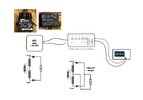
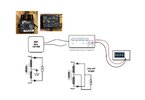
I'm planning to measure the HV output waveform from an NST using a 1000:1 potential divider, which is yet to be built, and I have a few queries about the measurement setup. I have included a diagram of the proposed design and arrangement and where the small NST has a stated output of 1.5kV RMS.

My main query is regarding the effect of the assumed centre tap of the NST on the measurement setup. As I understand it, if the output is 1.5kV RMS, then the two output cables provide + and - 750V RMS AC. However, if I connect both cables to the single + input of the divider, that will surely constitute a short for the NST and shut it down. If I don't connect the second cable then I have a floating ±750V. I don't know if the NST has diodes as my suggested circuit shows, but if there were then that might also change matters.

The second issue is that this third-party divider design does not have a negative or ground line on the input side but, if needed, I presume one can link the negative on the low-voltage output side to the ground of the input source? In the case of the NST I am using, the only ground line would seem to be the centre tap, which must be connected in this case to the DC supply ground, but this device does not provide an external connection to that, although I understand that many NSTs do provide a connection to the usual AC supply ground.

I would appreciate any advice.

Thanks
Measuring NST Output.jpeg
 

Attachments

  • Measuring NST Output.jpeg
    Measuring NST Output.jpeg
    109.4 KB · Views: 6

poor mystic

Apr 8, 2011
1,106
Joined
Apr 8, 2011
Messages
1,106
Hi :)
Quite frankly I'm afraid to advise you, because your plan is not safe.
It is not safe to make your first experiments with electricity on a Neon Sign Transformer. I'm worried that the device under test produces high current at high voltages - way enough to kill in less than a second, no second chances.
If we give you some theoretical help, would you promise not to do this thing without a qualified electrician right there to help you?
Take care
Mark
 

Kerrowman

Dec 13, 2020
70
Joined
Dec 13, 2020
Messages
70
Im not new to working with electricity and have researched HV back pulses for the last 6 years and published it all. I’m just newer to working with a NST and can’t get the info I would like from the manufacturer.
 

Harald Kapp

Moderator
Moderator
Nov 17, 2011
14,282
Joined
Nov 17, 2011
Messages
14,282
However, if I connect both cables to the single + input of the divider, that will surely constitute a short for the NST
Right, that's a no go.
I don't know if the NST has diodes as my suggested circuit shows
No diodes. 1.5 kV RMS is a sure sign of an AC output.
The second issue is that this third-party divider design does not have a negative or ground line on the input side but, if needed, I presume one can link the negative on the low-voltage output side to the ground of the input source?
There's only one ground common for input and output.
In the case of the NST I am using, the only ground line would seem to be the centre tap, which must be connected in this case to the DC supply ground, but this device does not provide an external connection to that, although I understand that many NSTs do provide a connection to the usual AC supply ground.
I'm afraid I'm a bit lost as to what you mean by that :(

From a purely technical point of view there is no need for a ground on the HV side at all. You could operate the circuit floating. However, since you are going to connect the circuit to an oscilloscope for measuring the waveform, a solif ground/earth conenction is good advice. Otherwise you risk stray currents going from the HV generator through the 'scope to earth with potentially detrimental consequences.
You can connect any of the three outputs of the HV generator to ground, generating (after the diodes) either +1.5 kV, -1.5 kV or +-750 V, depending on where you connect ground.

Im not new to working with electricity and have researched HV back pulses for the last 6 years and published it all.
Hmmmh, your questions don't reflect that.

Last not least: The device you're dealing with is not a simple Neon Sign Transformer (NST). A transformer would require an AC input (typically mains) which is transformed up to a high voltage. The device you show has a DC input and is labeled Neon Power Supply. This is a complete self-contained AC generator and transformer working obviously at a very much higher frequency than mains.

I totally agree with @poor mystic : You're working with potentially lethal power. Know what you do or don't do it. Or have an expert supervise your experiments.
 

Kerrowman

Dec 13, 2020
70
Joined
Dec 13, 2020
Messages
70
Thanks for the detailed reply. In a previously built divider I had a common ground and sockets for + and - on the HV and LV sides but this ‘new’ design doesn’t. Instead I think when necessary he uses a lead to connect the LV output neg to the HV source neg/ground. That would get round the stray current issue.

I’m suggesting that my small NST must have its secondary centre tap connected to the DC supply ground instead of in larger devices where the centre tap can be connected to the chassis or a separate ground lead. In this case the load can be either between the two output leads or instead between the two output leads joined together and the centre tap ground. This is what my two NST schematics were trying to show.

A dc supply for an NST is certainly unusual but convenient for HV experiments.

Regarding my technical background, electronics is not my primary discipline so I like to double check on certain issues, just to be sure I haven’t missed something important, but I have many years experience as an experimental physicist and my website, with an example of one of the image galleries, should give some indication of activities over the last few years in HV research work: https://www.kerrowenergetics.org.uk/portfolio-1/project-three
 
Last edited:

Kerrowman

Dec 13, 2020
70
Joined
Dec 13, 2020
Messages
70
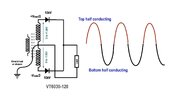
Here is how I think adding diodes can be useful to prevent a short detection, whatever way the centre tap is configured, and without a half-wave rectified result. In each half of the output cycle, one or other of the diodes is in forward bias - isn't it?

NST Full-Wave Conducting.jpeg
 

poor mystic

Apr 8, 2011
1,106
Joined
Apr 8, 2011
Messages
1,106
Hi again
Look I really think you need to be talking to electrical engineers.
This is a hobby forum.
Asking about stuff like that and telling us you know what you're doing.
Just don't, please.
 

davenn

Moderator
Sep 5, 2009
14,474
Joined
Sep 5, 2009
Messages
14,474
Hi again
Look I really think you need to be talking to electrical engineers.
This is a hobby forum.
Asking about stuff like that and telling us you know what you're doing.
Just don't, please.

Agreed
@Kerrowman Find someone who can directly guide you :)

thread closed
 
Status
Not open for further replies.
Top