Battery treatment

hankins

Dec 29, 2025
13
Joined
Dec 29, 2025
Messages
13
I am using Lifepo4 batteries for power storage from solar panels. My inverters sound an alarm if battery voltage drops below 10 volts. I have been consistently running batteries to a 10 volts level. When alarm sounds, I disconnect the discharged battery bank and connect circuits to a fully charged battery bank. Am I doing any injury to my batteries as far as capacity or lifespan is concerned?
 

crutschow

May 7, 2021
984
Joined
May 7, 2021
Messages
984
Am I doing any injury to my batteries as far as capacity or lifespan is concerned?
10V is the absolute minimum discharge voltage for a 12V Lifepo4 battery.
I would recommend using no lower than 11-12V for best battery life unless you really need to use the full battery capacity.
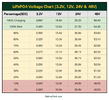
Stopping at 12V uses about 90% of the battery capacity (below).
1767027500706.png
 

Sunnysky

Jul 15, 2016
573
Joined
Jul 15, 2016
Messages
573
A cutoff below 20% accelerates the reduction in life recharge cycles rapidly.

Short-term gain vs long-term pain.

That's why it is shaded in red.
 

hankins

Dec 29, 2025
13
Joined
Dec 29, 2025
Messages
13
10V is the absolute minimum discharge voltage for a 12V Lifepo4 battery.
I would recommend using no lower than 11-12V for best battery life unless you really need to use the full battery capacity.
Stopping at 12V uses about 90% of the battery capacity (below).
View attachment 69694
I am in float mode. The batteries do not necessarily latchup at 13,1 volts but do dwell around that value once reached. In the other mode (cycle mode?) battery is expecting to be charged to max voltage around 14.4 volts. It appears, that much like a lead/acid battery, during a full cycle charge, 13.5-14.0 volts is reached rapidly (3-4 hours) but to charge the battery to hold a voltage of 13.6-14.x volts after disconnect, at least another 24 hours of charging at a trickle rate will be needed. These are the actions I have observed which coincide with some of the text I have read. As I remember, pertaining to Lifepo4 batteries in float mode, 13.1 volts is considered full charge while when dropped down to 12 volts, 12 volts is considered 50% charge. 10 volts is considered fully discharged. Twice I used a discharged bank to charge a phone or other hand held item and dropped the voltage low enough to cause the BMS to shut the battery off. My multi-battery charger will restart a shut off battery, no problem but I try to avoid any use once ten volts has been reached. I will check again about 12 volt being 50% capacity. I may have that figure mixed up with lead/acid battery.
 

Delta Prime

Jul 29, 2020
2,987
Joined
Jul 29, 2020
Messages
2,987
You have been testing your system empirically. Bravo!
Please provide make & model of your multi-battery charger if you can.
LiFePO4 batteries using float mode chargers enter "float" after bulk/absorption.Additionally for LiFePO4, it's more of a standby, the battery rests, & the charger only adds power if the battery voltage drops below the set float level, allowing your BMS to enter cell balancing. “instead of manually disconnecting”, you could set your system solar charge controller's float voltage low enough (e.g., 13.6V) so it acts as a low-power supply to the loads, letting the battery gently discharge slightly before the charger fully takes over or cycles again, preventing stress.
If you wish to understand LiFePO4 (Lithium Iron Phosphate) batteries.
The link below is an authority on the subject. It’s a Very good read…
https://www.batteryuniversity.com/article/bu-409b-charging-lithium-iron-phosphate/
 
Last edited:

olivia_49

Dec 26, 2025
24
Joined
Dec 26, 2025
Messages
24
Yep, regularly letting LiFePO4 batteries drop to 10 V can stress them and slowly reduce their lifespan, so it’s better to keep them above ~11–11.5 V for daily use.
 

hankins

Dec 29, 2025
13
Joined
Dec 29, 2025
Messages
13
You have been testing your system empirically. Bravo!
Please provide make & model of your multi-battery charger if you can.
LiFePO4 batteries using float mode chargers enter "float" after bulk/absorption.Additionally for LiFePO4, it's more of a standby, the battery rests, & the charger only adds power if the battery voltage drops below the set float level, allowing your BMS to enter cell balancing. “instead of manually disconnecting”, you could set your system solar charge controller's float voltage low enough (e.g., 13.6V) so it acts as a low-power supply to the loads, letting the battery gently discharge slightly before the charger fully takes over or cycles again, preventing stress.
If you wish to understand LiFePO4 (Lithium Iron Phosphate) batteries.
The link below is an authority on the subject. It’s a Very good read…
https://www.batteryuniversity.com/article/bu-409b-charging-lithium-iron-phosphate/
NEXPEAK brand. Product model RJ-C121501A/ NC215. Executive standard T/TCDZ0001-2019
 

hankins

Dec 29, 2025
13
Joined
Dec 29, 2025
Messages
13
You have been testing your system empirically. Bravo!
Please provide make & model of your multi-battery charger if you can.
LiFePO4 batteries using float mode chargers enter "float" after bulk/absorption.Additionally for LiFePO4, it's more of a standby, the battery rests, & the charger only adds power if the battery voltage drops below the set float level, allowing your BMS to enter cell balancing. “instead of manually disconnecting”, you could set your system solar charge controller's float voltage low enough (e.g., 13.6V) so it acts as a low-power supply to the loads, letting the battery gently discharge slightly before the charger fully takes over or cycles again, preventing stress.
If you wish to understand LiFePO4 (Lithium Iron Phosphate) batteries.
The link below is an authority on the subject. It’s a Very good read…
https://www.batteryuniversity.com/article/bu-409b-charging-lithium-iron-phosphate/
LIFEPO4 DISCHARGE RATE 1.png

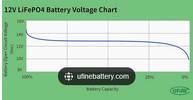
This graph is typical rate of discharge for lifepo4 12 volt battery. My observations are in agreement with the chart. The discharge sweet spot does reside from 12.9V to 12,8V. I have a 5 place LED panel display attached to a bank of 4 lifepo4 batteries. This gives me access to millivolts so I can better observe when I enter and exit that region. From the BU article I gathered optimal discharge practice is charging to 85% and discharging to 30%. From the table posted by crutschow, this is the range from 13.35V to 12.9V. As logical as that might be, it is not practical for my application. The over night run-times would not be adequate. I am only 2 weeks away from the shortest day of the year with days getting longer until mid-June. I feel justified in my practice of discharging batteries to a near 0% capacity level (10V) for a short time. It may be a good idea to build an alarm that notifies me at 10,5V to avoid the extreme but my current opinion is that I am not doing significant damage to my batteries with the occasional dip to 10V. So I'll chance the gain today, pain tomorrow scenario. I will predict that by February, full discharge will not be an issue. And also, that by April, high temps will be my new issue. When trying to maintain a max temp of 86° F, it does no good to blow 100° air over the batteries. I'll burn that bridge when I get to it.
 

crutschow

May 7, 2021
984
Joined
May 7, 2021
Messages
984
The over night run-times would not be adequate. I am only 2 weeks away from the shortest day of the year with days getting longer until mid-June. I feel justified in my practice of discharging batteries to a near 0% capacity level (10V) for a short time.
So, is your battery charged up to 100% during the daytime?
If not, there's no good reason to discharge to 0% since that has no effect on the total cycle energy available for the day.
 

hankins

Dec 29, 2025
13
Joined
Dec 29, 2025
Messages
13
So, is your battery charged up to 100% during the daytime?
If not, there's no good reason to discharge to 0% since that has no effect on the total cycle energy available for the day.
Using the table you sent as a reference, I do not charge batteries to 100% capacity. I am not clear as to how the Battery Management System (BMS) works, but it does seem to recognize that I am using battery in float mode as opposed to cycle mode. I will use a golf cart as an example of cycle mode. Batteries are charged to 100% capacity, often indicated by an approximate voltage reading in the neighborhood of 14.4 volts. The cart is then taken out onto the golf course and power is used until golf round is complete and then put back on the charger. In my case, I use power from the batteries that are being simultaneously charged on the charger, or more exactly, sharing the output from the solar charge controller. In this configuration, the BMS considers a voltage of 13.1-13.3 to indicate full charge. If batteries are in a no-load situation when solar panels stop producing power, the battery bank voltage would likely remain at 13.1 volts. As things are, there is always a load on the active bank and voltage soon drops to 13 then 12.9 volts. I'm going to say that approximately 80% of stored power is delivered while the battery voltage reads from 12.8 to 12.9 volts. Once voltage falls to 12.7 volts, an accelerated decrease in voltage is noticeable. After reaching 12.0 volts and running typical night time load of a few lights, starlink, computer, I may have 2 hrs of power left. The same load will run maybe 30 minutes after 11,5 volts is reached. At 9.999 volts, the alarm sounds and I disconnect inverter from spent bank and reconnect to a charged bank. I might be making a faulty assumption but logic would dictate that an alarm would be utilized at a value prior to damage accuring than after damage done. But who says logic enters the equation anyway.
 

crutschow

May 7, 2021
984
Joined
May 7, 2021
Messages
984
the BMS considers a voltage of 13.1-13.3 to indicate full charge.
According to the chart I posted, that's only 60-80% charged.
Would seem to be better for the battery if it were charged it to a higher voltage, and also the discharge stopped at a higher voltage.
 

hankins

Dec 29, 2025
13
Joined
Dec 29, 2025
Messages
13
According to the chart I posted, that's only 60-80% charged.
Would seem to be better for the battery if it were charged it to a higher voltage, and also the discharge stopped at a higher voltage.
My thought is that the chart you posted pertains to using the battery in cycle mode. My use is float mode. The differences were mentioned in the abbreviated manual that came with each battery. I'll dig the manual out and review it. If there are no concrete answers in the manual, I'll contact the manufacturer for the straight skinny. I'll let you know what I find.
 

crutschow

May 7, 2021
984
Joined
May 7, 2021
Messages
984
the chart you posted pertains to using the battery in cycle mode. My use is float mode.
Don't understand that. :confused:
Float mode is used for standby purposes such as emergency lighting.
You are charging and discharging the battery daily, so I would consider that cycle mode.
 

Delta Prime

Jul 29, 2020
2,987
Joined
Jul 29, 2020
Messages
2,987
@hankins can you draw a rough sketch of your entire system that you are using i.e.the connections itself?
Thank you…
 

hankins

Dec 29, 2025
13
Joined
Dec 29, 2025
Messages
13
Alrighty. We are back to sunny skys and slightly longer days. About 10 days ago I charged both battery banks until they were nearly fully charged. It was charged enough to maintain 13 volts at rest. That made a big difference in their ability to reach full charge on these short days. I try to utilize only one bank on any given day. This affords the other bank a chance to charge all during the sunny hours. I even turn off the inverter so as not to have the display drawing power. I guess I will build an alarm that sounds at 11V -11.5V. Inverters may have programmable alarms. It often happened around here, people trashed their lead/acid batteries by severely discharging. Thanks for the suggestions.
 

hankins

Dec 29, 2025
13
Joined
Dec 29, 2025
Messages
13
Honestly, the term 'battery treatment' can be a bit misleading because what works wonders for one type can actually kill another. It all comes down to the chemistry.

For example, Lead-acid batteries are 'happy' when they’re kept full; if you let them sit half-empty, they develop sulfation and die pretty quickly. On the flip side, Li-ion batteries (like in your phone or laptop) actually get stressed at 100% charge. They live much longer if you keep them in that 20% to 80% 'sweet spot.' Then you have NiMH, which is a different beast entirely and doesn't handle constant trickle charging very well.

The best universal advice? Keep them cool. Heat is the number one killer regardless of the type. I actually learned a lot of these nuances from Battery University, it’s a fantastic resource if you want to see the actual data behind why batteries degrade.

Battery University: How to Prolong Lithium-based Batteries
I will visit BU looking specifically for How to prolong lithium-based batteries. I think it was at BU where it was mentioned that 86° F was the absolute maximum temperature in regards to a lithium battery. Knowing that terminology is a bit flaky in the world of batteries, I take statements with a grain of salt. I assume what is meant by the statement of max temp means 86° is the limit at which no damage will accure. That is a good thing to know, as is the fact that the battery is stressed when charged to 100%. Sometimes the articles will go more in-depth and might explain a difference between stopping charging at 100% compared to keeping battery connected to charger and continuing to trickle charge, maintaining a 100% charge. One has to rely on intuition if absolute variables are not addressed. In a few months, high temps will be my issue. This past summer was my introduction to using LiFePo4 batteries. Also my first summer in a new dwelling with no air conditioning. My regiment during that time was to merely feel the battery cases for evidence of overheating. The batteries consistently felt cool to the touch. Often times, max limits are given in regards to optimum performance as opposed to serious damage. Statements like, "Charging the battery with a temperature of 87° puts you just under optimum performance. Charging a battery with a temperature of 120° is a battery execution." For small battery operated devices I use NIMH exclusively. At the time I started using them, self discharge seemed to be a concern. I have not noticed self-discharge as a problem. Over a period of 6 to 12 months of no use, I have noticed voltage drops but I do not recall seeing any charts showing self-discharge rates although I'm guessing there may be some out there. My thoughts were that improvements have been made since the material I read was written. Again, that's just a guess.
 

crutschow

May 7, 2021
984
Joined
May 7, 2021
Messages
984
For small battery operated devices I use NIMH exclusively. At the time I started using them, self discharge seemed to be a concern. I have not noticed self-discharge as a problem.
NiCds and the old NiMH cells had a significant self-discharge rate, losing 20-30% monthly, but there are now NiMH batteries that use an improved design with a much lower rate.
They are generally stated as being "precharged".
 
Top