Sparkystuff
- Oct 23, 2026
- 3
- Joined
- Oct 23, 2026
- Messages
- 3
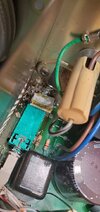
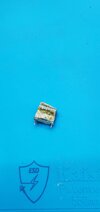
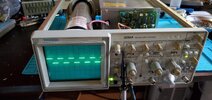
I have this scope for my interest in restoring vintage audio equipment. The mains mylar safety capacitor exploded while I was using it. Little flakes everywhere. The trace wasn't affected, but I shut it off as fast as I could. Which wasn't super fast because a piece of the debris blocked the power switch.
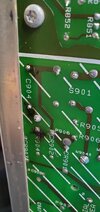
I carefully spec'd out the replacement capacitor, and managed to replace it. There's evidence of overheating on the board from my amateur soldering, but probably just the solder mask discolored. Also, there is an adjacent rectifier diode that I may have overheated because it's label is almost identical, and right next to the capacitor's, so I accidentally heated that joint a bit too much thinking it was the dead component. I didn't see any evidence of lifted pads or traces. I was very careful to not heat the new mylar capacitor's joints for more than 2 seconds when soldering it in.
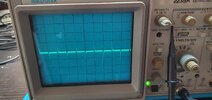
When I first powered it up, it worked normally, getting a nice crisp square wave trace from the onboard calibrator lug. Two days later, I turned it on again, and got just a flat line when connected to the calibrator lug on Channel 1. Trigger not activated. I switched to channel 2, and got a normal trace with trigger. Switched back to Channel 1 and still flat lined. Went back to Channel 2, and now it also flat lined, no trigger. No changes to my settings between switching the probe. If I decrease the v/div to 50mv I get a trigger. But still no differential voltage between pulses - All on the same line, but showing leading-edge distortion spike (up, down, up, down) on each pulse. The trigger sees that spike.
So basically, I'm confused and pessimistic. Why was it good, and why did it stop being good first on Channel 1, then infected Channel 2? Would a bad rectifier diode cause voltage abnormalities that slowly fried something important? Otherwise, I'm assuming my prized instrument is damaged beyond what my limited skills can diagnose or fix (probably because I was too lazy to check that diode). I might check/replace the diode, but concerned it may not matter anymore at this point.
I've ruled out a problem with the test signal itself. Any troubleshooting ideas other than visual inspection for other issues? I'm also here hoping that it's an issue someone else has seen and fixed or something easy that I'm overlooking.
Blown capacitor pics and good vs bad trace under same conditions attached for your entertainment.