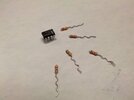
Older Big Discreet Circuits versus Multiple Micro Circuits in ICs

John R Retired

Mar 13, 2022
155
Joined
Mar 13, 2022
Messages
155
This subject-question is rather old school antiquated, but just for understanding the significance modern micro-miniature circuits in IC packages comparedto old school big circuits.

If you took an old discreet circuit like an audio amplifier, or radio or whatever complete circuit with all its individual resistors, caps, inductors, transistors (or even earlier tubes-valves) and wiring it would be big but easy to access the individual discreet compnents
and their terminals. But after these complete circuits were minatureized and even multiple times in one IC package, where in the IC
pins configuration would the old terminals buried in the IC, and instead the individual terminals routed to say one or 2 ICpins instead
of very visible terminals that were open and visible with the older bigger circuits? Example would be in an older big circuit you could
access an emitter on any transistor but in an IC many, maybe hundreds of transistor emitters would be tied to one IC pin, and you could not access individual transistors. The same would be true for capacitors, resistors, inductors. Just a blind pin with no access to individual components. So what was forfeited for tiny blind one pin convenience was access to individual components, terminals and wires. Yeah you get more condensed circuitry in a chip and reduction in size, but this is one disadvantage of micro IC circuits, i.e., you can't acces individual components or connections. Hope this makes sense.
 

Harald Kapp

Moderator
Moderator
Nov 17, 2011
14,272
Joined
Nov 17, 2011
Messages
14,272
Hope this makes sense.
I'm afraid not to me. Technically you're right: you can't access individual components within an IC.
But there are several reasons it makes no sense to access them:
  • With up to millions of components within a single IC, accessing them is completely unpractical.
  • One would have to know and understand the full internal circuit of the IC to make sense of accessing any internal node.
  • If one had access to an internal node, the parasitics of that connection (resistance, inductance, capacitance) would completely alter the behavior of the circuit. Especially if one were to attach an additional probe to such a node.
  • The internal structures of an IC are much smaller anh highly sensitive to e.g. ESD than the I/O structures. The latter being designed for robustness to interface with external circuitry, the internal nodes being optimized for performance (e.g. minimum parasitics).
  • Within an IC circuitry is often realized differently than in a discrete circuit. E.g. resistors are replaced by current sources or switched capacitors

The idea of using ICs is to hide all the complexity from the user (plus miniaturization, of course). An additional positive effect is that the parameters of components within an IC track way better than in a discrete circuit. Namley because the components are manufactured in the same process and the temperature distribution within an IC is much more even than in a discrete circuit (exemptions confirm the rule :)).
 

John R Retired

Mar 13, 2022
155
Joined
Mar 13, 2022
Messages
155
I'm afraid not to me. Technically you're right: you can't access individual components within an IC.
But there are several reasons it makes no sense to access them:
  • With up to millions of components within a single IC, accessing them is completely unpractical.
  • One would have to know and understand the full internal circuit of the IC to make sense of accessing any internal node.
  • If one had access to an internal node, the parasitics of that connection (resistance, inductance, capacitance) would completely alter the behavior of the circuit. Especially if one were to attach an additional probe to such a node.
  • The internal structures of an IC are much smaller anh highly sensitive to e.g. ESD than the I/O structures. The latter being designed for robustness to interface with external circuitry, the internal nodes being optimized for performance (e.g. minimum parasitics).
  • Within an IC circuitry is often realized differently than in a discrete circuit. E.g. resistors are replaced by current sources or switched capacitors

The idea of using ICs is to hide all the complexity from the user (plus miniaturization, of course). An additional positive effect is that the parameters of components within an IC track way better than in a discrete circuit. Namley because the components are manufactured in the same process and the temperature distribution within an IC is much more even than in a discrete circuit (exemptions confirm the rule :)).
Superb answer....Thanks

What you described is exactly within the context and comparison I was trying to get at.

The volatile nature (ESD) of ICs is significant as you described, but my question was more theoretical-philosophical rather than practical.

I especially like what you said that:

"there are several reasons it makes no sense to access them:" (individual components within an IC.)
Yeah, those days are gone now with the little black boxes called ICs, except for nostalgia seekers.

"The idea of using ICs is to hide all the complexity from the user" (plus miniaturization, of course).
Access to individual components is what makes big circuits more "hands on" interesting IMO.

However, as you described the "Millions of components inside an IC", that almost puts them in the realm of black box magic.
Just connect this pin and that pin and you have a functioing device fit for major practical use in the real world that a big discreet
device could never equal except with huge cabinets of old school electronics.

Something about the ergonomics and tactile experience of big individual components.
I guess that's why some old timers still like to build 5W transmitters with tubes-valves using a Key for Morse Code. Is that boring?
I think using a fancy digital IC based handheld Ham radio with LCD screen and layers of access menus is even more boring
and is missing something the old larger devices with wires , and individual components (and maybe tubes) is more interesting.

Of course we would not be where we are today with technology without the miniaturization of ICs obviously and time marches on.
 
Last edited:

Harald Kapp

Moderator
Moderator
Nov 17, 2011
14,272
Joined
Nov 17, 2011
Messages
14,272
Is that boring?
Not at all. It's an interesting technology for those who dare dive into tube technology.
I think using a fancy digital IC based handheld Ham radio with LCD screen and layers of access menus is even more boring
and is missing something the old larger devices with wires , and individual components (and maybe tubes) is more interesting.
Also not at all. It depends on your personal preferences.

Where one Ham radio amateur is more interested in connecting to other people worldwide and does not want to bother with the technology, another amateur may be deeply interested in the technology behind the curtains.
Plus: Exploring what is feasible using modern integrated circuits compared to "old fashioned" tube radios can bring a lot of fun into the hobby, too.
 

ariajames_121

Mar 17, 2025
5
Joined
Mar 17, 2025
Messages
5
This subject-question is rather old school antiquated, but just for understanding the significance modern micro-miniature circuits in IC packages comparedto old school big circuits.

If you took an old discreet circuit like an audio amplifier, or radio or whatever complete circuit with all its individual resistors, caps, inductors, transistors (or even earlier tubes-valves) and wiring it would be big but easy to access the individual discreet compnents
and their terminals. But after these complete circuits were minatureized and even multiple times in one IC package, where in the IC
pins configuration would the old terminals buried in the IC, and instead the individual terminals routed to say one or 2 ICpins instead
of very visible terminals that were open and visible with the older bigger circuits? Example would be in an older big circuit you could
access an emitter on any transistor but in an IC many, maybe hundreds of transistor emitters would be tied to one IC pin, and you could not access individual transistors. The same would be true for capacitors, resistors, inductors. Just a blind pin with no access to individual components. So what was forfeited for tiny blind one pin convenience was access to individual components, terminals and wires. Yeah you get more condensed circuitry in a chip and reduction in size, but this is one disadvantage of micro IC circuits, i.e., you can't acces individual components or connections. Hope this makes sense.
You're right, microchips trade accessibility for size. When everything gets packed into an IC, individual components like transistors and resistors are no longer accessible. It's great for compactness and efficiency but makes troubleshooting and modifying specific parts harder. It’s a trade-off between convenience and control.
 

John R Retired

Mar 13, 2022
155
Joined
Mar 13, 2022
Messages
155
You're right, microchips trade accessibility for size. When everything gets packed into an IC, individual components like transistors and resistors are no longer accessible. It's great for compactness and efficiency but makes troubleshooting and modifying specific parts harder. It’s a trade-off between convenience and control.
and contributed to the end of your local TV Repair Man. Also contributed to the electronics throw away trash heap, or "board swap"
technician, which eliminated the need for techs who can troubleshoot and identify problems at the component level. Also has
caused knowledge of Arduino type processors to be called, "understanding electronics". The most notable is the elimination of
real electronics jobs that require knowledge of components and circuits, except for maybe powersupplies or OLD dinosaur gear
still being used until they can figure a way, in due time, to get rid of that also. Even 20 years ago I worked for a company which
used stuffed PC boards with ICs and when something went wrong they swapped out the boards, threw the defective one into a
box until they had enough to send to the salvage vendor to extract the vauable metals on the board (gold etc.). Didn't want to
waste the time to troubleshoot and fix the boards. Easily replaceable electronics Junk is what we are left with. Unless you want to
be an EE there's not much opportunity in electronics Tech anymore, and even the EE jobs have migrated to India.
Electronics as a fun hobby still exists however, or nostalgic "Vintage Discreet Gear" repairman. With this thread I was trying to get
feedback of whether DIY backyard ET was a worthwhile pursuit for practical reasons same as Automobile DIY repair is.
 

John R Retired

Mar 13, 2022
155
Joined
Mar 13, 2022
Messages
155
Only YOU know what you are capable of doing.

It's not about ME and what I'm capable of doing. It's about what is the current state of Electronics opportunities and skill level and the state of supply and demand in the Electronics field that would offer a Do-it-Yourself type situation a justification for spending his or her time and effort to pursue. With DIY auto repair you can save money. I don't know if that is True about electronics gear. THAT is why I was asking and trying to get some information from people who might know.
 

Martaine2005

May 12, 2015
5,276
Joined
May 12, 2015
Messages
5,276
We seem to be going round in circles.
You had plenty of answers in your other thread about this very subject.
You have already stated that you’re not interested in the hobby and only want to make extra money.
Do yourself a favour and watch some YouTube videos by ‘mend it Mark’. He repairs all sorts of equipment. If you think you can do it, go for it!.
 

John R Retired

Mar 13, 2022
155
Joined
Mar 13, 2022
Messages
155
You have already stated that you’re not interested in the hobby and only want to make extra money.

Correct. That's what I was inquiring about in THAT thread which was making some extra money repairing various electronic gear and if that was possible in todays throw-away electronics economy, sort of like the TV repairman of past decades.

In THIS thread I was inquiring about a different approach which was the extent of possible repair from a DIY perspective similar to DIY auto repair and if you could save any money doing it yourself, like you can with DIY auto repair.in todays throw-away electronics economy.

2 different approaches, and my rationale for inquiring HERE was that there should be people with experience, knowledge and perspective
on those 2 approaches. I have some knowledge in electronics as I was a student in college, but I have no real hard bench knowledge
and my method of making a living all my life was not electronics, but I always had a fondness and interest for the subject. So in my retired
years I was wondering if I could put that interest and limited hands-on to good use, or if it is worth pursuing at all.

I'll check out that guys youtube and see what he has to say.
 
Last edited:

Martaine2005

May 12, 2015
5,276
Joined
May 12, 2015
Messages
5,276
Then the answer is yes, absolutely.
If you have the time to research and the time to do it yourself, then you’re not paying someone else for their labour. Plus you won’t have overheads to contend with like 25% on top of components.
Now, you still have to have a basic understanding of what components do and be able to trace through the circuit.
Where do you start?
Well that depends on the fault.
An amplifier for example is popping fuses. Is it the power supply or the output.
Does the output to speakers work but the headphones don’t.
If you can and want to fix it, then you’ll save money but not necessarily time.️
 

John R Retired

Mar 13, 2022
155
Joined
Mar 13, 2022
Messages
155
If you can and want to fix it, then you’ll save money but not necessarily time.️

As someone once said, "Time is Money" It is part of the "Is it Worth it" equation.

Unless you have no other choice and you do have some extra Time available.
 

Martaine2005

May 12, 2015
5,276
Joined
May 12, 2015
Messages
5,276
You’re retired looking to save money on repairs by doing it yourself. Time is not money in your case.
I’ll give an example:
A cordless angle grinder £150 comes into my work that’s not working.
We have a minimum labour cost of one hour £45.
Upon stripping the tool, it requires 2 bearings, a fan and brushes.
Bearings to us are £16. We sell them on for £24.
Brushes are £11. Sell for £13.50.
Fan is £8. We sell for £10.
Total £92.50 is it worth it?
DIY = £35.
 
Top