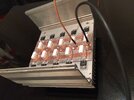
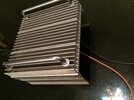
0-30 VDC Stabilized Power Supply 0.002-3 A

CBETO3AP

Oct 21, 2015
22
Joined
Oct 21, 2015
Messages
22
Hi all

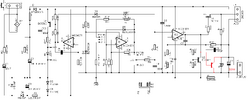
I really like this scheme and I am thinking about reproducing it for my own use. Even though, there is something that I miss and it's that the capacitors are too small in the out and I need them to be bigger. I think add a transistor in order to avoid problems with discharge of 0.1F cap.

Svetozar
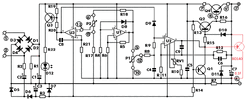
schem1.gif


audioguru2

Apr 6, 2004
12,026
Joined
Apr 6, 2004
Messages
12,026
You do not need a huge output capacitor because the circuit has voltage regulation.

Actually this original old circuit from a Greek kit has many overloaded parts and is not reliable. We fixed in and you can see the improved circuit in the forum.

A Chinese kit copy (from Banggood or something) is sold at a very low cost but it also has some overloaded parts.


CBETO3AP

Oct 21, 2015
22
Joined
Oct 21, 2015
Messages
22
Thanks for the warning. I actually first saw Hristo scheme, and which I will be adapt to 0-20V 0-10A.

PS_sch2.png

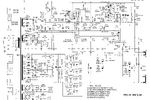
Clear that one of the purposes of this circuit is to maintain a stable output voltage, but how it would behave if the load is 9A pulses? My idea for laboratory power supply is a device in which the pulses of output V are kept to a minimum in all conditions, and when consumption exceeds the set limits - lowering out Instantly. So I think an improvement add a large capacitor on the output and the possibility of discharge Instantly. And if they are not really necessary discharge transistor it is, to discharge the capacitors in the device that we connected to our source of power. Here I leave as an example an old but very good Bulgarian scheme which implements the discharge transistor.

 TES-18.png


audioguru2

Apr 6, 2004
12,026
Joined
Apr 6, 2004
Messages
12,026
When a capacitor is discharged by a high load current then its voltage begins to drop immediately since it has no voltage regulation.

When you want the output capacitor discharged then you are using a transistor that will vaporize. The only thing limiting the current in the discharge transistor is its current gain since the opamp can supply its base with only about 20mA .


CBETO3AP

Oct 21, 2015
22
Joined
Oct 21, 2015
Messages
22
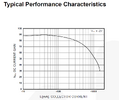
I can see myself forced to put a resistor 10R, but according to manufacturer seems not.

BD140-hFE.png

To test the reaction of the discharge transistor of a TES I set I = 0.01A and U = 15V. When connecting a 0.1W LED Light Peak is not noticeable, just lights. I know it's something old test this way, but I did over 25 years ago. I would love to get the same but with large capacitors in the output. This might not be the most appropriate transistor and connection. It is the first thing that occurred to me, basic and seems to work. The idea is to eliminate the charge on the capacitors even in the device we tested when something goes wrong to protect circuits behind them.


CBETO3AP

Oct 21, 2015
22
Joined
Oct 21, 2015
Messages
22
Hi audioguru.
Now that I'm done with the other conversation I would like to continue this.
To me the truth I do not like to limit the transistor with a resistor if possible. You do not think it is possible to hold without burning? From what I see in the manufacturer PDF, gain low wen collector current up. I would try immediately if possible, but for now have only the PCB, I hope the components, and am content with theory.
Please excuse my bad English, it is the google translator.. :-[


audioguru2

Apr 6, 2004
12,026
Joined
Apr 6, 2004
Messages
12,026
Your main filter capacitor value is much too low for an output of 10A. use at least 20,000uF.

The transformer voltage is too high for a maximum output voltage of only 20V and its current rating is much too low.

The poor little BD139 driver transistor will smoke and die if you are unlucky to find those very old output transistors with low current gain.

Q1 is completely wrong. Its maximum allowed reverse bias on its base-emitter is only 5V.   


CBETO3AP

Oct 21, 2015
22
Joined
Oct 21, 2015
Messages
22
First thanks for the comments.
Just I get started to modify the scheme and did not have much time to review and change everything I need. Also I expect your comments. It is the first time I use Proteus. I always try to build recycling scrap, bought mainly old PCB 1 € / 1kg. The TIP35C have them in large quantities, with pin collector cut but not be a problem. The toroid transformer is 2x12v / 300w, C1 will probably be 2x18000uf, my friend has 4 also scrap. So far I have not decided, we'll see.
What I had not thought is the reverse bias of BD140, I'll have to protect it, thanks for advice.  BD139 is 12W 1.5A, TIP35C gain to 1.5A is 25-50. If consumed 10A output to 0V, in the collector BD135 would have 0.4A for 30Vce = 12W. I'm wrong? I know, it is at the limit... You can suggest another transistor to facilitate me?


Why R7 is the wrong value for this configuration???

View attachment TIP35C.pdf

View attachment BD140.pdf

View attachment BD139.pdf

View attachment 42644

View attachment 0-20v,0-10a1.bmp

 
Last edited by a moderator:

liquibyte

Aug 27, 2015
23
Joined
Aug 27, 2015
Messages
23
I'm sorry, I should have said I think it's the wrong value for this configuration.  I'd have to work out the math for it but I think you'd do better with a much lower value at 10A output.  Doing that would require also adjusting the resistor values around the voltage reference and current regulation circuit.


audioguru2

Apr 6, 2004
12,026
Joined
Apr 6, 2004
Messages
12,026
The datasheets for the BD139 and BD140 show that the chip will be at its maximum allowed temperature if it dissipates 12.5W and its case is cooled down to 25 degrees C somehow (with a huge heatsink in liquid nitrogen?). In free air a pretty big heatsink will get hot then the chip will be too hot.

EDIT: I forgot. I do not know of a power transistor that can dissipate more heat and is as fast as the BD139. The problem with using two BD139 transistors in parallel, each with an emitter resistor, is that they will overload the opamp that drives them. 

 
Last edited by a moderator:

CBETO3AP

Oct 21, 2015
22
Joined
Oct 21, 2015
Messages
22
I have a doubt. What is the function of zener D1 (D3) of 10v, why is there?


audioguru2

Apr 6, 2004
12,026
Joined
Apr 6, 2004
Messages
12,026
The 10V zener diode reduces the total supply voltage of U3 from its absolute maximum of about 44 V to about 34V. Then opamp U3 will be cooler and it will live longer.

EDIT: But it is not needed in your circuit since your input and output voltages are lower.

 
Last edited by a moderator:

CBETO3AP

Oct 21, 2015
22
Joined
Oct 21, 2015
Messages
22
Thank you.
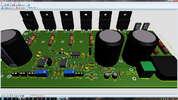
At the moment he stays. I have some progress with Proteus.

0-20V_0-10A_20x20-3Dmm.png


kollin

Dec 20, 2015
5
Joined
Dec 20, 2015
Messages
5
Hi mr. Audioguru. Why would say that the kit from banggood is overloaded? I was about to make myself one. 


audioguru2

Apr 6, 2004
12,026
Joined
Apr 6, 2004
Messages
12,026
The kit from Banggood is a copy of the original kit from Greece with a couple of parts changed. It will not produce 30VDC at 3A and the TL081 opamps will have a total supply voltage higher than they are allowed when the load current is low. The single output transistor will get much too hot when the output voltage is low but the current is high. If you calculate the power in many resistors then you will see that they are overloaded.

The schematic is from the Greek kit and does not show the 7824 regulator that would drive a fan. The regulator is also not on Banggood's parts list. 

If you like to gamble then you can build it and maybe you will be lucky that it does not become destroyed.


audioguru2

Apr 6, 2004
12,026
Joined
Apr 6, 2004
Messages
12,026
What will you use to drive the 10 output transistors? 5 or 10 driver transistors that are driven from 5 opamps.

Do you really need 30A? For what?

 
Top