M
MrDarkenRahl
- Jan 1, 1970
- 0
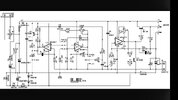
The U1 is clear - a reference voltage source 11,2V. U2 also - opamp reinforcement 3, so that the maximum voltage at the input of the output equal to 11,2V receive up 33,6V (using an appropriate transformer, but we assume that it is good).
One of the features is not very clear U3 - I know it is responsible for the current protection and opamp works here as a comparator (I think). However, from my calculations in section 6 of the potentiometer P2 maximum voltage of about 1,7V (P2 and R18 are a voltage divider, R17 can be omitted because it is of little value, we put it becouse on the lowest setting to P2 amplifier input can be shorted to ground). So potentiometer P2 can set the voltage from 0 to 1,7V. However, at maximum current consumption measurement resistor R7 hangs at most 1,41V (0,47R * 3A). Which implies the difference? Comparator can detects a voltage difference already tiny.
But another question - if U3 inverting input (-) have less potential than the non-inverting input (+) the output voltage of U3 is potential of leg 7 of U3, and according to that diode D9 does not conduct. However, if power consumption exceeds the voltage at the output of U3 have potential of leg 4 of U3 (so it is about -5V) and diode D9 becomes conductive. But what happens next? Because that's the part I do not understand.
Another problem is the presence of R8 and R9. I think in terms of the setting of gain opamp U2, right? What the presence of C4, C6 and C9?
And the last question - why current limiter isn't linear? I mean when we change output voltage with the same load, the current limiter change value. Why? Maybe you can give me a example power supply we can set output current which doesn't depend of output voltage?
I know that on this site is to explain the action, but does not respond to my questions. I hope someone enlighten me, because a long time I break their heads.
One of the features is not very clear U3 - I know it is responsible for the current protection and opamp works here as a comparator (I think). However, from my calculations in section 6 of the potentiometer P2 maximum voltage of about 1,7V (P2 and R18 are a voltage divider, R17 can be omitted because it is of little value, we put it becouse on the lowest setting to P2 amplifier input can be shorted to ground). So potentiometer P2 can set the voltage from 0 to 1,7V. However, at maximum current consumption measurement resistor R7 hangs at most 1,41V (0,47R * 3A). Which implies the difference? Comparator can detects a voltage difference already tiny.
But another question - if U3 inverting input (-) have less potential than the non-inverting input (+) the output voltage of U3 is potential of leg 7 of U3, and according to that diode D9 does not conduct. However, if power consumption exceeds the voltage at the output of U3 have potential of leg 4 of U3 (so it is about -5V) and diode D9 becomes conductive. But what happens next? Because that's the part I do not understand.
Another problem is the presence of R8 and R9. I think in terms of the setting of gain opamp U2, right? What the presence of C4, C6 and C9?
And the last question - why current limiter isn't linear? I mean when we change output voltage with the same load, the current limiter change value. Why? Maybe you can give me a example power supply we can set output current which doesn't depend of output voltage?
I know that on this site is to explain the action, but does not respond to my questions. I hope someone enlighten me, because a long time I break their heads.