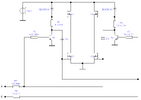
50V, 50A H-Bridge IC needed

Riccardo1

Jul 28, 2008
56
Joined
Jul 28, 2008
Messages
56
Ok, I melted it! (not so suprising :-[)

Wen I tested with 18V, it was simply a pair of 9V PP3 batteries in series.

The test load was a little solenoid with a resistance of 54 ohms.

When I replaced the 18V with a 24V SLA battery, the MOSFETs (rated for 40A) blew immediatley. I had a 30A car fuse installed but I guess it was too slow acting.

It seems like there must have been a shoot through condition, but I don't know why.


I replaced the MOSFETs and then tested again at 18V from a 5A PSU. This again seems to be working fine, even with lower resistance loads. I do notice though that the heat sink holding the high side MOSFETs gets quite warm, while the low side one is totally cold.

I noticed that you mentioned I could replace R1 and R3 with zeners. Is something like this going to make this work better with the different possible voltages/currents?


Hero999

Oct 28, 2007
2,433
Joined
Oct 28, 2007
Messages
2,433
The high side MOSFETs will dissipate more power because they are P-channel and will have a higher on resistance.

two 9V batteries in series driving a 54R load is not 18V because the batteries are overloaded the voltage will drop to around 14V.

I don't know why the MOSFETs blew when it was connected to a 24V supply. Replacing the resistors with zeners will enable the circuit to work from any voltage above the required gate voltage for the high side to pass the desired current, up to the maximum voltage rating of the MOSFET and the load. Just make sure that the power dissipation of the zeners and resistors is not exceeded.


Riccardo1

Jul 28, 2008
56
Joined
Jul 28, 2008
Messages
56
Yes, that makes sense, they have twice the resistance (0.06 vs the 0.033 of the n types). I'm using IRF5210PBF and STP40NF10L.

With the current limited to 5A, I can turn up the voltage without it blowing, but I do notice that if I feel the case of the p-types, they are very hot within seconds while the n-types are cold (this explains why the blew when using the 24V SLA).
The load (a hollow coil with a screwdriver in it so I can hear it vibrate) sounds like it is working with the pulses I send from a PIC.

So do you think the p-types are not switching on, or maybe off properly? How could I test this?

I've attached my current circuit.

View attachment 40880


Hero999

Oct 28, 2007
2,433
Joined
Oct 28, 2007
Messages
2,433
Only D3 and D5 are required.

Think about it.

The gate voltage for the lower MOSFETs comes from a logic circuit so there's no chance of it exceeding 5V, let alone 20V.

The voltage is also only one polarity so there's no need to connect the zeners back-to-back which is only required for AC.

D3 and D5 are also in completely the wrong place: they need to be connected between the gate and source.

The circuit should be the same as my previous circuit but with R1 and R3 replaced with zener diodes. D1 and D2 don't need to be Schottky barriers, ordinary silicon diodes will do.


Riccardo1

Jul 28, 2008
56
Joined
Jul 28, 2008
Messages
56
I see, so those zeners being in the wrong place would be why the p-types were not switching as I expected.

I had the other excess zeners like that just as some overkill really. I can see they are not needed, but there's no harm in leaving them there is there (they are already soldered to my board)?

The attached diagram is better?

View attachment 40881


Hero999

Oct 28, 2007
2,433
Joined
Oct 28, 2007
Messages
2,433
The polarity of the zeners needs to be reversed, they won't protect the MOSFETs as they're currently connected.

Remember a zener just acts like a normal diode when it's forward biased.


Riccardo1

Jul 28, 2008
56
Joined
Jul 28, 2008
Messages
56
oh yes, sorry, I never worked with p-types before.

I made the changes and it did seem to work better.

When I switched to the 24V SLA though, it melted again. It did seem to take about half a second this time rather than being instant as before. The heat sink is pretty big so it can't be that.

The test coil I was using has a resistance of 2.8 ohms and an inductance of a few mH. So at most the current should be about 9A.

There are two things I can think of to check. One would be to test the circuit with a resistive load to see if it is somehow the inductance causing the problem. The other thing will be to check the voltage drop on the battery as if it goes too low, the gates wont switch properly.


Riccardo1

Jul 28, 2008
56
Joined
Jul 28, 2008
Messages
56
The battery voltage drops to 22 when I connect the coil directly, so this should be fine.

I replaced the MOSFETs, and I've noticed that the circuit draws some current even when no load is connected. If I put the 4k7 resistors across the zeners, it stops this happening.

Could the values of R2/4/5/6 need changing?

(PS they are 12V zeners)

I've not removed the low side zeners yet as I think they are doing nothing right?

I really appreciate your help, I'll send you something nice when its working!


Riccardo1

Jul 28, 2008
56
Joined
Jul 28, 2008
Messages
56
It makes no difference unfortunately. I've even tried just pulsing bridgeA and leaving the other off. The high side MOSFET still gets hot quickly.

For example using a 1R resistive load, 24V input (drops to 22V)  from an SLA. Pulsing to give avearge current of about 9A. After 10 secs, low side measures 25C and the high side measures 85C and rising. (I'm measuring the front of the case rather than the heat sink)

So, now it is only pulsing a resistive load and in one direction. When I've use single n-types, such heating would make me think it is not fully on, or has a high on state resistance. The datasheet says 0.06 ohms, so average power dissipation should be just 5W.

I want to try manually holding the high side on, then pulsing one of the low side ones to see if the same heating occurs. For the P-type, do I need to make it about 10V lower than the source pin rather than 10V higher as you would in an N-type?


Hero999

Oct 28, 2007
2,433
Joined
Oct 28, 2007
Messages
2,433
First check that the schematic is wired as per the attachment below.

Check the voltage across each zener is around 10V.

You might need to reduce the values of R2 and R4 slightly to ensure the zener current is high enough for the zeners to clamp the voltage effectively.

50V_50A_h-bridge_zener.PNG

 
Last edited by a moderator:

Riccardo1

Jul 28, 2008
56
Joined
Jul 28, 2008
Messages
56
I just measured Vgs during the pulse to be about -5.8 V (Vth is -4V max on the datasheet).

I will reduce those resistor values slightly (R2, R4) to pull the gates a bit lower.


Alex Tsekenis

Nov 29, 2009
299
Joined
Nov 29, 2009
Messages
299
If everything is fine and the heating is purely due to the Mosfet being a P-type, I can reccomend an excellent 8-pin IC to drive an N-channel device on the high-side by using a capacitor charge pump topology and an internal oscillator, gate driver.


Alex Tsekenis

Nov 29, 2009
299
Joined
Nov 29, 2009
Messages
299
I just had a better look at the final circuit. The zener voltage is too low which makes me think that you are operating them far away from the zener region. As suggested, reduce R2,R4. You can also measure and include in your resistor calculation the C-E saturation voltage of Q1, Q2 although that will be tiny compared with Vpower-Ground.

Also in a previous post you say that you will keep a high side on and pulse the low sides. Careful, you will blow a pair up on either the first or second pulse.


Riccardo1

Jul 28, 2008
56
Joined
Jul 28, 2008
Messages
56
Ok, I reduced R2 and R4 to 4k7 as it seemed the gate voltage needed to be about -11V to have it fully on. I've also got zeners in parallel for when the voltage input gets higher. This seems to work pretty well!

 
Top