Why?
When you are designing an audio amplifier, specifying a
single dc power supply severely limits your circuit design options. The sub-woofer is accepting low-frequency alternating current audio signals and producing sound by moving a voice-coil back and forth about a centered position in an axial magnetic field. The centered position occurs when no signal is applied to the sub-woofer.
To produce 50 watts into an 8 ohm impedance requires a 20 volt (rms) AC voltage across the speaker terminals. That's about 28 volts peak amplitude on either side of zero, or about 56.6 volts peak-to-peak. To get this from a single power supply will (1) require about 60 volts DC and (2) an electrolytic capacitor coupling between the amplifier output and the sub-woofer speaker terminals connected between the amplifier output and power supply common.
The amplifier output from a single 60 VDC supply will be at about 30 VDC with respect to power supply common when the audio input signal is zero. If you apply this DC voltage to the sub-woofer voice coil, it will either cause draw excessive current and burn up, or the voltage will cause the voice coil to move far away from it's normally centered position and create distortion and clipping of the audio sound output. Hence the need for the dc-blocking/ac-coupling electrolytic capacitor.
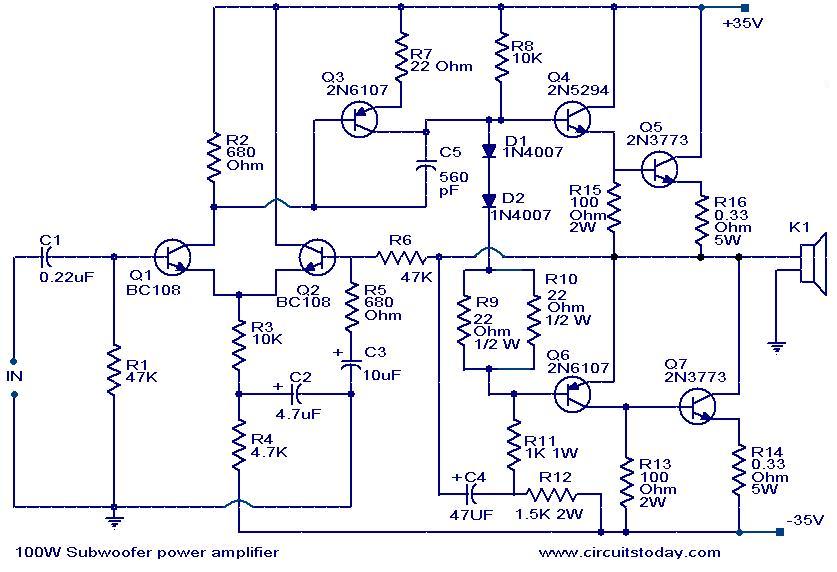
You could avoid item (2) by using bi-polar ±30 VDC supplies, or a slightly greater pair of opposite voltages, say ±35 VDC. See schematic below. You cannot avoid item (1) if you need to provide 50 watts into an 8 ohm load.
The reactance of the electrolytic dc-blocking/ac-coupling capacitor should be small compared to the 8 ohm speaker impedance, say 0.8 ohms at the lowest frequency of interest, but 0.08 ohms would be even better. Ideally, the dc-blocking capacitor would have zero ac-coupling reactance, but that is impossible.
If the sub-woofer response goes down to, say, 10 Hz then X
C = 1/(2πFC) = 0.08 yields a value for C = 1/[2π(10)(0.08)] = 0.1989 F = 198,900 μF or about 200,000 μF. Good luck finding, or being able to afford, one of those puppies with a voltage rating of 100 WVDC or thereabouts.
Even if you allow for a capacitive reactance of "only" 0.8 ohms instead of 0.08 ohms, that still requires a humongous 20,000 μF electrolytic capacitor. And all because you refuse to consider using a bi-polar power supply to power your sub-woofer amplifier. OTOH, if you change your mind, maybe you could try building
this circuit:
Also, maybe you could learn a little more electronics before imposing arbitrary limits on your circuit designs. Having a single power supply is a WANT, but there is good reason to believe it is NOT a NEED for this application and causes needless extra expense.