A little help on how to switch transistors

MizziTDK

Jan 21, 2015
7
Joined
Jan 21, 2015
Messages
7
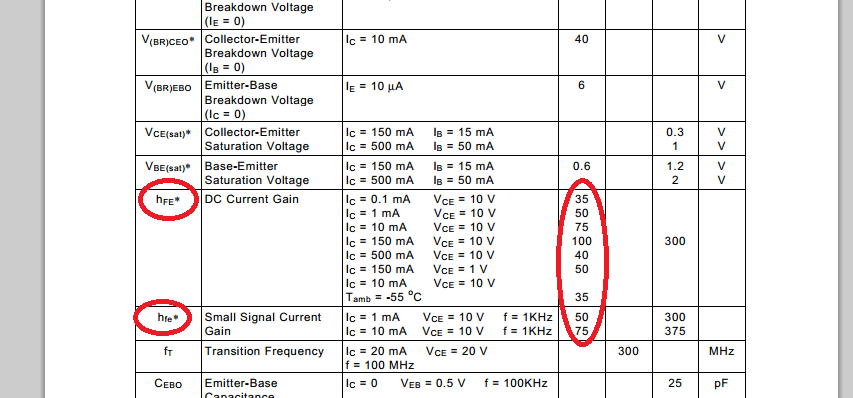
Hi guys! I am currently making a project using an arduino. In this project, I will be using transistors to multiplex 7 segment displays. I know a little about transistors. But I am having a problem reading the datasheet. I'd like to use the transistor (specifically 2n2222a) as a switch but I don't know how to choose which Beta to use from the datasheet. I know that in order to saturate the transistor IB > ICsat/Beta, but how should I know beta from this datasheet:
hclDMLQ.png


Which beta should I use to base my calculations? Thanks!
 

KrisBlueNZ

Sadly passed away in 2015
Nov 28, 2011
8,393
Joined
Nov 28, 2011
Messages
8,393
It depends on what collector current you will be running the transistor at. But all but one of those lines is measured at VCE = 10V which is not true when you're using the transistor as a saturated switch.

This is why you should use a base current several times the value you calculate by dividing IC by hFE if you want to ensure that the transistor is fully saturated.

You may find the following resources useful:
https://www.electronicspoint.com/resources/using-a-bipolar-transistor-to-turn-a-load-on-and-off.30/
https://www.electronicspoint.com/resources/saturation-in-transistors-bjts-why-and-how.28/

You may find it's simpler to use N-channel MOSFETs instead. These are voltage-driven and you need to ensure that VGS is high enough to guarantee a nice low RDS value, which means you'll probably want a "logic level gate" device which has its maximum RDSon specified at VGS = 4.5V and even lower. They're normally more efficient than transistors, though the best ones are so new they're only available in SMT packages. Have a look at http://www.digikey.com/product-sear...8007d,9780013&stock=1&quantity=1&pageSize=500
 

MizziTDK

Jan 21, 2015
7
Joined
Jan 21, 2015
Messages
7
It depends on what collector current you will be running the transistor at. But all but one of those lines is measured at VCE = 10V which is not true when you're using the transistor as a saturated switch.

This is why you should use a base current several times the value you calculate by dividing IC by hFE if you want to ensure that the transistor is fully saturated.

You may find the following resources useful:
https://www.electronicspoint.com/resources/using-a-bipolar-transistor-to-turn-a-load-on-and-off.30/
https://www.electronicspoint.com/resources/saturation-in-transistors-bjts-why-and-how.28/

You may find it's simpler to use N-channel MOSFETs instead. These are voltage-driven and you need to ensure that VGS is high enough to guarantee a nice low RDS value, which means you'll probably want a "logic level gate" device which has its maximum RDSon specified at VGS = 4.5V and even lower. They're normally more efficient than transistors, though the best ones are so new they're only available in SMT packages. Have a look at http://www.digikey.com/product-search/en?pv959=5&pv959=7&pv959=8&pv959=9&pv959=11&pv959=13&pv959=18&pv959=15&FV=fff40015,fff8007d,9780013&stock=1&quantity=1&pageSize=500

Thanks for your reply. I'll surely read those articles. Well, I am still learning the BJT so I'll pass the MOSFETs for the mean time. But thanks though. I have another question. What if the Ic that I will be using is not indicated in data sheet like for example my Ic would be 14ma which is definitely not indicated in the datasheet. How should I know what is its corresponding beta?
 

KrisBlueNZ

Sadly passed away in 2015
Nov 28, 2011
8,393
Joined
Nov 28, 2011
Messages
8,393
A simple way is to find the two lines on the specification table that are above and below your IC value and choose the lowest hFE, to be on the safe side. In your case, 14 mA is between 10 mA and 150 mA so you choose the lowest of 75 and 100, which is 75.

You can also look at the hFE vs. IC graph in the typical characteristics section of the data sheet to see how hFE varies with IC. Change the vertical scale so hFE is 75 at IC = 10 mA, and 100 at IC = 150 mA, and use the shape of the graph to estimate the minimum hFE for 14 mA. It will be pretty close to 75 anyway.

But as I said in the first paragraph of post #2, those figures apply with VCE = 10V, i.e. the transistor is a long way from saturation. That's why you need to use a large safety factor when calculating IB to saturate the transistor at a given IC.
 
Top