Adjustable brightness torch??

KrisBlueNZ

Sadly passed away in 2015
Nov 28, 2011
8,393
Joined
Nov 28, 2011
Messages
8,393
They don't have BUZ11 but that one is suitable for that circuit.
 

bikemech

Oct 23, 2014
456
Joined
Oct 23, 2014
Messages
456
they do have that one , but the store is over half an hours drive from me,
there is lots on ebay, should i just go for a buz11, i dont know which others would do the job
 

KrisBlueNZ

Sadly passed away in 2015
Nov 28, 2011
8,393
Joined
Nov 28, 2011
Messages
8,393
Sure, you can get them via eBay. You're more likely to get stung by a counterfeit though. (Yes, counterfeiting is a growing problem in the electronics industry - see http://sound.westhost.com/counterfeit.htm for some good information.)

Any N-channel MOSFET with a current rating of at least a few amps, and a voltage rating of at least 30V, should be fine. If the auctions also specify the device's ON-resistance, RDS(ON), go for the lowest one you can find, because that will be the most efficient.
 

bikemech

Oct 23, 2014
456
Joined
Oct 23, 2014
Messages
456
PWM is the sensible option. Can be done fairly simply using a 555 driving a MOSFET. See http://www.reuk.co.uk/LED-Dimmer-Circuit.htm for an example. It is designed to vary the speed of a motor but there's little difference. Here's the circuit from that page:

View attachment 17135
Replace MOT1 with the torch (bulb or LED). D3 is not needed because the load is not inductive. Connect another 0.1 µF capacitor (ceramic) directly between pins 1 and 8 of the 555. That circuit should work pretty well. Can be built up on stripboard aka veroboard. Google stripboard construction for info.

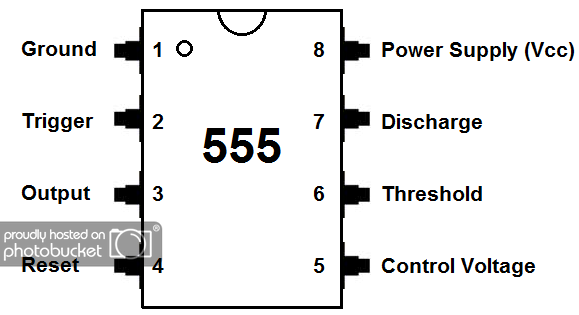
do the numbers on the 555IC in the diagram represent the pin numbers? just on the pin out there not in this order,
is it just drawn this way to make it easier to draw?
 

Gryd3

Jun 25, 2014
4,098
Joined
Jun 25, 2014
Messages
4,098
do the numbers on the 555IC in the diagram represent the pin numbers? just on the pin out there not in this order,
is it just drawn this way to make it easier to draw?
The numbers = the pins.
I've seen it drawn like that often, it confuses me too...
 

bikemech

Oct 23, 2014
456
Joined
Oct 23, 2014
Messages
456
so this is the correct location of the numbers in the drawing?
555ICpinout_zps631f0113.png
 

Gryd3

Jun 25, 2014
4,098
Joined
Jun 25, 2014
Messages
4,098
so this is the correct location of the numbers in the drawing?
555ICpinout_zps631f0113.png
Looks right from what I can tell... and the oddball drawing from before, I understand why.
take a look here. I guess it makes it simpler to show the internals and understand when you draw it out than to make a mess of wires to use the actual chip pinout.
 

bikemech

Oct 23, 2014
456
Joined
Oct 23, 2014
Messages
456
Will the circuit in post #4 handle a 100watt halogen bulb and a 12V 14ah battery, this is what it is to be used on, looking at the components they seem a little inadequate for the job?
 

KrisBlueNZ

Sadly passed away in 2015
Nov 28, 2011
8,393
Joined
Nov 28, 2011
Messages
8,393
Yes, a 12V, 100W halogen bulb will draw 8A, and that's at full operating temperature. It will draw more current at lower brightness because the filament resistance will be lower because it will be cooler. This could well cause problems.

The important factors are:
  1. The MOSFET must be a type with very low RDS(on). For operation over the full range of brightness, to keep I2R losses under 1W, RDS needs to be less than 20 mΩ, and the MOSFET's current rating needs to be at least 100A. Here's one that looks quite good: http://www.digikey.com/product-detail/en/IRFB7437PBF/IRFB7437PBF-ND/3454580 and it's under USD 2.00.
  2. Switching losses must be minimised. This means hitting the MOSFET gate with a high drive current in both positive and negative directions. The 555 is pretty limited here. A high-current low-side MOSFET gate driver IC is probably the best option, and a good choice would be the MCP1407 (typically ±6A drive current): http://www.digikey.com/product-detail/en/MCP1407-E/P/MCP1407-E/P-ND/1228640. It can be driven directly from the 555's output.
  3. The circuit must be constructed using thick connections and wires ino all high-current parts of the circuit. These parts of the circuit are the battery, the lamp, and the drain and source of the MOSFET. Other parts of the circuit just "hang off" those parts, with connections at the MOSFET's source and the point where the battery and the bulb join together. So the actual layout of the construction will be important.
  4. Inductors (rated for dozens of amps) may be needed to reduce emissions of electromagnetic interference. This emission can be reduced by keeping the battery, circuitry, and lamp all housed in a single metal container.
I'll draw up a schematic.
 

KrisBlueNZ

Sadly passed away in 2015
Nov 28, 2011
8,393
Joined
Nov 28, 2011
Messages
8,393
Schematic as promised
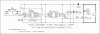
271430.001.GIF

The 555 oscillator is exactly as before, apart from the addition of a decoupling capacitor, CD1, which must be connected as directly as possible between pins 1 and 8 of the 555 to ensure reliable operation.

The 555's output feeds U2, a Microchip MCP1407 low-side MOSFET gate driver which has a specified maximum output current of 6A. It also needs a decoupling capacitor, placed as close as possible to pins 5 and 8.

The gate drive current is limited by RG and drives Q1, a very grunty MOSFET with a maximum RDS(on) of 2 mΩ, a maximum voltage of 40V and a rated current of 195A, which switches the circuit to the lamp.

The oscillator and drive circuit is decoupled from disturbances in the high-current path due to inductance and battery ESR/ESL. DS and CD ensure that brief dips don't disturb the signal circuitry, and DP protects it from overvoltage due to overshoot.

The section shown with thick lines should be as compact and solidly constructed as possible, and wire lengths should be minimised as much as possible. The rest of the circuit should connect only at Q1's source and at the common point between the battery positive and the lamp.

Q1 will probably not need heatsinking.

This circuit switches heavy currents (8A and more) very quickly. This design is only a starting point. Modifications may be needed to reduce EMI and possibly for other reasons too.
 

bikemech

Oct 23, 2014
456
Joined
Oct 23, 2014
Messages
456
Thank you for the schematic, going to try and get all the parts soon , I have veroboard now and we'll all the parts listed in the first schematic, so just need a few more to start building
 
Top