Auto shut off circuit

circuitmaker

Mar 20, 2024
18
Joined
Mar 20, 2024
Messages
18
Hi everyone,

I have a security siren circuit, using a CMOS IC. It goes off as soon as it is connected to a power supply. I would like to limit it by 30-60 seconds and turn it off automatically. I am aware of the 555 timer monostable circuit, but cannot figure out how to use it without a physical button. I wonder if there is a way to trigger a 555 monostable circuit when it is connected to a power supply? In such a case I could use the 555 output for the siren. I want the circuit to work automatically without any physical interaction.

I am open to any other ways if using 555 in my application is impossible.
 

AnalogKid

Jun 10, 2015
3,045
Joined
Jun 10, 2015
Messages
3,045
Please clarify your question.

I would like to limit it by 30-60 seconds and turn it off automatically.

Do you mean that you want the siren to come on immediately when power is applied, and they turn off after 30-60 seconds?

Then what? Does the siren remain silent until power is removed and reapplied?

What is the voltage for the timer circuit?

What is the voltage for the siren? What is the siren current?

Please post your circuit. It might be possible to do what you want by modifying it, as opposed to starting over with a 555.

ak
 
Last edited:

circuitmaker

Mar 20, 2024
18
Joined
Mar 20, 2024
Messages
18
Do you mean that you want the siren to come on immediately when power is applied, and they turn off after 30-60 seconds?
Yes
Then what? Does the siren remain silent until power is removed and reapplied?
Yes
What is the voltage for the timer circuit?
I didn't expect it to be so important. Probably 5v-12v.
What is the voltage for the siren? What is the siren current?
Probably the same 5v-12v. Current is <1A.
Please post your circuit. It might be possible to do what you want by modifying it, as opposed to starting over with a 555.
It is an assembled siren that you may get from Amazon, like this one:
 

AnalogKid

Jun 10, 2015
3,045
Joined
Jun 10, 2015
Messages
3,045
The siren draws 120 mA at 12 V, which is within the capabilities of a standard 555 without an external driver transistor. Based on your responses, a single 555 should do what you want. Schematic to follow.

However, this also can be done with just 1 transistor, a small-signal MOSFET like the 2N7000, or two small transistors such as the 2N3904/3906.

The standard (bipolar) 555 does not do long timer periods well. An alternative is a CMOS version such as the LMC555, but this part cannot drive a 120 mA load and would need a small transistor to drive the siren. Another option is a CMOS logic IC like the CD4093.

ak
 

AnalogKid

Jun 10, 2015
3,045
Joined
Jun 10, 2015
Messages
3,045
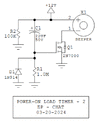
Turns out I already answered this two years ago on another forum. Here is that schematic, re-worked for your application.

This circuit powers the load for approx. 44 seconds. R1and C1 set the delay.

R2 and D1 provide a rapid discharge path for C1 when power is removed, so it doesn't take the circuit another 44 seconds (or more) to reset.

Rearranging the parts, this circuit also will work with a p-channel FET if you already have some of them.

ak
Power-On-Load-2-c.gif
 
Last edited:

circuitmaker

Mar 20, 2024
18
Joined
Mar 20, 2024
Messages
18
Thank you so much for your quick response. This works perfectly well. It turned out that I was trying something similar but the cap was connected directly to the ground. Could you please explain how this works? I don't understand why the cap is slowly turning off the MOSFET.

Also, there is a minor problem. When the capacitor is fully charged a subsequent power supply dis/connection does not work. Is there a simple way to discharge the cap?
 

AnalogKid

Jun 10, 2015
3,045
Joined
Jun 10, 2015
Messages
3,045
While you were typing, I updated the post with an improved schematic.

In almost all R-C timer circuits, a capacitor is charged "up" through a resistor. Over a time period, the voltage across the cap steadily (but not linearly) increases until it equals the supply voltage. Actually, the voltage increases as an inverse-exponential that theoretically *never* equals the supply, but I digress.

"up" is in quotes because just like in outer space, there is not absolute up or down. The cap starts out with zero charge, and over time that charge increases and so does its terminal voltage. But the cap doesn't know about this thing we call GND. It only knows that one lead is more or less positive than the other. Holding one end at GND and applying a positive voltage to the other is exactly the same as holding one end at a positive voltage, and applying a less positive voltage to the other. So in this circuit, the cap is charging up, but the bottom end of the cap is moving down toward GND.

Whatever - When power is applied, the voltage across the cap is 0 V; thus, both ends, and the gate, are at +12 V. While the cap charges "up", the gate voltage decreases as R1 pulls one end of C1 toward GND. At any gate voltage above about 2.5 V, the FET is fully enhanced ("on") and the siren is at full volume. As the gate voltage continues its relentless descent to GND, the FET begins to turn off. At about 0.5 V the FET is fully off.

Because it takes about 2 V of change in cap voltage for the FET to go from on to off, the siren will not turn off crisply; its volume will decrease over several seconds. If this is an issue, there are several possible remedies.

The same thing can be done with a 555. Reversing the R and C positions, with the C connected to Vcc, can make a 555 so the same thing, but with much more crisp transitions.

ak
 

AnalogKid

Jun 10, 2015
3,045
Joined
Jun 10, 2015
Messages
3,045
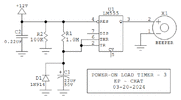
Here is the same circuit using a 555, with the timing capacitor in its traditional location.

Note that while a bipolar 555 output stage is extra-beefy, it is not super efficient. At your load current and a 12 V operating supply, the voltage across the siren will be around 10 V, not 12. Still, it will have a very crisp turn-off.

ak
Power-On-Load-3-c.gif
 

circuitmaker

Mar 20, 2024
18
Joined
Mar 20, 2024
Messages
18
Note that while a bipolar 555 output stage is extra-beefy, it is not super efficient. At your load current and a 12 V operating supply, the voltage across the siren will be around 10 V, not 12. Still, it will have a very crisp turn-off.
I know that the siren is using an autotransformer with three pins to increase the voltage. It remains very loud even with a low voltage like 3.3V. Anyway, thanks for your concern.
 

bertus

Moderator
Nov 8, 2019
3,835
Joined
Nov 8, 2019
Messages
3,835
Hello,

NE555 and LM555 are basicaly the same but different manufactures.
The LMC555 is a cmos version, that can not drive the sirene.
@AnalogKid , should pin 8 also be connected to the 12 Volts?

Bertus
 

AnalogKid

Jun 10, 2015
3,045
Joined
Jun 10, 2015
Messages
3,045
@AnalogKid , should pin 8 also be connected to the 12 Volts?

Bertus
My schematic software does not show power and GND connections to logic devices. I should have pointed that out to the TS. oops.

C2 is the power supply decoupling capacitor. It connects to the device Vcc and GND pins with the shortest possible leads. Most ICs require power supply impedance mitigation (decoupling) to function properly.

R2 provides a discharge path for C1. If power is switched off, as in a physical switch, then the top end of R1 is basically an open circuit. Depending on a little leakage current through the unpowered IC, C1 could hold its charge for a while, possibly even longer than the timing period and certainly way longer than you want to wait for the circuit to reset itself. The value of R2 is a tradeoff. The higher the value, the longer the reset time, but the lower the static current through it when the circuit is operating. This might be important in a battery-powered application. A low value resets (discharges) C1 much more quickly, but consumes more power when the circuit is powered. With the values shown, the reset time is less than 7 seconds.

ak
 

circuitmaker

Mar 20, 2024
18
Joined
Mar 20, 2024
Messages
18
My schematic software does not show power and GND connections to logic devices. I should have pointed that out to the TS. oops.

C2 is the power supply decoupling capacitor. It connects to the device Vcc and GND pins with the shortest possible leads. Most ICs require power supply impedance mitigation (decoupling) to function properly.

R2 provides a discharge path for C1. If power is switched off, as in a physical switch, then the top end of R1 is basically an open circuit. Depending on a little leakage current through the unpowered IC, C1 could hold its charge for a while, possibly even longer than the timing period and certainly way longer than you want to wait for the circuit to reset itself. The value of R2 is a tradeoff. The higher the value, the longer the reset time, but the lower the static current through it when the circuit is operating. This might be important in a battery-powered application. A low value resets (discharges) C1 much more quickly, but consumes more power when the circuit is powered. With the values shown, the reset time is less than 7 seconds.

ak
Thank you so much for your explanation. I learned a lot in this short post.
 

Delta Prime

Jul 29, 2020
2,987
Joined
Jul 29, 2020
Messages
2,987
"up" is in quotes because just like in outer space, there is not absolute up or down.
When we look up into the sky on earth,
it may seem counterintuitive, but we are actually looking downwards into the vast expanse of the infinite universe. This intriguing perspective is a result of the gravitational force that binds us to our planet, pulling us towards its center. Despite our perception of looking 'up,' we are essentially peering through the atmosphere towards the depths of space, where countless celestial bodies, galaxies, & cosmic wonders unfold before our eyes. The force of gravity, while keeping us grounded, also allows us to explore & marvel at the boundless mysteries of the universe, reminding us of the interconnectedness & grandeur of our cosmic existence...
-Delta Prime
ephoto_1645886530338~2.jpg
 

Abhejit_Saha

Mar 5, 2025
2
Joined
Mar 5, 2025
Messages
2
Turns out I already answered this two years ago on another forum. Here is that schematic, re-worked for your application.

This circuit powers the load for approx. 44 seconds. R1and C1 set the delay.

R2 and D1 provide a rapid discharge path for C1 when power is removed, so it doesn't take the circuit another 44 seconds (or more) to reset.

Rearranging the parts, this circuit also will work with a p-channel FET if you already have some of them.

ak
View attachment 63101
This circuit works fine. I also need same configuration circuit.
But can you help me to make this same circuit with transistor?
Like bc547 type transistor.
 

AnalogKid

Jun 10, 2015
3,045
Joined
Jun 10, 2015
Messages
3,045
As shown, Q1 *is* a transistor. If you are asking about changing the circuit to use a bipolar transistor instead of a MOSFET, that will require some changes. Is that what you are asking?

ak
 
Top