automatic switch

Aj_s87

Dec 15, 2012
13
Joined
Dec 15, 2012
Messages
13
please could you help?
i need a circuit that will block voltage lower than 5V
is there a specific component for this or will i need to build a sub-circuit? [/SIZE][/SIZE]
 

BobK

Jan 5, 2010
7,682
Joined
Jan 5, 2010
Messages
7,682
You are going to have to be more specific than that. What are you trying to do?

bob
 

Aj_s87

Dec 15, 2012
13
Joined
Dec 15, 2012
Messages
13
It's a circuit that runs from a dynamo on a push bike.
Obviously the dynamo will take a second or two to get up to 6+ volts.
But my circuit only works when the voltage is above 5V because the device doesn't accept it at first you have to plug it in when you’re moving which can be a bit dodgy.
 

(*steve*)

¡sǝpodᴉʇuɐ ǝɥʇ ɹɐǝɥd
Moderator
Jan 21, 2010
25,510
Joined
Jan 21, 2010
Messages
25,510
The situation is quite complex because if not under load, the voltage will rise to 5V very quickly.

As soon as a load is placed on the alternator the voltage will drop.

It may be better to detect the speed at which the alternator is running (it produces AC, so measuring the frequency would do it). However this is a much harder option.

The other option, which gets you around most of the messy details is to have a rechargeable battery powering your device and have that charged by the alternator.

This is one of those problems that sounds simple until you examine more closely...
 

KrisBlueNZ

Sadly passed away in 2015
Nov 28, 2011
8,393
Joined
Nov 28, 2011
Messages
8,393
Agreed Steve. I had a think about this one too, and came to a similar conclusion.

Other difficulties are the fact that the dynamo is a magneto and just produces bursts of voltage, that these bursts could peak at very high voltages and could include noise and spikes, and that the load characteristics (including the maximum allowed voltage, and the load current) are not known.
 

BobK

Jan 5, 2010
7,682
Joined
Jan 5, 2010
Messages
7,682
I suppose, if the current requirements are not that big, you could use a resistor to mimick the load and after the voltage across it remained stable for some time interval, switch it out and the real load in. Then you could switch back if the voltage across the real load drops. But again, way more complicated than the original problem sounds.

Bob
 

Aj_s87

Dec 15, 2012
13
Joined
Dec 15, 2012
Messages
13
the alternator/dynamo is connected to a bridge rectifier so the circuit is effectively DC and i have a regulator keeping it to 5V.
Frequency depends on my speed and that will obviously vary.
after the first stroke the voltage is right and stays right till i stop, speed doesnt have a noticeable impact on the voltage. its when i stop at lights etc. and set off again that the device detects the rise in voltage from 0 to 5V and says this isnt a proper power source.
 

Aj_s87

Dec 15, 2012
13
Joined
Dec 15, 2012
Messages
13
i had thought about adding a switch in between the alternator and the circuit but its fiddling trying to find it when i'm cycling that put me off the idea.
 

(*steve*)

¡sǝpodᴉʇuɐ ǝɥʇ ɹɐǝɥd
Moderator
Jan 21, 2010
25,510
Joined
Jan 21, 2010
Messages
25,510
I once had a "generator" on my bike that was rated for a 6V 6W load. It would easily hit 80V unloaded.

If yours generates a stable voltage then it's a bit special.

A bridge rectifier doesn't mean DC, it just means rectified AC -- and that's different. However a filter capacitor will turn it into something closer to DC.

If the device has the characteristics toy claim, then you can probably get away with a "voltage detector" and a mosfet.

In a hurry now, can't explain. Maybe later. However if this behaves like a normal device it will switch on and off until you get to a speed where it can maintain 5V under load.
 

KrisBlueNZ

Sadly passed away in 2015
Nov 28, 2011
8,393
Joined
Nov 28, 2011
Messages
8,393
Aj_s87 there is an elephant in the room on this thread, and it is the device you want to power.

What is it? Do you have a manufacturer and model number? A link to a sales description? A schematic diagram? A detailed description?
 

Aj_s87

Dec 15, 2012
13
Joined
Dec 15, 2012
Messages
13
It's for a smart phone. i'll have to upload the schematic later.
When the bike gets going, the voltage builds up. when it gets to 5V the phone starts charging but then a few seconds after an error message appears saying the device isn't compatible. rather than have to reach down and manually flick a switch i'd like it do be able to do it 'automatically' when it reaches +5v. whether its on the AC side or on the rectified side.
 

Electrobrains

Jan 2, 2012
259
Joined
Jan 2, 2012
Messages
259
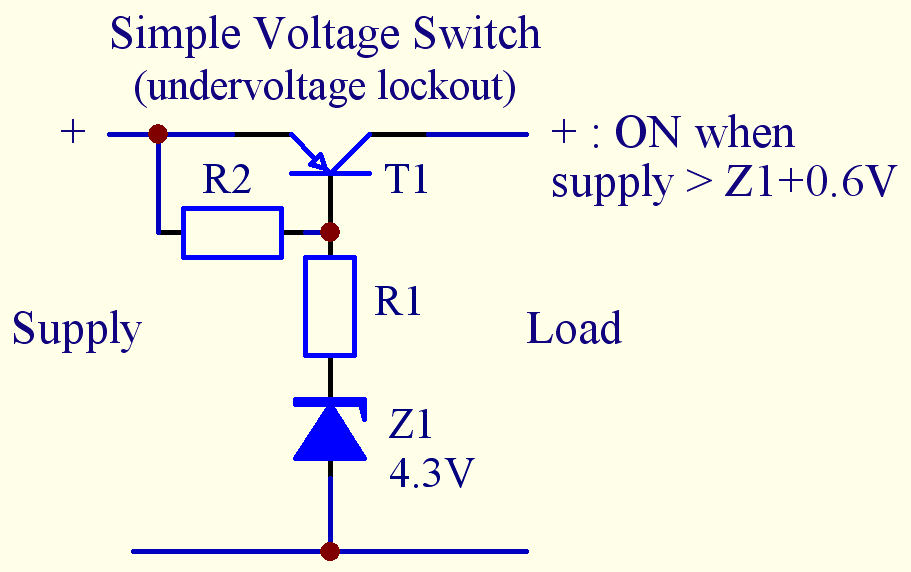
Maybe you can try this simple circuit. The transistor should be dimensioned according to your load current. The other components you can easily calculate. R2 is "big" (or not even needed), The zener voltage could be changed a bit to see where it works best (3.9,4.3,4.7V).

SimpleVoltageSwitch.JPG
 

Aj_s87

Dec 15, 2012
13
Joined
Dec 15, 2012
Messages
13
Thanks,
Is there a formula for the Resistors?
Is there a specific transistor you would recommend?
 

Electrobrains

Jan 2, 2012
259
Joined
Jan 2, 2012
Messages
259
For instance:
T1: BD438
R1: 100 Ohm
R2: not used (or 47k Ohm)

EDIT: Sorry, I was a bit too quick with the suggestion. I did not see that TIP107 is a Darlington! That will not work well.
Better use BD438 (or BD436). Also, you could probably lower R1 to 100 Ohm instead of 470 Ohm.
 
Last edited:

Aj_s87

Dec 15, 2012
13
Joined
Dec 15, 2012
Messages
13
Would any T0126 transistor work? I'm using multi sim and it doesn't have BD438 or BD436. It does have BF470/BF471
 

Electrobrains

Jan 2, 2012
259
Joined
Jan 2, 2012
Messages
259
If you just want to simulate, you could try with almost any normal PNP transistor.
BF470 would show the principle of how it's working, although that transistor has a bit high VCE(sat) and low current (Ic).

I just suggested BD438 because it's cheap, handles high current, has reasonable hFE and quite low VCE(sat) (typical 0.2V).
 

Ryan E Miranda

Sep 3, 2014
3
Joined
Sep 3, 2014
Messages
3
If you just want to simulate, you could try with almost any normal PNP transistor.
BF470 would show the principle of how it's working, although that transistor has a bit high VCE(sat) and low current (Ic).

I just suggested BD438 because it's cheap, handles high current, has reasonable hFE and quite low VCE(sat) (typical 0.2V).
what if BF472?
 

davenn

Moderator
Sep 5, 2009
14,470
Joined
Sep 5, 2009
Messages
14,470
Hi Ryan

welcome to EP :)

just be aware you posted to a VERY OLD thread ( ~ 1.5 yrs since last post) ... something to try and avoid

cheers
Dave
 
Top