Batteries in Series AND Parallel to get 2 Usable Voltages?

guido666

May 10, 2011
3
Joined
May 10, 2011
Messages
3
I have 3 battery packs that are 7.2V each. I need 7.2V to run one thing, and 21.6V to run a different thing. Can I hook the batteries up in series, for the 21.6V, and simultaneously hook them up in parallel for the 7.2V?

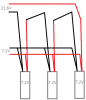
Here is a crude drawing of what I'm asking...
 

Attachments

  • BatteriesInSeriesAndParallelSimultaneously.png
    BatteriesInSeriesAndParallelSimultaneously.png
    11.7 KB · Views: 1,684

poor mystic

Apr 8, 2011
1,106
Joined
Apr 8, 2011
Messages
1,106
Hi Guido
I'm sorry man, that idea just won't work.
You could just put them all in series and that would make your high voltage, and then you could draw your low voltage from the lowest battery in the stack.
The problem is that the current for the high voltage would have to come from the same battery that is already providing the low voltage. So the low-voltage battery ends up doing double duty, running out first and making recharging difficult.
 

guido666

May 10, 2011
3
Joined
May 10, 2011
Messages
3
Ok, can you clarify the reasons that it won't work? I want to make sure I understand this fully.

Some rebuttals/questions...
- Recharging is not a concern. I can remove the battery packs and recharge them individually.
- So I can only draw the low voltage from one battery? Does it have to be the lowest voltage one?
- I have seen other "parallel and series" configurations - how do they differ and work? (See attached.)
 

Attachments

  • BatteriesInSeriesAndParallelSimultaneously2.png.jpeg
    BatteriesInSeriesAndParallelSimultaneously2.png.jpeg
    9 KB · Views: 439

poor mystic

Apr 8, 2011
1,106
Joined
Apr 8, 2011
Messages
1,106
Well Guido I guess if you try connecting that cct up it'll soon show you there are problems, namely a short circuit around each battery.
Take the right-hand battery for example. Follow the black wire up from the left-hand terminal, and see it change to a red wire. This colour change will not impress the electricity except maybe it'll get a good laugh.
Follow the re-coloured wire down to the left-hand terminal of the middle battery. Notice a red wire leading off that terminal to the right-hand battery - the right terminal of the right-hand battery.
The same is true of each battery in the circuit.
So, each battery is short-circuited, and if you want to try connecting them that way I recommend heavy gloves and safety glasses.

Time for some encouragement.
Don't let this misconception stop you from learning about electricity or electronics. Nobody ever got good at seeing how circuits work without mistakes to make them blush and hide. Certainly not myself.
 
Last edited:

wjousts

Apr 26, 2011
17
Joined
Apr 26, 2011
Messages
17
- I have seen other "parallel and series" configurations - how do they differ and work? (See attached.)

They are only trying to get one voltage out of a set of 4 (presumably 12V) batteries. They show two different arrangements that achieve the same thing, getting 24V out with twice the capacity of a single battery.
The first one "Larry's Method" takes two pairs of batteries in series (i.e. 24V) and connects them in parallel (i.e. double capacity). The second "Our Method" takes two pairs of batteries in parallel (i.e. double capacity) and connects them in series (i.e. 24V). Other than "less wires", I'm not sure if there is really any reason to prefer one over the other.
 

osterchrisi

Mar 8, 2011
28
Joined
Mar 8, 2011
Messages
28
I don't know if that is an option but why not simply hook up all the three batteries in series to get your high voltage and then put a voltage divider after it (best with an opamp) to get your low voltage...?
 

(*steve*)

¡sǝpodᴉʇuɐ ǝɥʇ ɹɐǝɥd
Moderator
Jan 21, 2010
25,510
Joined
Jan 21, 2010
Messages
25,510
I don't know if that is an option but why not simply hook up all the three batteries in series to get your high voltage and then put a voltage divider after it (best with an opamp) to get your low voltage...?

That's fine if alll you want is a voltage, but if you intend to draw current from it then it won't work.

At it's best it will be highly inefficient and be no better than having a single 7.2V battery.
 

nbw

May 8, 2011
48
Joined
May 8, 2011
Messages
48
Maybe the 3 cells in series for the higher voltage, with a step-down for 7.2V? As with anything in electronics though - there are no free lunches - and it's not the most efficient way of doing things. You might get 70-80% efficiency on the step-down, maybe up to 90% on a good day - but that's introducing an element of complexity you probably don't need on your plate at present.
 
Last edited by a moderator:
Top