Bridge problem!

Mukhalled

Aug 17, 2004
137
Joined
Aug 17, 2004
Messages
137
Hi friends,

Are TDA2005S and TDA2005M diffirent? I know S = Stereo and M = Mono, but can i for ex connect TDA2005S as a bridge? I did it but it didn't work !!  ???

The stereo one gives 2 x 10W and the mono gives 20W.

Please help  ;D


zak4000

May 12, 2006
92
Joined
May 12, 2006
Messages
92
From the datasheet it looks like the TDA2005M and TDA2005S are both the same.
They are dual amps - 10W each
There are plenty of application configurations for mono and stereo.
Hope it helps  ;D

TDA2005.pdf


Attachments

  • TDA2005.pdf
    262.1 KB · Views: 2

Mukhalled

Aug 17, 2004
137
Joined
Aug 17, 2004
Messages
137
From the datasheet it looks like the TDA2005M and TDA2005S are both the same.
They are dual amps - 10W each
There are plenty of application configurations for mono and stereo.
Hope it helps
 

audioguru2

Apr 6, 2004
12,026
Joined
Apr 6, 2004
Messages
12,026
Hi Mukhalled,
Attach the schematic of your bridged TDA2005 for us to see what is wrong with it.

The only difference on the datasheets between the TDA2005M (for a bridged amp) and the TDA2005S (for a stereo amp) is that the TDA2005M is selected for a max output offset voltage of 150mV. Then it will have a max DC current in a 3.2 ohm speaker of 150mV/3.2 ohms= 47mA without a signal which also creates heat. The TDA2005S doesn't have an output offset voltage spec so it could be too high for a bridged amp.


Mukhalled

Aug 17, 2004
137
Joined
Aug 17, 2004
Messages
137
audioguru said:
Hi Mukhalled,
Attach the schematic of your bridged TDA2005 for us to see what is wrong with it.

The only difference on the datasheets between the TDA2005M (for a bridged amp) and the TDA2005S (for a stereo amp) is that the TDA2005M is selected for a max output offset voltage of 150mV. Then it will have a max DC current in a 3.2 ohm speaker of 150mV/3.2 ohms= 47mA without a signal which also creates heat. The TDA2005S doesn't have an output offset voltage spec so it could be too high for a bridged amp.
Hi Mr. Audioguru,

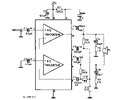
I was waiting for your answerTDA2005_bridge.JPG

tda2005.pdf


Attachments

  • tda2005.pdf
    252.8 KB · Views: 1
Last edited by a moderator:

audioguru2

Apr 6, 2004
12,026
Joined
Apr 6, 2004
Messages
12,026
Your very fuzzy schematic is a copy of the one in the datasheet so it should work. It would be clearer if you saved it at a GIF or PNG file type. You saved it as a huge JPG file type which is used for photographs.
The polarity of the electrolytic capacitors are shown with the solid bar as the negative end.

What is your exact supply voltage?
What is the voltage at pin 8 and pin 10?
What is the speaker's impedance?


Mukhalled

Aug 17, 2004
137
Joined
Aug 17, 2004
Messages
137
Ok, I've attached it again and i hope it's clearer now...
the supply voltage i use is 9V.
The only difference between my circuit and this schematic is that i use the tda2005 S , not tda2005 M, so i dont know if it works.

View attachment 39212


audioguru2

Apr 6, 2004
12,026
Joined
Apr 6, 2004
Messages
12,026
Mukhalled said:
Ok, I've attached it again and i hope it's clearer now...
Thanks. It is much clearer and uses many fewer bytes.

the supply voltage i use is 9V.
Its minimum supply voltage is 8.0V and it uses a very high current at full output. If your supply is a little 9V battery then it won't work.

What is the DC voltage at pin 8 and at pin 10?
What is the impedance of the speaker?
What is the level of the input signal?
 

Mukhalled

Aug 17, 2004
137
Joined
Aug 17, 2004
Messages
137
The DC voltage between pin 8 and 10 is about 1,6V.
Impedance 4 ohm
I use headphones output as an input to the power amp.
I've tried with 14V power supply,

 
Last edited by a moderator:

audioguru2

Apr 6, 2004
12,026
Joined
Apr 6, 2004
Messages
12,026
It is oscillating at a low frequency.
I think it has way too much voltage between outputs because it isn't the IC selected for being a bridged amp which would have a very low voltage between outputs. The voltage between its outputs causes a high supply current which might reduce the supply voltage enough that the amplifier doesn't draw so much current so the supply voltage rises. Then it does it over and over.
It might work fine if the supply voltage doesn't change by its current. A regulated supply or a direct connection to a charged car battery.


Mukhalled

Aug 17, 2004
137
Joined
Aug 17, 2004
Messages
137
I've tried to connect it directly to the car battery, but it's still the same problem ...
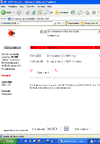
I've checked out another web-shop to be sure about the differences between these ICs and it looked like this attachment: they are two different ICs.

Difference.GIF


audioguru2

Apr 6, 2004
12,026
Joined
Apr 6, 2004
Messages
12,026
The only difference on the datasheet is the matching of the pin 8 and pin 10 voltages for the TDA2005M for a bridged IC. Your TDA2005S doesn't have the voltages matched causing  them to be 1.6V different.

Maybe the 1.6V difference is causing the IC to heat then shut-down for a moment before cooling then working again, over and over.

Did you use the pcb layout on the datasheet? If you didn't then maybe the IC oscillates at a very high frequency which makes it hot, shuts down then cools and works again, over and over.

The heatsink is too small if the IC gets hot enough to shut-down.


Mukhalled

Aug 17, 2004
137
Joined
Aug 17, 2004
Messages
137
I didn't use the pcb layout on the datasheet.
The IC doesn't get hot when in use ...
I used  ceramic capacitors (polarized) C1, C2 ? they don't need to be elctrolytic, right?


Mukhalled

Aug 17, 2004
137
Joined
Aug 17, 2004
Messages
137
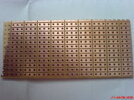
Ok, i will change the board ... do you think this board is good (attachment)?
Sorry they were Tantalum capacitors which i used not ceramic, should i change them too, to electrolytic?

DSC00660.JPG

 
Last edited by a moderator:

audioguru2

Apr 6, 2004
12,026
Joined
Apr 6, 2004
Messages
12,026
The board you show is poor for a high current amplifier. Years ago I made a similar amplifier with Veroboard and it worked well. Maybe my wiring layout was lucky.

Tantalum capacitors have poor reliability and cause audio distortion when used as coupling capacitors. Electrolytic capacitors are better for audio but film capacitors are best. Since 2.2uF film capacitors are huge and expensive, use electrolytics.


Mukhalled

Aug 17, 2004
137
Joined
Aug 17, 2004
Messages
137
Hi again,
It works now  ;D. I've changed the board and the two capacitors.

Thank you Audioguru for the help  :)

 
Top