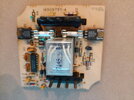
Burnt component on module

noquacks

Jun 26, 2013
148
Joined
Jun 26, 2013
Messages
148
People,

Have a "module" that controls the opening/closing of 1980's Firebird and Sunbird, Fiero, etc, headlight doors. Similar to this one on ebay, for reference:


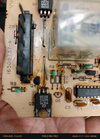
Picture I have included below shows a burnt part, kinda elongated metallic "rod", not sure what to call it, to the right of F2. Any idea what amps that thing could be? Friend of mine is trying to repair it as he has some background in this type of repair, but he is not sure what the thing is (he does not speak english and asked me to poke around to find out). I said the people on this forum have helped me before on such matters.

Any advice appreciated.
 

Attachments

  • 4010161195437445695.jpg
    4010161195437445695.jpg
    240.8 KB · Views: 24

Martaine2005

May 12, 2015
5,276
Joined
May 12, 2015
Messages
5,276
They are usually called jumper wires.
A metal wire connects one track to another.
But in your case it’s in the position of a fuse, reference designator F2.
So is it a fuse wire?.
Has the board got a F1?.
 

davenn

Moderator
Sep 5, 2009
14,470
Joined
Sep 5, 2009
Messages
14,470
Picture I have included below shows a burnt part, kinda elongated metallic "rod", not sure what to call it, to the right of F2.

But in your case it’s in the position of a fuse, reference designator F2.
So is it a fuse wire?.

Yeah, definitely a fuse wire .... unusual to see it without any encapsulation ... glass tube etc
looks to be around 3 Amps approx.
 

noquacks

Jun 26, 2013
148
Joined
Jun 26, 2013
Messages
148
Wow, so good to know. But I have no idea where to buy a new one, can anyone help me source this tiny piece? Think Amazon has these?

Thanks, people.
 

Martaine2005

May 12, 2015
5,276
Joined
May 12, 2015
Messages
5,276
“pa75 n85s" refers to a specific electronic component, likely a type of power transistor, with the original being a GM internal part number. A suggested replacement is the Fairchild FQP20N06L”.

There is probably a reason why the fuse blew. Not always of course but more than likely.
The above Fairchild component is a good replacement.
Check the Q2 transistor for a short circuit first.
 

noquacks

Jun 26, 2013
148
Joined
Jun 26, 2013
Messages
148
Thanks, Martaine. I will also check the operation of the headlight door motors, to make sure they are not binding, etc. But who sells this Fairchild FQP20N06L item? Where can I buy it?
 

Martaine2005

May 12, 2015
5,276
Joined
May 12, 2015
Messages
5,276
You have loads of online electronics stores, CPC, Farnell, Digikey etc. even eBay.
Also, loads of PCB fuses that can replace your wire fuse.
A glass type, a TO-92 type etc.
 

noquacks

Jun 26, 2013
148
Joined
Jun 26, 2013
Messages
148
Update: I soldered 2- 3A fuses (2 whitish cylindricals on the board). But before I tried it I followed advice from Martaine above, and checked the left motor- it was frozen up! Took it apart on the bench, and restored the whole thing (the right motor behaved nicely). Tested it by hand, turned left/right now with no resistance.

Then, installed the board on the car's pin connectors, and turned on the lights and expected the doors to open immediately (normal) but nothing happened. Went inside for 5 minutes, came back out and found mysteriously (hey, It's Halloween , right?) the left door was open. So weird. What could this mean?

Meanwhile, wondering if it is the relay "box" in the center of the board (shown). Should that click when activated by the light switch in the car? Could that be defective?

Im also now trying to find a schematic/diagram of the circuitboard, no luck so far on the internet. Anyone know maybe the proper key word(s) to use on Google to locate this electrical diagram? Also, should I look for other points of burnt on the board?

Thanks, people.
 

Attachments

  • 5789836767794400210.jpg
    5789836767794400210.jpg
    196.2 KB · Views: 7
Last edited:

ivak245

Jun 11, 2021
143
Joined
Jun 11, 2021
Messages
143
You should be able to see the relay operate through the clear housing & can usually feel the relay click.
 

noquacks

Jun 26, 2013
148
Joined
Jun 26, 2013
Messages
148
Update: Turned out the motor I restored was still defective, screaming when 12V was applied to it, so I bought an entirely new one. Tested it with 12v directly from the car battery and it opened/closed. But when I plugged in the module and activated it with the headlight switch it burned a fuse on the board. If the motor is new, and tested OK with 12V directly, and fuse blows, could it be something else on this board? I doubt it is bad wires going to the headlight motor.

Thanks.
 

noquacks

Jun 26, 2013
148
Joined
Jun 26, 2013
Messages
148
Partial success (at least the fuse has stopped blowing now), I ordered a transistor which should have matched the Fairchild code listed above, best I can figure, from Arrow Electronics, shown below:


Then I took a chance replacing the suspect transistor (for the left headlight door, the problem one which kept blowing a fuse). Then connected the pins from the car wiring to the module, and activated the car's light switch. Now, fuse does not blow for the left door, but the 2 doors are not opening together/in sync. The right door opens, then when closing the door switch, that same left door closes as it is supposed to but now the left door opens. They are operating not in sync, but by opposing each other's door opening.

To clarify- one door opens while the other does not, and when the opened one closes the other finally opens. And it repeats over and over. Lefty open, righty closes. Righty opens lefty closes.

There is something called "PNP vs NPN, for "directional operation". Can anyone help me understand what I may have done wrong? Did I buy the wrong transistor? I am almost there with this module, on a 39 year old car.

PS: I replaced only one transistor, the one on the side blowing the same fuse. The other was not replaced.

Thanks, people.
 
Last edited:

baldguyfromblackpool

Dec 18, 2025
27
Joined
Dec 18, 2025
Messages
27
Some info available at an archived Fiero forum.

They suggest as possible replacements, BUZ24, 2N6763, 2SK561, 2SK906, 2SK1429, NTE2389, or BUZ10S2 .. I think these are all N-type enhancement mode FETs bar a couple. It's an archived site so even these equivalents, might be in need of updating.

Does the new transistor have the same pin configuration as the old (drain - gate - source order)? Both N-channel enhancement type? Can't find any info on the original 75N85 myself, to check for sure what it actually was when it was available. N-enh/P-enh/N-dep/P-dep..

Not sure if it's a good or safe idea but I'd probably try changing the other transistor to be the same as the other & see how it goes, if I wasn't too worried about risking further damage

I'm guessing really but maybe the 75N85 was P channel or depletion type, rather than N or enhancement. I'll have to sit down and really think it through to see if that'd cause the operation you're seeing. Others here can probably tell you if I'm on the right track or wildly off, in an instant.

In fact what kind of transistor at all, was the 75N85? FET, bipolar, etc.. Can't find anything on it.

ChatGPT thinks it was a silicon PNP bipolar power transistor good for 2A of collector current and 0.625 W, I don't think that's right though, since it then goes on to say that "The power consumption of a headlamp raising motor typically ranges from 10 to 30 watts"

Nearest numerical match I could find was for 75N75, which is/was apparently, able to take 80A (that one was an N type enhancement mode)
 
Last edited:

baldguyfromblackpool

Dec 18, 2025
27
Joined
Dec 18, 2025
Messages
27
Maybe 75N85 was a depletion version of 75N75?

Looking at the back side of the board on the archived page, I think the hole for the original part's gate pin, does match up with the gate pin on FQP20N06L. Not sure about the drain & source but I suppose it probably wouldn't work at all, if that were wrong?

FQP20N06L says it can take 14.7A continuously at 100'C which at 12V would allow 176.4W so it should run a 30W motor ok, intermittently. I'd get another of those & try it in the other side. If that works but means the headlamps are out of synch with the light switches in the car you'd probably need to change them both for a similar but depletion mode, N-type FET. It might be worth probing the gates with a voltmeter to try and work out the threshold value you need for the FET, you might need it to be a bit different than what works for an enhancement part

Bear in mind I'm often wrong so you might want to wait for further replies, I could very easily be misunderstanding how FETs work.
 
Last edited:

baldguyfromblackpool

Dec 18, 2025
27
Joined
Dec 18, 2025
Messages
27
But when I plugged in the module and activated it with the headlight switch it burned a fuse on the board. If the motor is new, and tested OK with 12V directly, and fuse blows, could it be something else on this board?

I'm thinking, my thinking's been wrong. All this nonsense about FET modes.

Hypothesis.. The N type enhancement FET is right for the job, and all it's doing is switching the power on and off. Not somehow reversing the current which I'd been vaguely ruminating on. Repairs so far are all good. The reversing of the current (to make the lights pop up or conversely, pop down) is the job of the relay. I'm guessing the relay is sticking on one pole, which might cause a short in series with one FET - blowing the fuse link and FET. Prior to those finally dying, this might explain the sluggish operation on one side, and possibly the subsequent 'winking' action.

I'll spend a while looking at the back of the board again, see if it fits

.. yes, the relay does a crossover thing right after the two FETs, to swap the polarity heading toward the motors. So if one or two out of four contact sets are welded shut or sticking, it could burn out the FETs and links, and cause erratic operation.

You could try cleaning the relay contacts by popping off the lid and using a piece of writing paper soaked in contact cleaner between the contact faces, maybe even give the moving parts a spray off, but don't soak the coil. Don't use anything abrasive on the contacts. Best to just replace the relay. Cleaning would be a long painstaking job.

Here's a possible replacement relay (not sure whether yours is MY4-C2 or MY4-02): https://shorturl.at/PwJU5

I'm wondering how the system 'knows' when the lids are down or up. Maybe the big chip monitors the current rise due to motors stalling, or maybe there are microswitches in the headlamps.. probably best to check that out too
 
Last edited:
Top