I have some queries regarding capacitor charging using inductively generated HV pulses, in contrast to with regular DC. First, to check my understanding, I will recount the situation with non-pulsed DC.
If the energy supplied by the battery U = QV then the capacitor will always(?) receive and store 1/2 QV (= 1/2 CV^2) due to resistive, inductive and radiative losses.
So with a known value of capacitor being charged from a voltage Vmin to Vmax, as seen on a scope trace, one can calculate the energy stored and compare it to what was delivered by the battery and, at best, this will be 50%. In practice it will likely be less due to other losses.
If the capacitor is then discharged, whatever energy was stored will again incur resistive losses, (possibly up to 50%?) such that, over a complete cycle of charging and discharging, perhaps only 25% of the original energy supplied by the battery is available for whatever the discharge energy might be used for.
Looking now at the situation with HV pulses, of the sort produced from the field collapse of a coil (flyback pulses), then the situation may be quite different and I am seeking to understand how charging takes place and, more importantly, the losses incurred during the charging and discharging stages.
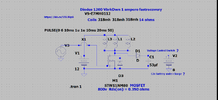
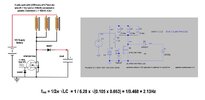
With reference to the diagram on the link below, the capacitor is made up of 4 x 15mF 80V low ESR caps connected in parallel and with a combined measured value of 53mF.
https://ibb.co/ZTLJNpR
The output pulses have a peak voltage of 1.7kV, a FWHM of 20us and a PRF of 50Hz and, on the face of it, the time-averaged voltage across the capacitor is zero since after the pulse rise time to a peak voltage it returns again to zero before the next pulse. However, practical measurements show a very real and rapid rise in capacitor voltage using such pulses, so clearly the pulses are resulting in a positive charge and voltage differential across the capacitor plates.
What I presume is happening is that with each HV pulse the capacitor starts to charge a little and, when the pulse voltage returns to zero, the capacitor is unable to discharge due to the presence of the top diode and the VDSwitch. As such the capacitor charges in small discrete steps in a staircase fashion and this is what appears as the ‘fuzzy’ charging curve on the 'capacitor voltage’ insert.
Assuming this is basically correct, of more interest is what losses are incurred in the charging and discharging stages and whether they are larger or smaller than with regular DC?
The reason for the interest is for my research into non-linear and ‘far from equilibrium’ effects of these voltage transients on batteries and capacitors. If the losses are such that, in a complete charge and discharge cycle, I am going to see more or less than approximately 25% of the battery input energy, then that is very significant.
Sorry for the long post but it’s important that I give a clear picture of the setup and context.
If the energy supplied by the battery U = QV then the capacitor will always(?) receive and store 1/2 QV (= 1/2 CV^2) due to resistive, inductive and radiative losses.
So with a known value of capacitor being charged from a voltage Vmin to Vmax, as seen on a scope trace, one can calculate the energy stored and compare it to what was delivered by the battery and, at best, this will be 50%. In practice it will likely be less due to other losses.
If the capacitor is then discharged, whatever energy was stored will again incur resistive losses, (possibly up to 50%?) such that, over a complete cycle of charging and discharging, perhaps only 25% of the original energy supplied by the battery is available for whatever the discharge energy might be used for.
Looking now at the situation with HV pulses, of the sort produced from the field collapse of a coil (flyback pulses), then the situation may be quite different and I am seeking to understand how charging takes place and, more importantly, the losses incurred during the charging and discharging stages.
With reference to the diagram on the link below, the capacitor is made up of 4 x 15mF 80V low ESR caps connected in parallel and with a combined measured value of 53mF.
https://ibb.co/ZTLJNpR
The output pulses have a peak voltage of 1.7kV, a FWHM of 20us and a PRF of 50Hz and, on the face of it, the time-averaged voltage across the capacitor is zero since after the pulse rise time to a peak voltage it returns again to zero before the next pulse. However, practical measurements show a very real and rapid rise in capacitor voltage using such pulses, so clearly the pulses are resulting in a positive charge and voltage differential across the capacitor plates.
What I presume is happening is that with each HV pulse the capacitor starts to charge a little and, when the pulse voltage returns to zero, the capacitor is unable to discharge due to the presence of the top diode and the VDSwitch. As such the capacitor charges in small discrete steps in a staircase fashion and this is what appears as the ‘fuzzy’ charging curve on the 'capacitor voltage’ insert.
Assuming this is basically correct, of more interest is what losses are incurred in the charging and discharging stages and whether they are larger or smaller than with regular DC?
The reason for the interest is for my research into non-linear and ‘far from equilibrium’ effects of these voltage transients on batteries and capacitors. If the losses are such that, in a complete charge and discharge cycle, I am going to see more or less than approximately 25% of the battery input energy, then that is very significant.
Sorry for the long post but it’s important that I give a clear picture of the setup and context.
Last edited by a moderator: