clever vibration motor driver?

CDRIVE

Hauling 10' pipe on a Trek Shift3
May 8, 2012
4,960
Joined
May 8, 2012
Messages
4,960
15 years! Heck, you're a puppy. :p

I still have a stock of first generation LEDs. I remember a bunch of us (coworkers) standing there asking "Is it ON yet? Someone turn off the lights"! :D

They've come a long, long way.

Chris
 

hevans1944

Hop - AC8NS
Jun 21, 2012
4,968
Joined
Jun 21, 2012
Messages
4,968
I can certainly do that and I appreciate your interest.
Nostalgia perhaps. I remember learning about R-2R ladder networks in the 1960s when we did everything with discrete logic. Large-scale-integration (LSI) of TTL was just beginning, CMOS logic was pie-in-the-sky, and if you wanted a DAC or ADC it had to be roll-your-own or purchase an expensive hybrid or even more expensive hybrid data acquisition module.

I really drooled when Burr-Brown came out with a multiplying DAC in the mid 1970s and TI offered 1 K-bit SRAM ICs. Intel was just getting started making microprocessors and hobbiests with deep pockets had started to pick up on that. This was the hey-day of TTL, so I used the DAC and ten of the RAM chips to build a multiplying digital function generator (MDFG) for a customer at Wright-Patterson AFB. The MDFG was used to linearize the spectral response of a monochrometer/photo-multiplier tube, visible light, transmission absorption-measuring system. Our tax dollars at work of course.

Last year I found the monochrometer scrapped and for sale at Mendelson Electronics. I tried to buy it (not that I had any use for it), offering them $25. No sale. Instead they immediately got online and Googled monochrometers and found it was worth much more than that to anyone who needed one. I should have kept my mouth shut about it being a monochrometer and instead told them I was only slightly interested in the mirrors inside... one of which was a large focusing diffraction grating that sold for several thousand dollars when it was new.

And I did find an app note where discrete transistors were suggested to switch in resistors for binary control of a three-terminal adjustable regulator. But I seem to recall that at one time you could purchase a device (maybe a hybrid?) that had the switches and a TTL interface built-in. Probably obsolete now...

Many years ago I heard of a cell phone that they stopped selling because it didn't break. As we all know most or many companies design their products to last past the warranty and then hopefully break soon after
Yeah, I had to replace a large window air conditioner a few years ago that quit working. I fixed it once when the motor-starting capacitor failed and I was able to locate a replacement part... not an exact replacement; the one I found was larger and had to be mounted outboard with extension wires. That worked for one season. Then the bearings in the common shaft for the evaporator fan and condenser fan failed because they rusted out and there was no provision for lubricating them. Bad design that, exposing the bearings to the elements so they could rust and fail. Or maybe that was the intent. Nothing wrong with the air conditioning components. No leaks. Compressor worked fine. But out of warranty as you said. Everything inside was made in China.

It's kind of funny how suddenly the big hype came out about LEDs, how they are the latest and greatest even though the rest of us have been dealing with them since like 15 years ago. I definitely remember when white and blue LEDs came out, that was cool, but at ~$3 a pop I couldn't even afford them haha.
I do remember that. I bought a TI four-function desk calculator with tiny red LED seven-segment displays when they first appeared and I was earning big bucks. I once even owned a wrist-watch with a tiny red seven-segment LED display (totally impractical). It was many years later that colored LEDs (green, orange/yellow, and red) became somewhat affordable, and much later than that (after UV LEDs were developed) that efficient white-light LEDs finally became practical and affordable.

Lately I have been converting many lamps in my house to LEDs. Not all! I like the warm glow of incandescent lamps, and they are easier to dim. Some of these LED replacements didn't last very long because they overheated in their fixture and the electronics failed. I just recently replaced some of the fluorescent fixtures that I installed forty years ago in my basement workshop areas. Their electro-magnetic ballasts have failed. The new ones use the smaller T4 tubes and electronic ballasts, but the laundry room down there now has LED luminaries. My wife hates fluorescent lamps.

Please return here and let us know how your motor control project turned out. If it's not proprietary, there is a forum area here just for showing off that sort of thing.

Hop
 

pgib8

Jul 26, 2015
107
Joined
Jul 26, 2015
Messages
107
@hevans1944

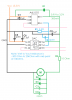
Here is what I have for now. I won't know for sure if this works until I build a prototype in 1 to 2 weeks and I'll post another update then.
del3.png

All parts have been carefully selected with a secondary emphasis on low price (assuming higher quantities).

A second revision with additional features of this PCB will be made at a later time; so I took the luxury of creating pads for some parts that will probably not be needed, just in case. I just want you to know why I doubled up on some of these capacitors.

DAC:
Microchip Technology
MCP47A1T-A0E/LT
(Digi-Key# MCP47A1T-A0E/LTCT-ND)

Adjustable LDO:
Diodes Incorporated
AP7335-WG-7
(Digi-Key# AP7335-WG-7DICT-ND)

R1:
6kOhm

R2:
Note: This is more of a place holder and may later
be replaced with a 0-ohm jumper or other resistance.

D1, D2:
Diodes Incorporated
BAT54TA
(Digi-Key# BAT54CT-ND)
Note: Vf = 230mV @ 100mA, Vr = 30V, Io = 1A

D3:
Infineon Technologies
ESD208B102ELE6327XTMA1
(Digi-Key# ESD208B102ELE6327XTMA1CT-ND)
Note1: Is actually a bi-directional diode which is OK.
Note2: Reverse working voltage 3.3V, trigger 3.65V, clamp at ~ 4.8V

C1, C2, C3:
Samsung Electro-Mechanics America, Inc
CL21F105ZBFNNNE
(Digi-Key# 1276-3010-1-ND)

C4, C5:
Note: Place holders and if necessary may later be stuffed with a larger capacitor, ex. 10uF tantalum.

C6:
Note: Place holder.
 

hevans1944

Hop - AC8NS
Jun 21, 2012
4,968
Joined
Jun 21, 2012
Messages
4,968
Wow! Looks like you have thought this out pretty thoroughly and have done your homework. Very conservative design. Are you sure there is anything any of us here can contribute? Thank you for posting this.
 

pgib8

Jul 26, 2015
107
Joined
Jul 26, 2015
Messages
107
thanks Hop, means a lot coming from someone with your experience :)
At this point I'm done with it at least until prototyping the circuit.
As for what motor it's using, I asked myself the same question but couldn't get a part number, just a link to ebay :) I tested two pieces I have on hand and saw at the most 100mA of current draw. If I had to put a spec on it I'd say any DC motor that draws 200mA or less.
The adjustable regulator also has a nice benefit of being protected against short-circuit, thermal protection, and current limited around 400mA. It should also have the side effect of providing a "nice" slew rate. If a very low voltage is used, one may have to get it spinning with a higher voltage first and then throttle back.
 

hevans1944

Hop - AC8NS
Jun 21, 2012
4,968
Joined
Jun 21, 2012
Messages
4,968
... If a very low voltage is used, one may have to get it spinning with a higher voltage first and then throttle back.
A minor inconvenience, that. But this is sometimes hawked as a "feature" for PWM because higher than steady-state voltages are often used, which result in greater starting torque at low duty cycles. It would not be uncommon to see a DC motor with a nominal rating of 4 V operated with a 40 V PWM voltage. Of course the duty cycle would never be 100% in that scenario but closer to 10%. Since you are using a μP for control, it would be trivial to include a "dead start" algorithm that would automagically start spinning the motor at a higher voltage and then throttle back to command speed. Lots of nifty things you can do with a μP with just a little imagination...

Yikes! You are purchasing motors from eBay?! How will you ever be assured of getting the same or a similar motor in the future? This must be a one-off or very low production run project. Not to say you can't find some bargains and good stuff on eBay... I bought a nice used Tektronix oscilloscope from an eBay vendor a few years ago and it is still working. And I notice that a lot of Chinese vendors are using eBay. I recently bought some Chinese solid carbide drills (for drilling holes in printed circuit boards) from such a vendor. It took a while to get them delivered, but the quality seems to be acceptable. I may dip my toe back into that water again for some high-power LEDs, although I would prefer to purchase Cree products.

In another thread I am recommending to a fellow in Great Britain that he use high-current (3A or 5A) regulators to control hydraulic valve solenoids. These are spool-driven proportional control valves, one valve for each direction, so the flow is a function of how much voltage in the range of four or five volts up to about twelve volts you send to the valve. Only one of each pair of valves operates at any given time, commanded by a joy-stick potentiometer. This will be an all-analog design based on the KISS principle. However, I got the idea from you! Thanks for that.
 

CDRIVE

Hauling 10' pipe on a Trek Shift3
May 8, 2012
4,960
Joined
May 8, 2012
Messages
4,960
Wow! Looks like you have thought this out pretty thoroughly and have done your homework. Very conservative design. Are you sure there is anything any of us here can contribute? Thank you for posting this.

Ha, isn't that the truth! I went back to the first post in this topic to see if there was one of those ..."Hi, I'm new to electronics...." intros. Happy to say... not there. Very thorough! Something we're not accustomed too. :D

Chris

Chris
 

pgib8

Jul 26, 2015
107
Joined
Jul 26, 2015
Messages
107
Hi again, it's been a while and I now got around to prototyping the circuit. It works very well. Thank you all for your feedback and ideas!
motor circuit.jpg
 

Minder

Apr 24, 2015
3,561
Joined
Apr 24, 2015
Messages
3,561
Hi again, it's been a while and I now got around to prototyping the circuit. It works very well.

I guess that would be a 'CardBoard' rather than a 'BreadBoard'?;)
M.
 

pgib8

Jul 26, 2015
107
Joined
Jul 26, 2015
Messages
107
True :) I don't know why I'm doing the cardboard. I started using it once and ever since then I like it. I also used to use hot glue to hold everything in place, then one time I didn't find my hot glue and I used super glue and ever since then that's what I use now. It is such a relieve not to have to deal with the hot glue strings lol. Not to mention the static when you rip them was a concern.
 

hevans1944

Hop - AC8NS
Jun 21, 2012
4,968
Joined
Jun 21, 2012
Messages
4,968
Cardboard is a "tried and true" method of prototyping. The real adventurous omit the cardboard and just leave all the soldered together components hanging in air. Bob Pease was known for this (see image below), and some hams actually prefer it for VHF/UHF projects. Either way, you don't have to worry about the component lead diameter restrictions associated with solderless breadboards. I find it a real PITA to have to solder on 22 gauge solid hook-up wire to the leads of a 5 watt resistor, for example.

29975d1169661536-whats-wrong-picture-osc-gearslutz.jpg
 

CDRIVE

Hauling 10' pipe on a Trek Shift3
May 8, 2012
4,960
Joined
May 8, 2012
Messages
4,960
Either way, you don't have to worry about the component lead diameter restrictions associated with solderless breadboards. I find it a real PITA to have to solder on 22 gauge solid hook-up wire to the leads of a 5 watt resistor, for example.
That's why all (I have quite a few) of my solderless breadboards are mounted on a much larger wood base. These wood bases make easy work of mounting and connecting large or incompatible components.

Chris
 

hevans1944

Hop - AC8NS
Jun 21, 2012
4,968
Joined
Jun 21, 2012
Messages
4,968
That's why all (I have quite a few) of my solderless breadboards are mounted on a much larger wood base. These wood bases make easy work of mounting and connecting large or incompatible components.

Chris
That's a good idea, Chris, but my complaint was that solderless breadboards only accept a narrow range of wire gauges, typically 22 to 24 AWG, and therefore require soldering on an acceptably smaller gauge wire to thicker diameter leads. If you use the "hang it all out in air" method of construction you don't even need a breadboard, although troubleshooting can be problematical.:D I don't know how Bob could even see where to clip on a probe, much less do it without shorting a bunch of nearby wires together while attaching it. I'm pretty sure he never bothered disconnecting power when attaching or removing test probes. The man lived dangerously while he lived, but boy did he LIVE! One of my idols.
 

pgib8

Jul 26, 2015
107
Joined
Jul 26, 2015
Messages
107
I used solder-less breadboards in the very beginning. Real PITA and sometimes the connections were lose. What Bob is doing would also not work for me. I'd spend half the time troubleshooting the wiring. I'd clip on a probe in one area and then get a short or open connection in another.
The cardboard, I can spread things out however I want and easily add any test points. By supergluing the wires, everything stays in place and nothing breaks. I can also work on one little cardboard at the time and then test it with the rest of the circuit, then glue it to a larger cardboard base to permanently join with the rest of the circuit. I also like wood, I have used that too, but cardboard is very easy and quick to cut.
 

dorke

Jun 20, 2015
2,342
Joined
Jun 20, 2015
Messages
2,342
That's a good idea, Chris, but my complaint was that solderless breadboards only accept a narrow range of wire gauges, typically 22 to 24 AWG, and therefore require soldering on an acceptably smaller gauge wire to thicker diameter leads. If you use the "hang it all out in air" method of construction you don't even need a breadboard, although troubleshooting can be problematical.:D I don't know how Bob could even see where to clip on a probe, much less do it without shorting a bunch of nearby wires together while attaching it. I'm pretty sure he never bothered disconnecting power when attaching or removing test probes. The man lived dangerously while he lived, but boy did he LIVE! One of my idols.

Hop,
Bob Pease was an icon.
Definitely, an "Analog World " hall of fame member,
with Jim Williams and probably the greatest of all Bob Widlar.

Their genius creative minds made the famous pioneering Analog companies invent and "tick"
(Fairchild,National-Semi and Linear-Tech.):)

Here is a treat :
THE BEST OF BOB PEASE
 

hevans1944

Hop - AC8NS
Jun 21, 2012
4,968
Joined
Jun 21, 2012
Messages
4,968
@dorke : thanks for the link! I just spent several hours reading some of the PDF. Yikes! I especially liked Bob's anecdote about how Bob Widlar made sure defective parts that bedeviled him in a prototype circuit would never come back to be re-inserted in another circuit: he placed them on the anvil of a hefty bench vice and beat them to a fine powder with a hammer! I have never gone quite that far (I am sure it is cathartic) but I do bend under the leads of defective DIPs so they look like "dead bugs" before depositing them in the trash. Other defective parts get their leads cut flush with the case to make sure I never try to use them again.

BTW, I was just getting started in my professional career when all three gentlemen were making waves in the solid-state analog world. The Philbrick-Nexus tube-type op-amp modules were still being used in analog computers at Wright-Patterson AFB, and I grew up "playing" with vacuum tube circuits, so I didn't entirely miss out on everything analog. I remember how happy all of us technicians were when the 741 came along to replace the 709, the latter requiring external "compensation" before it would behave in a closed-loop feedback circuit. About the same time I also got heavily involved in Texas Instruments TTL circuit design, at first using it to replace diode/relay logic. The 1970s were truly wondrous years for me. And then along came personal computers... been running very hard just to keep up ever since the 1980s.:eek:
 

dorke

Jun 20, 2015
2,342
Joined
Jun 20, 2015
Messages
2,342
I keep a " cemetery box" of bad/blown etc. parts.
This link shows how far have we came from 1Hz corner(pole)... how amazing and wonderful;)
 

hevans1944

Hop - AC8NS
Jun 21, 2012
4,968
Joined
Jun 21, 2012
Messages
4,968
... This link shows how far have we came from 1Hz corner(pole)... how amazing and wonderful;)
Not so wonderful about the raw deal that Loebe Julie received while working as an engineer for Columbia University. This is still common practice today. Basically, as an agreement for employment, you sign away your intellectual property rights to your employer. Everything you do for them becomes "work for hire" and they own it. This has happened to me on more than one occasion, the most recent occurring at my last employer. This was a sponsored research project, so technically the Government owns the rights to it too. The device my supervisor and I developed won an IR-100 award this year, but there is no mention of our names that I can find anywhere. He got to make a trip to Las Vegas to pick up the award plaque, but I was not invited to participate. I guess I will find out more at the department Christmas luncheon next week, to which I was invited to attend. Maybe even be allowed to touch and/or photograph the award.
 
Top