Alun: "What are you trying to do?"
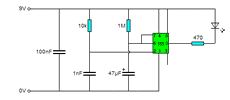
I am trying to use 555 as a delay-on timer. In this particular circuit when there is nothing applied to the base of the transistor it shorts out the capacitor which causes pins 2 and 6 to have positive with respect to ground - the output on 3 is low. Once we connect the base of the transistor to ground the capacitor is allowed to charge exponentially, thus eventually we get high on 3, untill we remove the ground from the transistor's base, in which case the transistor quickly discharges the capacitor and the output 3 is forced to low.
Audioguru: "I suspect that the supply voltage is too high because with only a 12V supply, the LED would look dim with only 1mA or less. Did you exceed the absolute max supply voltage of only 15V for National's or 18V for TI's Cmos IC?
Is a relay or something connected to its output?"
The supply voltage was 12V when I tested it and current limited to 15mA, so no - I didn't overvolted the chip. For now it drives an LED which lights up bright at 1mA even so I haven't tryed to source even 10mA , thus I haven't exceed the secifications in this way at least.

Also if the diode is trying to remove any excess negative voltage from the capacitor I am not sure if it can do lower than about -0.7V (Si) thus if this is enough to burn the chip .....oups. Just a guess though. I haven't tryed to bypass the chip and see if it burns again but I have the feeling that I am about to waste another chip by doing it. The bypassing is normally suggested for the bipolar version of 555 but the manufactors claim it's not necessary for CMOS types. I hope I won't burn another ... :