Convert Voltage

nwaste

Aug 15, 2005
54
Joined
Aug 15, 2005
Messages
54
i have a source with 7V and 2A DC, and i have to convert it to AC 7V(approx) 1-2A (approx) and frequency above 10Hz.
Help me please, you know the best!!!


audioguru2

Apr 6, 2004
12,026
Joined
Apr 6, 2004
Messages
12,026
1) Step-up the 7VDC/2A to 24V/0.47A with a switching power supply circuit having 80% efficiency.
2) Make a variable-frequency sine-wave generator.
3) Feed the sine-wave into a 60% efficient TDA2006 audio amplifier for a 7V RMS/1A sine-wave output. ;D


ante1

Jan 24, 2004
4,138
Joined
Jan 24, 2004
Messages
4,138
Well, that’s simple enough! And cheap too!  ;D


audioguru2

Apr 6, 2004
12,026
Joined
Apr 6, 2004
Messages
12,026
Hi Ante,
I was thinking about using one of TI's class-D audio amps for double the output current, but they all have a bridged output. ;D


nwaste

Aug 15, 2005
54
Joined
Aug 15, 2005
Messages
54
Waveform kind doesnt matter, i only need voltage which be verse polarated about 10 times in sec. (+,-  /  -,+)


audioguru2

Apr 6, 2004
12,026
Joined
Apr 6, 2004
Messages
12,026
It would be simple with a TL494 variable-frequency oscillator with its opposing outputs driving an H-bridge made from two pairs of complimentary Mosfets. I gave the details in your other posted topic.
You'll need some inverters to drive the H-bridge with some dead-time for the seriesed Mosfets. ;D


audioguru2

Apr 6, 2004
12,026
Joined
Apr 6, 2004
Messages
12,026
Hi Alun,
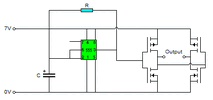
For about 50ns of each output transition, both Mosfets will conduct 10A to hundreds of amps from the power supply to ground. That's why I suggested using a SMPS IC with its dead-time controlled to avoid both Mosfets in series conducting at the same time. :(

The little 555 is bad by itself since it conducts about 400mA from the supply to ground through its output transistors in series across the supply. :(
;D

PS. Won't the bridge-connected load receive almost 14VAC peak-to-peak? ???
I guess a 14V peak-to-peak square wave has the same heating effect for a resistive load as a 5V RMS sine wave or 5VDC. To get 7V effective output it should be boosted by 1.4 times.

 
A

Alun

Jan 1, 1970
0
Just found this old thread whil searching, oh well I'lll respond even though no none probably cares. ;D

audioguru said:
Hi Alun,
For about 50ns of each output transition, both Mosfets will conduct 10A to hundreds of amps from the power supply to ground. That's why I suggested using a SMPS IC with its dead-time controlled to avoid both Mosfets in series conducting at the same time. :(
Both MOSFETs will only turn on for a few uS even less so use a choke on the power supply, about 470uH should do.


The little 555 is bad by itself since it conducts about 400mA from the supply to ground through its output transistors in series across the supply. :(
;D
Power the 555 though a 47hom resistor and connect a 100nf and 100uf capacitor across it and don't connect pin5 to 0V as shown in the diagram connect it to 0V vai a 10nf capacitor, better still use a 7555.

PS. Won't the bridge-connected load receive almost 14VAC peak-to-peak? ???
I guess a 14V peak-to-peak square wave has the same heating effect for a resistive load as a 5V RMS sine wave or 5VDC. To get 7V effective output it should be boosted by 1.4 times.
Better still use a a modified sine wave but that's a whole new story.
 
Top